Megachile rotundata
Alfalfa Leafcutter Bee
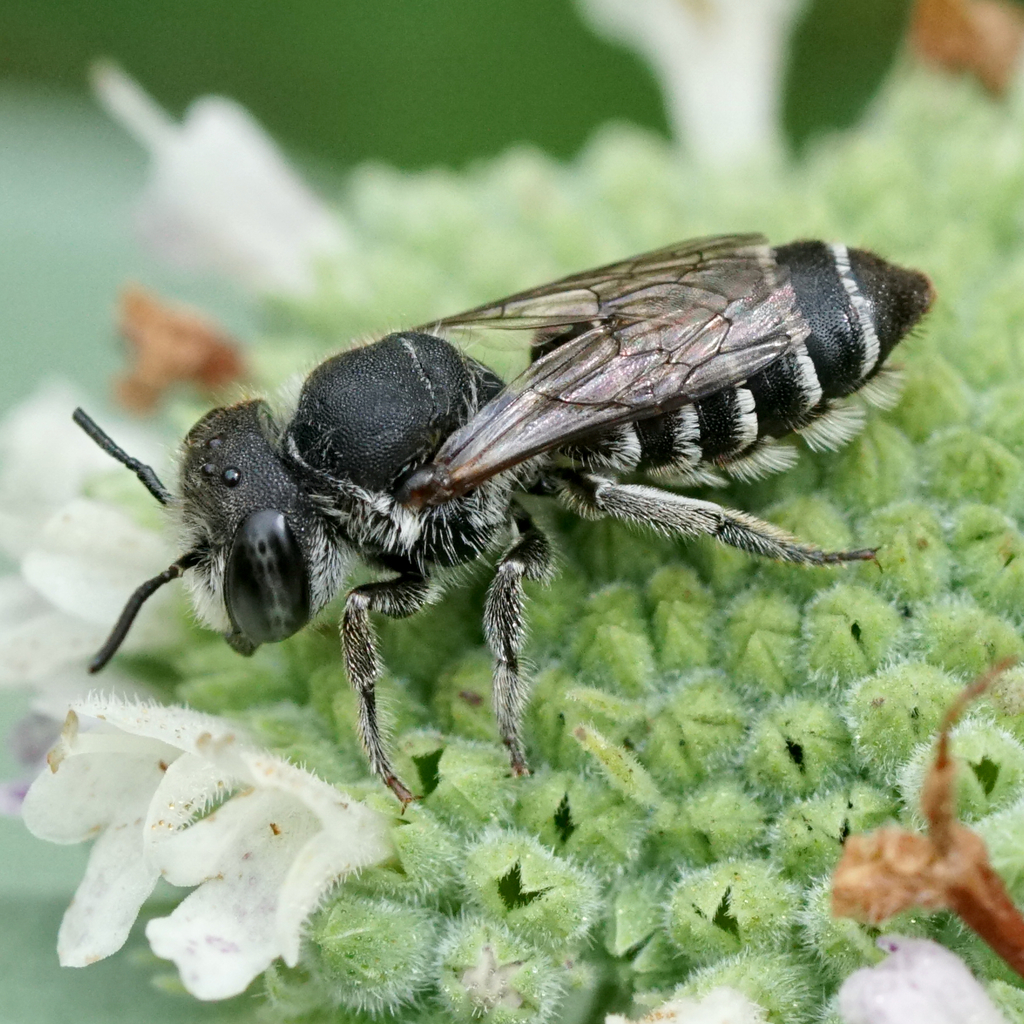
(c) Amy Schnebelin, some rights reserved (CC BY) · licence
Family: Megachilidae · Class: Insecta · Order: Hymenoptera
Megachile rotundata (Alfalfa Leafcutter Bee) is a California animal in the Megachilidae family.
The alfalfa leafcutter bee is a medium-sized solitary bee measuring approximately 8-12 mm in length. Females are typically larger than males and possess robust mandibles adapted for cutting leaf material. The body is dark brown to black with dense pale yellow to white hairs on the underside of the abdomen, which distinguishes them from other leafcutter bee species. Males display white facial markings and longer antennae compared to females. This species has an extensive distribution across North America, occurring in all Canadian provinces from British Columbia to Newfoundland, and throughout the contiguous United States from California to Maine (NatureServe 2025). Originally native to Europe and western Asia, Megachile rotundata was introduced to North America in the 1930s for agricultural pollination and has since established populations continent-wide. Alfalfa leafcutter bees inhabit diverse environments including agricultural areas, urban gardens, prairies, shrublands, coastal dunes, and forest openings. They avoid dense forests with reduced understories and require areas with suitable nesting sites such as dead wood, hollow stems, or vertical soil banks (Hanula et al. 2015). The species thrives in semi-arid regions and has adapted well to human-modified landscapes where alfalfa and other leguminous crops are cultivated. Females construct solitary nests in pre-existing cavities in wood, plant stems, or soil banks, lining each brood cell with precisely cut oval pieces of leaves or flower petals. Rose, alfalfa, and various broadleaf plants serve as preferred sources for nest construction material. Each cell is provisioned with a ball of pollen and nectar before a single egg is deposited. Development from egg to adult typically requires 6-8 weeks during summer months. Adults emerge in late summer and enter diapause within their nest cells, remaining dormant through winter until spring temperatures trigger emergence (Pitts-Singer & Cane 2011). This species exhibits strong fidelity to leguminous flowers, particularly alfalfa, making it the world's most intensively managed solitary bee for agricultural pollination (Pitts-Singer & Cane 2011). A single female can visit over 1,000 alfalfa flowers daily during peak foraging periods. The species has become crucial for alfalfa seed production across western North America, with commercial operations maintaining millions of individuals in managed nest boxes. Alfalfa leafcutter bees are not listed under any conservation legislation and maintain stable populations throughout their range. However, like other pollinators, they face potential threats from pesticide exposure, habitat loss, and climate change. Studies have documented lethal and sublethal effects from neonicotinoid insecticides, particularly imidacloprid (Abbott et al. 2008). Their agricultural importance has led to extensive research on population management and optimization techniques for crop pollination services.
Classification
Class: Insecta · Order: Hymenoptera · Family: Megachilidae
Frequently asked questions
How is Megachile rotundata classified?
Megachile rotundata belongs to class Insecta, order Hymenoptera, family Megachilidae.
What family does Megachile rotundata belong to?
Megachile rotundata is in the Megachilidae family.
What is Megachile rotundata?
The alfalfa leafcutter bee is a medium-sized solitary bee measuring approximately 8-12 mm in length.
Is Megachile rotundata found in California?
Yes. Megachile rotundata is recorded in California in The California Species Project's catalogue.
Related species
Other California species in the same genus, family, or bioregion.
Data from The California Species Project — 14,000+ California species with verified data from CNPS, CDFW, USFWS, and more.