Megascops trichopsis
Whiskered Screech-Owl
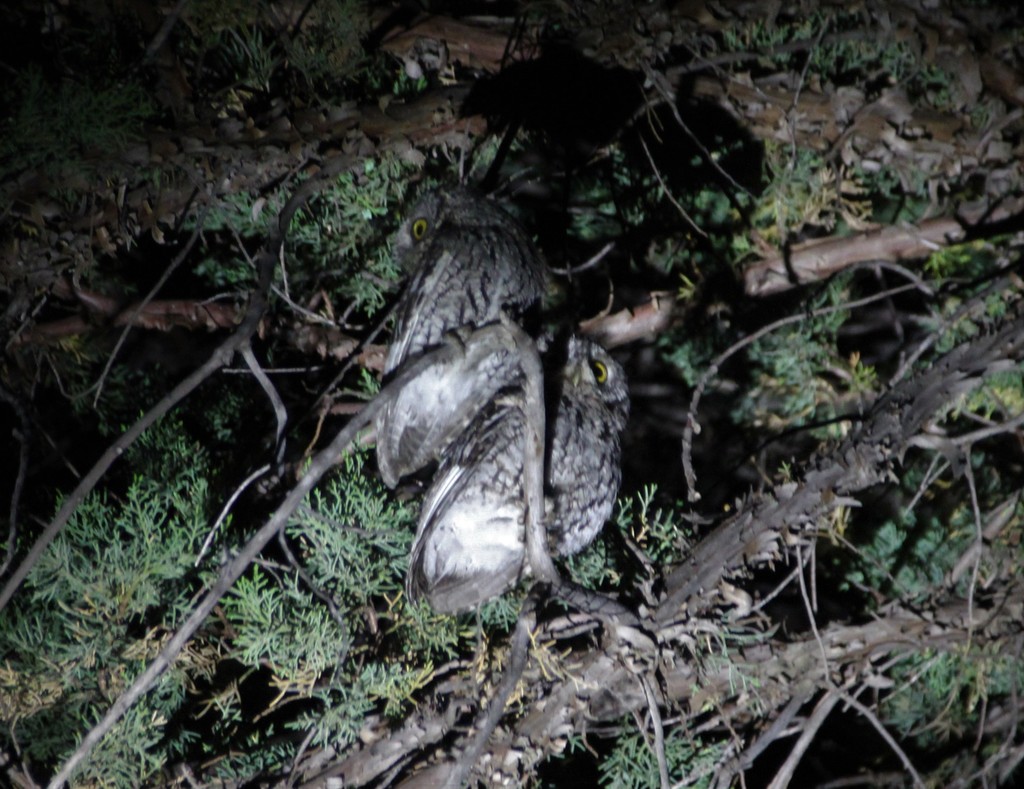
(c) Millie Basden, some rights reserved (CC BY) · licence
Family: Strigidae · Class: Aves · Order: Strigiformes
Megascops trichopsis (Whiskered Screech-Owl) is a California animal in the Strigidae family.
The Whiskered Screech-Owl is a small nocturnal owl measuring approximately 17-19 cm (6.7-7.5 inches) in length with a wingspan of 48-61 cm (19-24 inches). This compact raptor weighs 85-123 grams (3.0-4.3 ounces). The species exhibits prominent ear tufts and facial whiskers that give it its common name. Plumage varies from grayish-brown to reddish-brown with intricate barring and streaking patterns that provide excellent camouflage against tree bark. The facial disc is well-defined with a dark border, and the eyes are bright yellow. The Whiskered Screech-Owl inhabits montane woodlands and forests from southeastern Arizona and adjacent New Mexico south to northern Nicaragua (Gehlbach and Gehlbach 2000). In the United States, the species is restricted primarily to the Sky Island mountain ranges of southeastern Arizona, including the Chiricahua, Huachuca, Santa Rita, and Catalina Mountains. Small populations may occur in the Animas and Peloncillo Mountains of extreme southwestern New Mexico. The species occurs at elevations ranging from 1,200 to 2,700 meters (4,000 to 8,900 feet), with optimal habitat typically found between 1,500 and 2,400 meters (4,900 to 7,900 feet). This owl inhabits oak and pine-oak woodlands, favoring areas with dense canopy cover and permanent water sources. The species shows a strong association with Arizona oak, Emory oak, and Mexican pinyon pine communities. Unlike the sympatric Western Screech-Owl, which prefers lower elevation desert habitats, the Whiskered Screech-Owl requires the cooler, moister conditions of montane forests. Breeding pairs establish territories along permanent creeks and streams where prey abundance is typically higher. Whiskered Screech-Owls are strictly nocturnal, becoming active shortly after sunset. Their diet consists primarily of insects, including moths, beetles, crickets, and caterpillars, supplemented by small vertebrates such as mice and occasionally small birds. Research indicates that breeding pairs maintain home ranges approximately 1,550 meters long along permanent creek corridors (Gehlbach and Gehlbach 2000). The species nests in natural tree cavities or abandoned woodpecker holes, typically 3-9 meters above ground. Females lay 2-4 white eggs between April and June, with incubation lasting approximately 26 days. The Whiskered Screech-Owl is designated as a Species of Conservation Concern by the U.S. Fish and Wildlife Service in Bird Conservation Region 34 (USFWS 2021). The U.S. and Canada population estimate is no more than 5,000 individuals, with a classification of low precision and accuracy (USFWS 2007). Breeding Bird Survey data show no significant population trend, though the small sample size limits statistical power. Primary conservation concerns include habitat fragmentation, climate change impacts on montane ecosystems, and potential competition with Western Screech-Owls in areas of habitat overlap. The species' restricted U.S. range and specialized habitat requirements make it vulnerable to environmental changes affecting Sky Island ecosystems.
Classification
Class: Aves · Order: Strigiformes · Family: Strigidae
Frequently asked questions
How is Megascops trichopsis classified?
Megascops trichopsis belongs to class Aves, order Strigiformes, family Strigidae.
What family does Megascops trichopsis belong to?
Megascops trichopsis is in the Strigidae family.
What is Megascops trichopsis?
The Whiskered Screech-Owl is a small nocturnal owl measuring approximately 17-19 cm (6.7-7.5 inches) in length with a wingspan of 48-61 cm (19-24 inches).
Is Megascops trichopsis found in California?
Yes. Megascops trichopsis is recorded in California in The California Species Project's catalogue.
Related species
Other California species in the same genus, family, or bioregion.
Data from The California Species Project — 14,000+ California species with verified data from CNPS, CDFW, USFWS, and more.