Melanerpes erythrocephalus
Red-headed Woodpecker
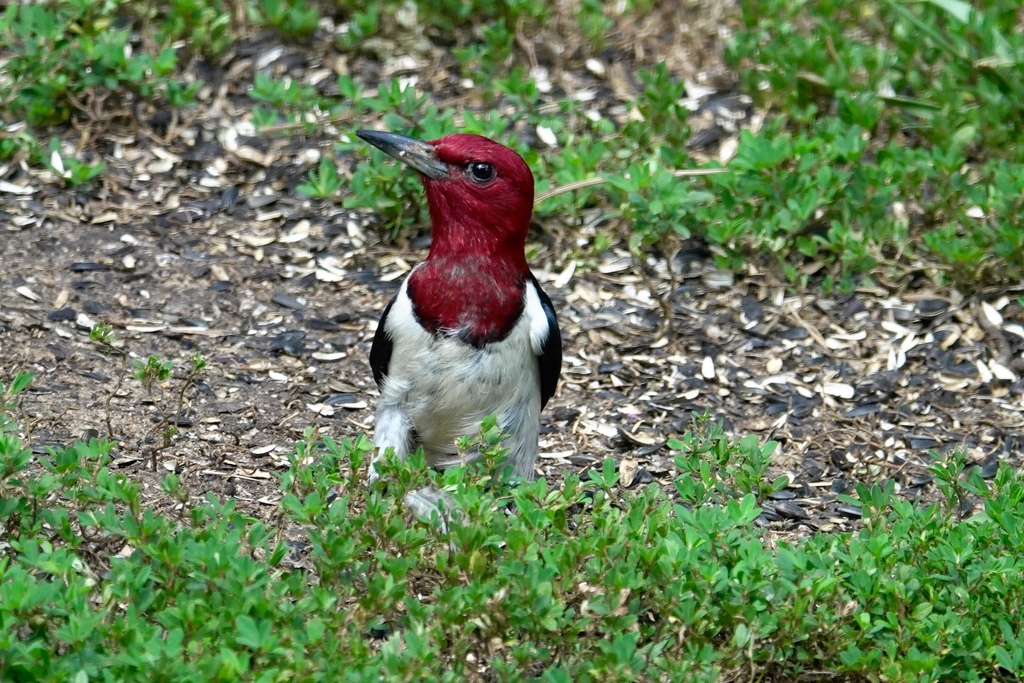
(c) Louise Woodrich, some rights reserved (CC BY) · licence
Family: Picidae · Class: Aves · Order: Piciformes
Melanerpes erythrocephalus (Red-headed Woodpecker) is a California animal in the Picidae family.
The Red-headed Woodpecker is a medium-sized woodpecker measuring 19 to 25 centimeters (7.5 to 9.8 inches) in length with a wingspan of 33 to 40 centimeters (13 to 15.7 inches). Adults weigh between 56 to 97 grams (2.0 to 3.4 ounces). The species exhibits striking tricolored plumage with a completely red head and neck, contrasting sharply with a white breast, belly, and rump. The back and wings are glossy black, with prominent white secondary flight feathers visible during flight. Both sexes display identical plumage, unusual among North American woodpeckers. Juveniles have brownish heads that gradually turn red during their first winter. Historically, Red-headed Woodpeckers ranged throughout eastern North America from southern Canada to the Gulf Coast. In California, the species is considered a rare vagrant with very few documented records. Most California observations have occurred in the Colorado River valley and southeastern desert regions, likely representing birds that have wandered from breeding populations in Arizona or New Mexico. The species remains primarily associated with oak savannas, riparian forests, and agricultural areas with scattered large trees in the Great Plains and eastern United States. Red-headed Woodpeckers inhabit open woodlands, forest edges, parks, and agricultural landscapes with mature trees. They show strong preference for oak-hickory forests, riparian corridors with cottonwoods and willows, and areas with abundant dead snags for nesting. The species requires both living trees for foraging and dead wood for excavating nest cavities. Open areas between trees are essential for their aerial foraging behavior. Unlike most woodpeckers, Red-headed Woodpeckers are omnivorous and employ diverse foraging strategies. They consume insects, nuts, seeds, berries, and occasionally eggs and nestlings of other birds. The species is notable for catching insects in flight, gleaning prey from bark surfaces, and storing food in tree crevices for winter consumption. Breeding occurs from May through August, with pairs excavating new nest cavities each year in dead wood 2.4 to 18 meters (8 to 59 feet) above ground. Females lay three to seven glossy white eggs, with both parents incubating for 12 to 14 days. Young fledge after 24 to 31 days but may remain with parents for several additional weeks. The Red-headed Woodpecker has experienced significant population declines throughout its range, with North American Breeding Bird Survey data indicating a 70 percent decrease since 1970. Primary threats include habitat loss due to agricultural intensification, removal of dead trees, competition with European Starlings for nest cavities, and vehicle strikes during aerial foraging. The species is not federally listed but is considered a species of conservation concern in many states. Partners in Flight estimates the global population at 1.2 million individuals. In California, the Red-headed Woodpecker remains an extremely rare visitor with no established breeding population.
Classification
Class: Aves · Order: Piciformes · Family: Picidae
Frequently asked questions
How is Melanerpes erythrocephalus classified?
Melanerpes erythrocephalus belongs to class Aves, order Piciformes, family Picidae.
What family does Melanerpes erythrocephalus belong to?
Melanerpes erythrocephalus is in the Picidae family.
What is Melanerpes erythrocephalus?
The Red-headed Woodpecker is a medium-sized woodpecker measuring 19 to 25 centimeters (7.5 to 9.8 inches) in length with a wingspan of 33 to 40 centimeters (13 to 15.7 inches).
Is Melanerpes erythrocephalus found in California?
Yes. Melanerpes erythrocephalus is recorded in California in The California Species Project's catalogue.
Related species
Other California species in the same genus, family, or bioregion.
Data from The California Species Project — 14,000+ California species with verified data from CNPS, CDFW, USFWS, and more.