Melanerpes lewis
Lewis's Woodpecker
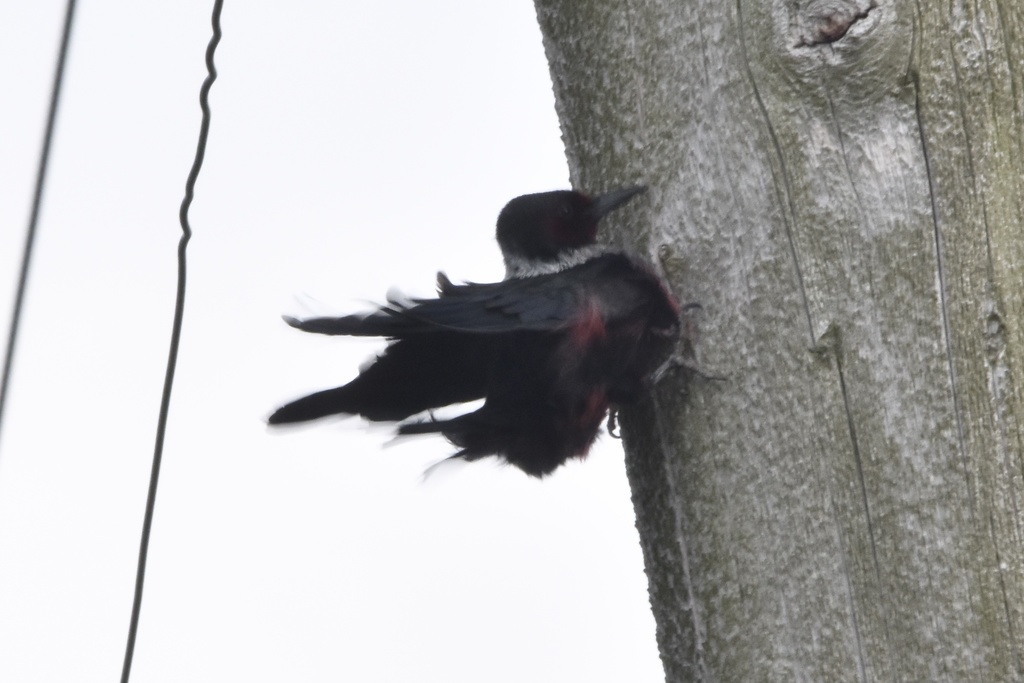
no rights reserved · CC0
Family: Picidae · Class: Aves · Order: Piciformes
Conservation status: G4 S4
Melanerpes lewis (Lewis's Woodpecker) is a California animal in the Picidae family.
Lewis's Woodpecker is a medium-sized woodpecker measuring 26 to 28 cm (10.2 to 11.0 inches) in length with a wingspan of 49 to 52 cm (19.3 to 20.5 inches). Adults weigh between 88 to 125 grams (3.1 to 4.4 ounces). The species exhibits distinctive plumage with a dark greenish-black back and wings that display an iridescent quality in sunlight. The face and throat are deep red, contrasting sharply with a broad gray collar around the neck. The belly is pink to rose-colored, while the rump displays a white patch visible during flight. Both sexes appear similar, though males may show slightly more intense coloration. Lewis's Woodpecker ranges across western North America from southern British Columbia through the western United States to northern Mexico. In California, the species occurs primarily in the Sierra Nevada, Cascade Range, and northeastern regions including the Modoc Plateau. Populations are also found in scattered locations throughout the Central Valley's riparian corridors and foothill regions. The species shows irregular distribution patterns, with populations fluctuating based on food availability and habitat conditions. This woodpecker inhabits open woodlands, particularly those dominated by ponderosa pine, Douglas-fir, and oak species. In California, Lewis's Woodpecker favors mixed coniferous-deciduous forests at elevations ranging from 300 to 2,100 meters (1,000 to 6,900 feet). The species requires large, mature trees for nesting and dead snags for foraging. Riparian areas with cottonwoods and willows provide important habitat, especially during migration and winter months. Open areas adjacent to woodlands serve as foraging grounds for aerial insect capture. Unlike most woodpeckers, Lewis's Woodpecker exhibits unique foraging behavior, spending considerable time catching insects in flight like a flycatcher. The species also feeds extensively on acorns, nuts, and fruits, particularly during fall and winter. Breeding occurs from May through July, with pairs excavating nest cavities in dead or decaying wood at heights of 4 to 30 meters (13 to 98 feet). Females lay 5 to 9 glossy white eggs, with both parents sharing incubation duties for 13 to 14 days. Young fledge after 28 to 34 days and may remain with parents for several weeks. Lewis's Woodpecker holds a Global Rank of G4 and California State Rank of S4, indicating the species is apparently secure but may face localized threats. According to North American Breeding Bird Survey data, populations have experienced long-term declines, with some regions showing decreases of over 60% since 1970. Primary threats include habitat loss from logging, fire suppression that reduces snag availability, and conversion of oak woodlands to agriculture or development. Climate change may alter the distribution of preferred tree species and affect insect prey availability. Conservation efforts focus on maintaining mature forest stands with adequate snag densities and protecting key riparian corridors.
Classification
Class: Aves · Order: Piciformes · Family: Picidae
Conservation status
G4 S4
Frequently asked questions
How is Melanerpes lewis classified?
Melanerpes lewis belongs to class Aves, order Piciformes, family Picidae.
What family does Melanerpes lewis belong to?
Melanerpes lewis is in the Picidae family.
Is Melanerpes lewis protected or of conservation concern?
Melanerpes lewis carries the following status: G4 S4.
What is Melanerpes lewis?
Lewis's Woodpecker is a medium-sized woodpecker measuring 26 to 28 cm (10.2 to 11.0 inches) in length with a wingspan of 49 to 52 cm (19.3 to 20.5 inches).
Is Melanerpes lewis found in California?
Yes. Melanerpes lewis is recorded in California in The California Species Project's catalogue.
Related species
Other California species in the same genus, family, or bioregion.
Data from The California Species Project — 14,000+ California species with verified data from CNPS, CDFW, USFWS, and more.