Melanitta americana
Black Scoter
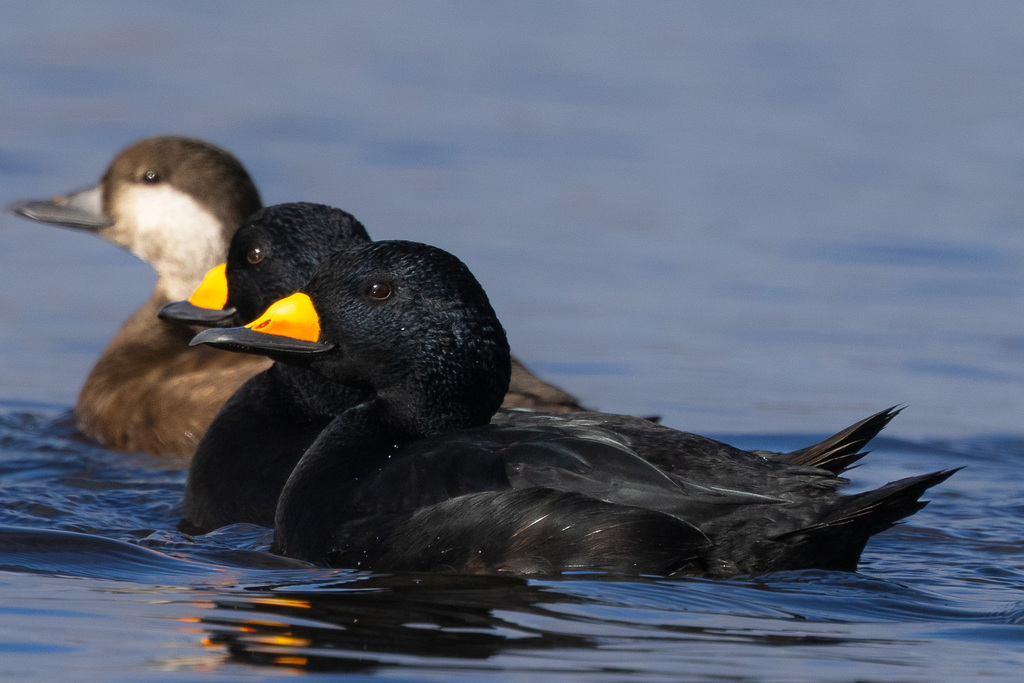
(c) Bjoern Rost, some rights reserved (CC BY) · licence
Family: Anatidae · Class: Aves · Order: Anseriformes
Melanitta americana (Black Scoter) is a California animal in the Anatidae family.
The Black Scoter is a medium-sized sea duck with pronounced sexual dimorphism. Adult males measure 43 to 49 centimeters (17 to 19 inches) in length and weigh 950 to 1,100 grams (2.1 to 2.4 pounds). Males are entirely black except for a distinctive bright yellow-orange knob at the base of the bill. The bill itself is black with yellow sides. Females are smaller, measuring 41 to 45 centimeters (16 to 18 inches) and weighing 800 to 950 grams (1.8 to 2.1 pounds). Females display brownish-black plumage with pale cheeks and throat, contrasting with a dark cap. Both sexes have dark eyes and orange to reddish legs and feet. Black Scoters breed across northern Canada and Alaska, with the majority of the North American population nesting in the boreal forest and tundra regions. In California, the species occurs primarily as a winter visitor along the coast from October through April. They are most commonly observed in nearshore marine waters from Humboldt County south to Monterey County, with smaller numbers continuing south to San Diego County. Peak winter abundance occurs from December through February. During winter, Black Scoters inhabit marine coastal waters, typically within 1.6 kilometers (1 mile) of shore. They prefer areas with rocky substrates and kelp beds, where prey is abundant. The species frequents surf zones, sheltered bays, and estuaries. Water depths of 2 to 40 meters (6 to 130 feet) are optimal for foraging. Black Scoters occasionally use large inland lakes during migration but rarely venture far from coastal areas during winter residence. Black Scoters are accomplished divers, using their feet for propulsion underwater while wings remain folded. They feed primarily on mollusks, particularly blue mussels, but also consume crabs, marine worms, and small fish. Foraging dives typically last 20 to 30 seconds and reach depths of 3 to 8 meters (10 to 26 feet). The species forms large flocks during winter, sometimes numbering in the hundreds. Males begin departing wintering areas in March, followed by females in April. Breeding occurs on freshwater lakes and ponds in the boreal zone, where females construct ground nests lined with down and vegetation. Clutch size ranges from 5 to 11 eggs, with incubation lasting 27 to 31 days. Black Scoters are not federally or state listed as threatened or endangered. However, continental populations have experienced decline since the 1970s according to Christmas Bird Count data and Breeding Bird Survey trends. The North American Waterfowl Management Plan identifies habitat loss on breeding grounds and potential climate change impacts as primary concerns. In California waters, the species may be affected by oil spills, marine pollution, and disturbance from recreational activities. Offshore wind energy development represents an emerging concern for wintering populations along the Pacific Coast.
Classification
Class: Aves · Order: Anseriformes · Family: Anatidae
Frequently asked questions
How is Melanitta americana classified?
Melanitta americana belongs to class Aves, order Anseriformes, family Anatidae.
What family does Melanitta americana belong to?
Melanitta americana is in the Anatidae family.
What is Melanitta americana?
The Black Scoter is a medium-sized sea duck with pronounced sexual dimorphism.
Is Melanitta americana found in California?
Yes. Melanitta americana is recorded in California in The California Species Project's catalogue.
Related species
Other California species in the same genus, family, or bioregion.
Data from The California Species Project — 14,000+ California species with verified data from CNPS, CDFW, USFWS, and more.