Melanitta fusca
White-winged Scoter
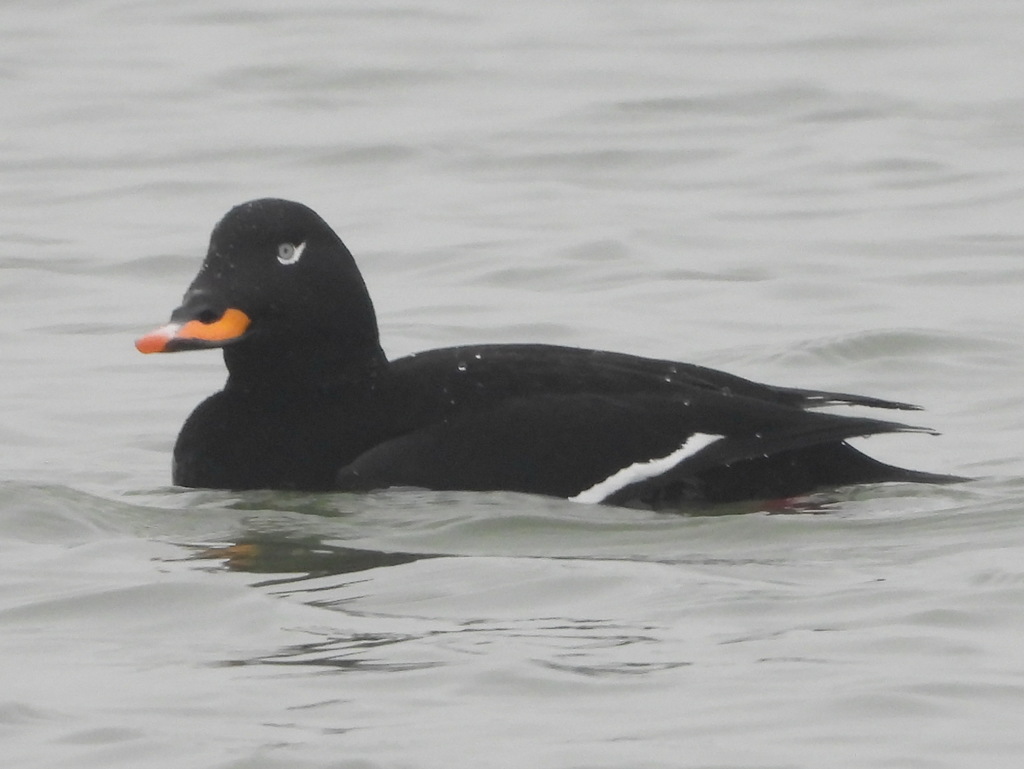
no rights reserved · CC0
Family: Anatidae · Class: Aves · Order: Anseriformes
Melanitta fusca (White-winged Scoter) is a California animal in the Anatidae family.
The White-winged Scoter is a large sea duck that winters along California's coast and adjacent marine waters. Males measure 52 to 58 cm (20 to 23 inches) in length and weigh 1.1 to 1.8 kg (2.4 to 4.0 pounds), while females are smaller at 45 to 52 cm (18 to 20 inches) and 0.9 to 1.4 kg (2.0 to 3.1 pounds). Adult males in breeding plumage are predominantly black with distinctive white wing patches visible in flight and a white crescentic patch around the eye. The bill is orange with a black knob at the base. Females and immature birds are brownish-black with white wing patches and two white facial patches. Both sexes display the characteristic white wing speculum that gives the species its common name. White-winged Scoters breed across boreal forests of Alaska and northern Canada, with nesting grounds extending from Alaska through northern Canada to the Great Lakes region. During winter months, populations migrate to coastal marine waters along both Atlantic and Pacific coasts. In California, the species is a common winter resident from October through April, occurring along the entire coastline from the Oregon border south to Mexico. Large concentrations are regularly observed in Monterey Bay, San Francisco Bay, Bodega Bay, and Humboldt Bay. The species inhabits nearshore marine waters during winter, typically within 5 km of shore in depths of 3 to 40 meters. White-winged Scoters prefer areas with sandy or rocky bottoms and are frequently found near kelp beds, eelgrass beds, and mussel beds. During breeding season, they utilize freshwater lakes and ponds in boreal and subarctic regions, particularly those surrounded by dense vegetation that provides nesting cover. White-winged Scoters are diving ducks that feed primarily on mollusks, crustaceans, and marine worms. Blue mussels, razor clams, and periwinkles constitute major portions of their winter diet in California waters. They dive to depths of 1 to 6 meters, using their feet for propulsion underwater. The species typically forages in flocks ranging from small groups to rafts of several thousand individuals. Breeding occurs from May through July on northern breeding grounds, where females construct ground nests lined with down near water bodies. Clutch size averages 8 to 11 eggs with an incubation period of 25 to 30 days. White-winged Scoters are not federally or state listed in California, and populations are considered stable overall. However, the species faces threats from offshore oil development, marine pollution, and climate change effects on marine ecosystems. Eelgrass bed degradation and shellfish harvesting in some areas may impact local food availability. Population monitoring through Christmas Bird Counts and waterbird surveys indicates relatively stable wintering numbers in California, though some localized declines have been noted in certain bays due to habitat modifications.
Classification
Class: Aves · Order: Anseriformes · Family: Anatidae
Frequently asked questions
How is Melanitta fusca classified?
Melanitta fusca belongs to class Aves, order Anseriformes, family Anatidae.
What family does Melanitta fusca belong to?
Melanitta fusca is in the Anatidae family.
What is Melanitta fusca?
The White-winged Scoter is a large sea duck that winters along California's coast and adjacent marine waters.
Is Melanitta fusca found in California?
Yes. Melanitta fusca is recorded in California in The California Species Project's catalogue.
Related species
Other California species in the same genus, family, or bioregion.
Data from The California Species Project — 14,000+ California species with verified data from CNPS, CDFW, USFWS, and more.