Melanoplus cinereus
Gray Sagebrush Grasshopper
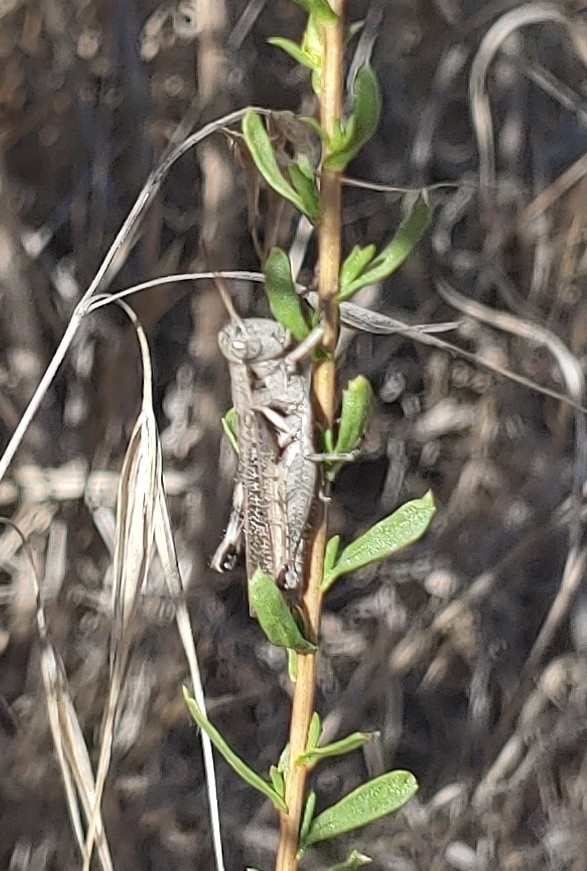
(c) Tom and T Herman, some rights reserved (CC BY) · licence
Family: Acrididae · Class: Insecta · Order: Orthoptera
Melanoplus cinereus (Gray Sagebrush Grasshopper) is a California animal in the Acrididae family.
The Gray Sagebrush Grasshopper (Melanoplus cinereus) is a medium-sized orthopteran insect in the family Acrididae. Adults typically measure 15 to 25 millimeters (0.6 to 1.0 inches) in body length, with females generally larger than males. The species exhibits the characteristic grayish coloration indicated by its common name, with body coloration ranging from gray to brownish-gray, providing effective camouflage against sagebrush substrates. The hind legs are well-developed for jumping, and the wings may be reduced or fully developed depending on the subspecies. Melanoplus cinereus occurs across western North America, with its range extending through the intermountain regions of the United States. In California, the species is found primarily in the eastern portions of the state, particularly in areas dominated by sagebrush ecosystems. The subspecies M. c. cyanipes (grayish sagebrush grasshopper) has been documented in California refuges and natural areas (USFWS Refuge Plant Species List). The species' distribution is closely tied to the availability of suitable sagebrush habitat throughout the Great Basin and adjacent mountain ranges. This grasshopper inhabits sagebrush-dominated ecosystems, particularly areas with big sagebrush (Artemisia tridentata) and associated shrubland communities. The species is typically found in semi-arid environments characterized by well-drained soils and sparse to moderate vegetation density. Elevational range varies across the species' distribution, but populations are commonly found from valley floors to montane areas where sagebrush communities persist. The habitat preferences align closely with Inter-Mountain Basins Big Sagebrush Shrubland ecological systems (NatureServe Explorer). Gray Sagebrush Grasshoppers are primarily herbivorous, feeding on various shrubs and forbs within their sagebrush habitat. Adults are most active during warmer months, typically from late spring through early fall. Like other members of the genus Melanoplus, this species likely has a single generation per year, with eggs overwintering in soil and hatching the following spring. Nymphs undergo several molts before reaching sexual maturity. The species' life cycle is synchronized with the phenology of its host plants and the seasonal patterns of its semi-arid habitat. The conservation status of Melanoplus cinereus has not been formally assessed at federal or state levels, and the species does not appear on current threatened or endangered species lists as of December 2025. However, like many sagebrush-associated species, populations may face pressure from habitat loss due to agricultural conversion, urban development, and altered fire regimes. Sagebrush ecosystems have experienced significant reduction across their historical range, potentially affecting associated arthropod communities. Climate change may also influence the species through alterations to precipitation patterns and temperature regimes in semi-arid regions. The subspecies M. c. cyanipes continues to be documented in protected areas, suggesting that conservation of sagebrush habitats provides important refugia for this and other specialized grasshopper species. Long-term monitoring of grasshopper communities in sagebrush ecosystems would help assess population trends and conservation needs.
Classification
Class: Insecta · Order: Orthoptera · Family: Acrididae
Frequently asked questions
How is Melanoplus cinereus classified?
Melanoplus cinereus belongs to class Insecta, order Orthoptera, family Acrididae.
What family does Melanoplus cinereus belong to?
Melanoplus cinereus is in the Acrididae family.
What is Melanoplus cinereus?
The Gray Sagebrush Grasshopper (Melanoplus cinereus) is a medium-sized orthopteran insect in the family Acrididae.
Is Melanoplus cinereus found in California?
Yes. Melanoplus cinereus is recorded in California in The California Species Project's catalogue.
Related species
Other California species in the same genus, family, or bioregion.
Data from The California Species Project — 14,000+ California species with verified data from CNPS, CDFW, USFWS, and more.