Melopsittacus undulatus
Budgerigar
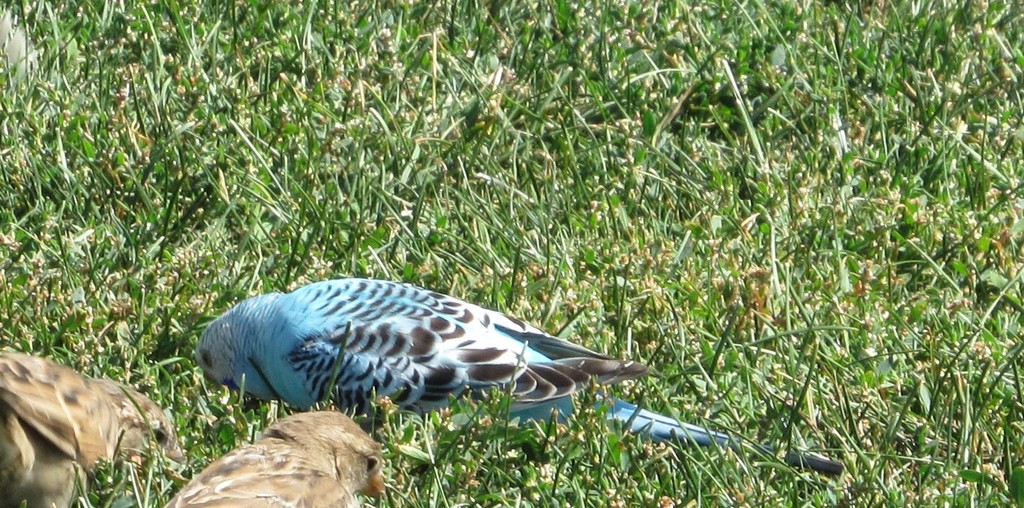
(c) Riccardo Marchingiglio, some rights reserved (CC BY) · licence
Family: Psittaculidae · Class: Aves · Order: Psittaciformes
Melopsittacus undulatus (Budgerigar) is a California animal in the Psittaculidae family.
The Budgerigar is a small parrot native to Australia, measuring approximately 18 cm (7 inches) in length and weighing 30-40 grams. The species exhibits bright green plumage with black barring on the wings and back, a yellow head and throat, and distinctive blue cheek patches. The tail is long and pointed, typically dark blue to black. Males can be distinguished from females by their bright blue cere (the area above the beak), while females display a brown or tan cere, particularly during breeding season. Budgerigars are endemic to Australia, where they occur across much of the continental interior. Their range extends throughout the arid and semi-arid regions, from Western Australia across to Queensland and south to South Australia, avoiding only the wettest coastal areas and the most arid desert centers (Animal Diversity Web). The species is highly nomadic, with populations moving in response to rainfall patterns and food availability. Budgerigars do not naturally occur in California, though escaped cage birds occasionally establish temporary populations in urban areas. The species occupies semi-arid and sub-humid habitats, primarily in Australia's interior regions (Animal Diversity Web). They favor open woodlands, scrublands, and grasslands, particularly areas dominated by Eucalyptus and Acacia species. Budgerigars require access to permanent water sources and typically remain within flying distance of rivers, lakes, or artificial water points. They utilize tree hollows for nesting, showing preference for dead or dying trees with suitable cavities. Budgerigars are highly gregarious, forming flocks that can number from a few dozen to several thousand individuals. They are nomadic seed-eaters, feeding primarily on grass seeds and chenopod seeds collected on or near the ground, with species composition and proportions varying seasonally and geographically (Birds of the World). The birds are opportunistic feeders, following rainfall patterns to areas where seeds are most abundant. Breeding is closely tied to environmental conditions, particularly rainfall and food availability. They nest in tree hollows, with females laying 4-6 white eggs. The species can breed multiple times per year when conditions are favorable. Budgerigars are strong fliers, capable of covering considerable distances during nomadic movements. Budgerigars are not listed under any conservation framework and maintain stable populations throughout their native Australian range. The species has actually benefited from some human activities, including the provision of artificial water sources for livestock, which has expanded their potential habitat. However, they face localized pressures from habitat modification and competition for nesting sites. The global pet trade has made Budgerigars one of the world's most familiar bird species, though this involves domesticated strains rather than wild populations. In California and other non-native regions, any established populations would be considered non-native species, though significant breeding populations are not currently documented.
Classification
Class: Aves · Order: Psittaciformes · Family: Psittaculidae
Frequently asked questions
How is Melopsittacus undulatus classified?
Melopsittacus undulatus belongs to class Aves, order Psittaciformes, family Psittaculidae.
What family does Melopsittacus undulatus belong to?
Melopsittacus undulatus is in the Psittaculidae family.
What is Melopsittacus undulatus?
The Budgerigar is a small parrot native to Australia, measuring approximately 18 cm (7 inches) in length and weighing 30-40 grams.
Is Melopsittacus undulatus found in California?
Yes. Melopsittacus undulatus is recorded in California in The California Species Project's catalogue.
Related species
Other California species in the same genus, family, or bioregion.
Data from The California Species Project — 14,000+ California species with verified data from CNPS, CDFW, USFWS, and more.