Melozone aberti
Abert's Towhee
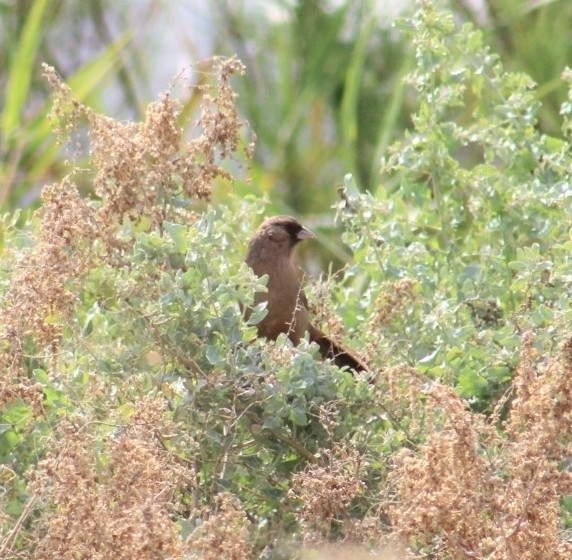
(c) Julio Cesar Ruiz García, some rights reserved (CC BY) · licence
Family: Emberizidae · Class: Aves · Order: Passeriformes
Conservation status: G4 S4
Melozone aberti (Abert's Towhee) is a California animal in the Emberizidae family.
Abert's Towhee is a large, ground-dwelling sparrow endemic to the southwestern United States and northwestern Mexico. Adults measure 21-25 cm (8.3-9.8 inches) in length with a wingspan of 27-30 cm (10.6-11.8 inches) and weigh 40-53 grams (1.4-1.9 ounces). The species displays uniform grayish-brown plumage above and paler buff-brown below, with a distinctive black facial mask extending from the base of the bill around the eyes to the ear coverts. The tail is long and rounded, and the thick, conical bill is well-adapted for seed consumption. Males and females appear similar, though males average slightly larger. Abert's Towhee occurs primarily in Arizona and extreme southeastern California, with small populations extending into southwestern New Mexico, southern Nevada, and Sonora, Mexico. In California, the species is restricted to the Colorado River valley in Imperial and Riverside counties, including areas around Blythe, Palo Verde, and the Salton Sea region. The species also inhabits portions of the lower Colorado River drainage along the California-Arizona border. The species inhabits dense riparian woodlands and desert scrub communities, typically below 600 meters (2,000 feet) elevation. Abert's Towhees show strong preference for areas with thick understory vegetation, particularly mesquite bosques, tamarisk thickets, and willow-cottonwood galleries along desert washes and rivers. They also utilize residential areas with dense shrub plantings, parks, and agricultural areas with adjacent cover. The species requires dense ground cover for foraging and nesting, avoiding open areas. Abert's Towhees are primarily ground foragers, using a distinctive double-scratch technique to uncover insects, seeds, and berries beneath leaf litter and debris. Their diet consists of beetles, ants, caterpillars, and other arthropods during breeding season, shifting to seeds of mesquite, palo verde, and various desert shrubs in fall and winter. Breeding occurs from March through September, with peak activity from April to July. Females construct cup-shaped nests 0.3-3 meters (1-10 feet) above ground in dense shrubs or low trees, laying 2-4 pale blue eggs with brown markings. The species produces 2-3 broods annually under favorable conditions. Abert's Towhee maintains a stable population status with a Global rank of G4 (apparently secure) and California State rank of S4 (apparently secure). According to the North American Breeding Bird Survey, populations have remained relatively stable range-wide since 1966, though with some regional variations. The species faces ongoing threats from habitat loss due to agricultural conversion, urban development, and water diversions affecting riparian corridors. Invasive plant species, particularly tamarisk and Russian olive, can alter habitat structure but may also provide alternative nesting sites. Climate change poses potential future threats through altered precipitation patterns and increased temperatures affecting desert riparian systems. The species' adaptation to human-modified landscapes has helped maintain stable populations in many areas.
Classification
Class: Aves · Order: Passeriformes · Family: Emberizidae
Conservation status
G4 S4
Frequently asked questions
How is Melozone aberti classified?
Melozone aberti belongs to class Aves, order Passeriformes, family Emberizidae.
What family does Melozone aberti belong to?
Melozone aberti is in the Emberizidae family.
Is Melozone aberti protected or of conservation concern?
Melozone aberti carries the following status: G4 S4.
What is Melozone aberti?
Abert's Towhee is a large, ground-dwelling sparrow endemic to the southwestern United States and northwestern Mexico.
Is Melozone aberti found in California?
Yes. Melozone aberti is recorded in California in The California Species Project's catalogue.
Related species
Other California species in the same genus, family, or bioregion.
Data from The California Species Project — 14,000+ California species with verified data from CNPS, CDFW, USFWS, and more.