Membranipora membranacea
Kelp lace bryozoan
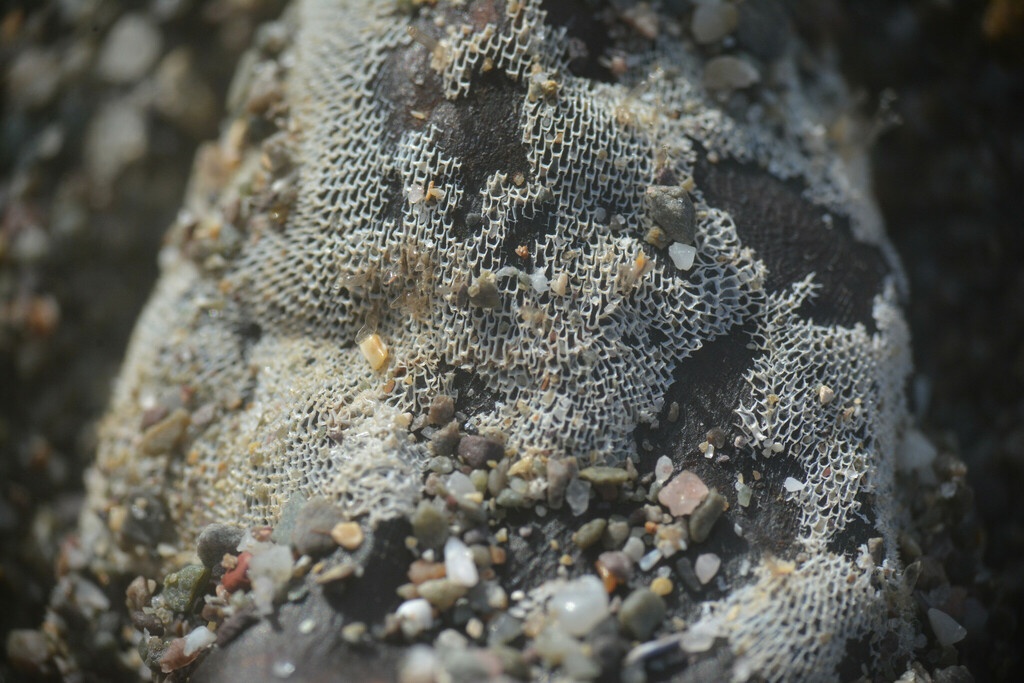
(c) Matthew Vosper, some rights reserved (CC BY) · licence
Family: Membraniporidae · Class: Gymnolaemata · Order: Cheilostomata
Membranipora membranacea (Kelp lace bryozoan) is a California animal in the Membraniporidae family.
Membranipora membranacea is a colonial marine bryozoan commonly known as the kelp lace bryozoan. Individual zooids (colony members) are rectangular and measure approximately 0.5-0.8 mm in length, forming thin, lace-like encrusting colonies that can cover extensive areas of substrate. The colony appears as a white to pale yellowish mesh-like growth with a characteristic honeycomb pattern of rectangular chambers visible to the naked eye. This bryozoan has a widespread distribution in temperate marine waters of both the Atlantic and Pacific Oceans. In the North Atlantic, it ranges from the Arctic Ocean south to North Carolina, while Pacific populations extend from Alaska to California. According to NatureServe, the species is most commonly found on Laminaria species kelp hosts and is more abundant in exposed versus protected kelp bed sites (NatureServe 2025). Membranipora membranacea inhabits shallow marine waters, typically occurring from the low tide line to depths of approximately 200 meters. The species forms encrusting colonies on various substrates but shows a strong preference for kelp fronds, particularly those of Laminaria and Macrocystis species. It thrives in areas with good water circulation and is more abundant in wave-exposed locations compared to sheltered sites. As a filter-feeding bryozoan, M. membranacea captures planktonic organisms and organic particles from the water column using specialized feeding structures called lophophores. Colony reproduction occurs through both sexual reproduction, producing free-swimming larvae, and asexual budding that expands existing colonies. Individual zooids can reproduce sexually, releasing larvae that settle and metamorphose to establish new colonies. The species exhibits seasonal growth patterns, with peak colony development typically occurring during warmer months. Membranipora membranacea has no federal or state conservation listing status and is considered globally secure with a NatureServe global rank of GNR (Global Not Ranked). However, the species has ecological significance as both a native component of marine ecosystems and as an invasive species in some regions. In the Gulf of Maine, it has been identified as contributing to the decline of native kelp forests by overgrowing kelp fronds and reducing their photosynthetic capacity (Berman et al. 1992). The species can form dense colonies that add weight to kelp fronds, making them more susceptible to breakage during storms. In some areas, M. membranacea works synergistically with other introduced species to displace native kelp communities. Despite its ecological impacts in certain regions, the species plays important roles in marine food webs as both predator of planktonic organisms and prey for various invertebrates and fish. Climate change and ocean acidification may affect colony growth and distribution patterns, though specific impacts on this species require further research.
Classification
Class: Gymnolaemata · Order: Cheilostomata · Family: Membraniporidae
Frequently asked questions
How is Membranipora membranacea classified?
Membranipora membranacea belongs to class Gymnolaemata, order Cheilostomata, family Membraniporidae.
What family does Membranipora membranacea belong to?
Membranipora membranacea is in the Membraniporidae family.
What is Membranipora membranacea?
Membranipora membranacea is a colonial marine bryozoan commonly known as the kelp lace bryozoan.
Is Membranipora membranacea found in California?
Yes. Membranipora membranacea is recorded in California in The California Species Project's catalogue.
Related species
Other California species in the same genus, family, or bioregion.
Data from The California Species Project — 14,000+ California species with verified data from CNPS, CDFW, USFWS, and more.