Menemerus bivittatus
Gray Wall Jumping Spider
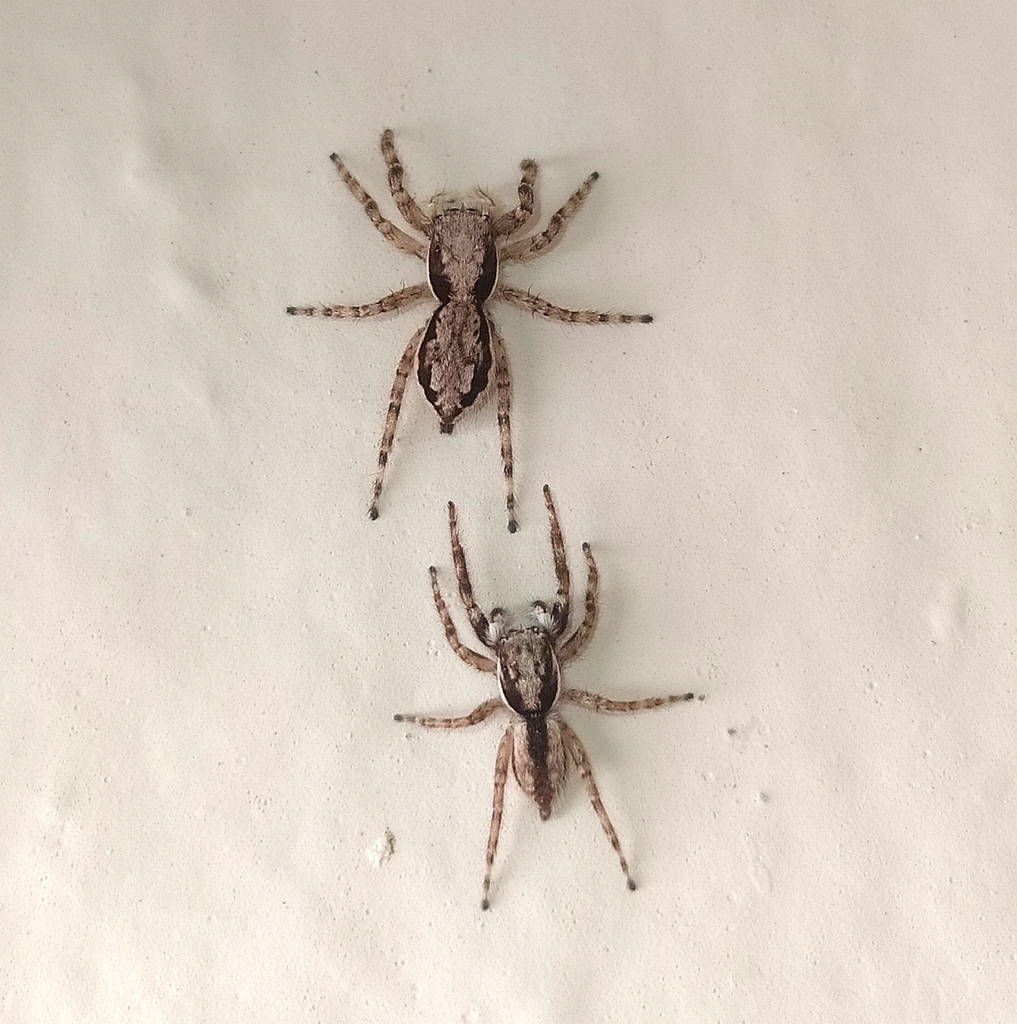
(c) Alexandre S. Michelotto, some rights reserved (CC BY-SA) · licence
Family: Salticidae · Class: Arachnida · Order: Araneae
Menemerus bivittatus (Gray Wall Jumping Spider) is a California animal in the Salticidae family.
The Gray Wall Jumping Spider is a small to medium-sized spider in the family Salticidae. Adult females measure approximately 7 to 10 mm (0.28 to 0.39 inches) in body length, while adult males are slightly smaller at 5 to 9 mm (0.20 to 0.35 inches) (BugGuide). The species exhibits marked sexual dimorphism in coloration and patterning. Males typically display a distinctive white central stripe running down the carapace that broadens frontally, with the entire interocular area appearing white in southern California populations. Females show different coloration patterns but share the overall body structure typical of jumping spiders, including large forward-facing eyes that provide acute vision. Menemerus bivittatus is a pantropical species with an extensive global distribution. In North America, its established range extends from North Carolina south to Florida and west across the southern states to California (BugGuide). While collection records exist for West Virginia and Minnesota, these do not represent established breeding populations. The species occurs throughout much of California's warmer regions, particularly in urban and suburban environments. This non-native spider shows a strong preference for anthropogenic habitats, earning its common name from its association with human structures. In the United States, Gray Wall Jumping Spiders are most commonly found on the exterior walls of buildings during daylight hours (BugGuide). They inhabit vertical surfaces including concrete walls, brick facades, wooden siding, and similar artificial substrates. The species appears well-adapted to urban environments and is frequently observed in residential areas, commercial districts, and industrial zones. As members of the jumping spider family, these spiders are active diurnal hunters with excellent vision. They stalk prey in a cat-like manner, stopping when they detect potential quarry, then slowly approaching before pouncing and capturing prey with their front legs and chelicerae. Their acute eyesight allows them to detect both prey and potential threats, often turning to face observers when approached. Gray Wall Jumping Spiders are capable jumpers, using this ability for both hunting and escape. Reproduction involves the female constructing a lens-shaped egg sac containing approximately 25 to 40 eggs (BugGuide). The species remains active year-round in warmer climates, though individuals are more noticeable during spring and summer months. Menemerus bivittatus is not listed under federal or state endangered species legislation and appears to maintain stable populations throughout its range. As a non-native species likely introduced from the Old World, it represents a successful colonizer of North American urban environments (BugGuide). The species benefits from human development, as building construction creates preferred habitat. No specific conservation concerns have been identified for this species, and its adaptation to urban environments suggests it may be expanding its range as development increases. The spider's presence on structures does not typically create conflicts with human activities, and it may provide beneficial pest control services by consuming other small arthropods.
Classification
Class: Arachnida · Order: Araneae · Family: Salticidae
Frequently asked questions
How is Menemerus bivittatus classified?
Menemerus bivittatus belongs to class Arachnida, order Araneae, family Salticidae.
What family does Menemerus bivittatus belong to?
Menemerus bivittatus is in the Salticidae family.
What is Menemerus bivittatus?
The Gray Wall Jumping Spider is a small to medium-sized spider in the family Salticidae.
Is Menemerus bivittatus found in California?
Yes. Menemerus bivittatus is recorded in California in The California Species Project's catalogue.
Related species
Other California species in the same genus, family, or bioregion.
Data from The California Species Project — 14,000+ California species with verified data from CNPS, CDFW, USFWS, and more.