Menemerus semilimbatus
Half-edged Wall Jumping Spider
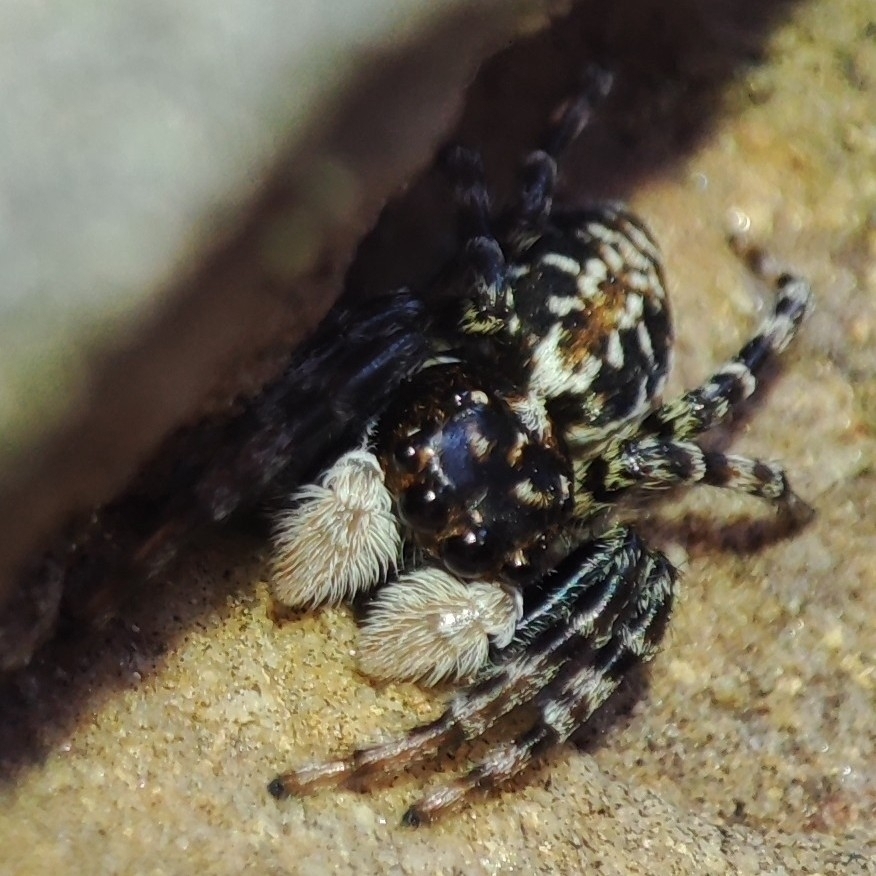
no rights reserved · CC0
Family: Salticidae · Class: Arachnida · Order: Araneae
Menemerus semilimbatus (Half-edged Wall Jumping Spider) is a California animal in the Salticidae family.
The Half-edged Wall Jumping Spider (Menemerus semilimbatus) is a small jumping spider in the family Salticidae. Adult females measure approximately 6-8 mm in body length, while males are slightly smaller at 5-7 mm. The species displays sexual dimorphism in coloration and markings. Males typically exhibit a grayish-brown cephalothorax with darker markings and distinctive white or pale markings around the eye region. Females are generally more uniformly colored with a brownish cephalothorax and abdomen, often showing subtle banding or striping patterns. Both sexes possess the characteristically large anterior median eyes typical of jumping spiders, which provide excellent vision for hunting and courtship behaviors. This species has been documented in California, with confirmed records from Sacramento County (Elk Grove) and Alameda County (Oakland) based on photographic observations (BugGuide.net). The distribution appears to include urban and suburban areas throughout central California, though comprehensive range mapping remains incomplete. As with many jumping spider species, M. semilimbatus likely has a broader distribution than currently documented, as these small arachnids are often overlooked in biological surveys. The Half-edged Wall Jumping Spider inhabits human-modified environments, particularly urban and suburban areas where it can be found on walls, fences, and building exteriors. The species appears to favor vertical surfaces and is commonly observed on concrete walls, wooden structures, and similar artificial substrates. This habitat preference for built environments suggests the species is well-adapted to anthropogenic landscapes and may benefit from urban development patterns that provide abundant vertical hunting surfaces. Like other jumping spiders, M. semilimbatus is a visual predator that actively hunts small arthropod prey during daylight hours. These spiders do not construct webs for prey capture but instead rely on their exceptional eyesight and jumping ability to stalk and pounce on insects, small spiders, and other arthropods. Mating behaviors likely involve complex courtship displays typical of salticids, where males perform visual and vibrational signals to attract females. Females probably construct silk retreats for egg-laying and may guard their egg sacs until spiderlings emerge. Seasonal activity patterns and specific reproductive timing have not been well documented for this species. The conservation status of Menemerus semilimbatus has not been formally assessed by state or federal agencies. The species is not listed under the Endangered Species Act or California Endangered Species Act as of December 2025. Given its apparent adaptation to urban environments and presence in developed areas, the species may be less vulnerable to habitat loss than spiders requiring pristine natural habitats. However, like many small arthropods, comprehensive population data and trend assessments are lacking. The species would benefit from increased survey efforts to better understand its distribution, habitat requirements, and population status within California's urban ecosystems.
Classification
Class: Arachnida · Order: Araneae · Family: Salticidae
Frequently asked questions
How is Menemerus semilimbatus classified?
Menemerus semilimbatus belongs to class Arachnida, order Araneae, family Salticidae.
What family does Menemerus semilimbatus belong to?
Menemerus semilimbatus is in the Salticidae family.
What is Menemerus semilimbatus?
The Half-edged Wall Jumping Spider (Menemerus semilimbatus) is a small jumping spider in the family Salticidae.
Is Menemerus semilimbatus found in California?
Yes. Menemerus semilimbatus is recorded in California in The California Species Project's catalogue.
Related species
Other California species in the same genus, family, or bioregion.
Data from The California Species Project — 14,000+ California species with verified data from CNPS, CDFW, USFWS, and more.