Menidia beryllina
Inland silverside
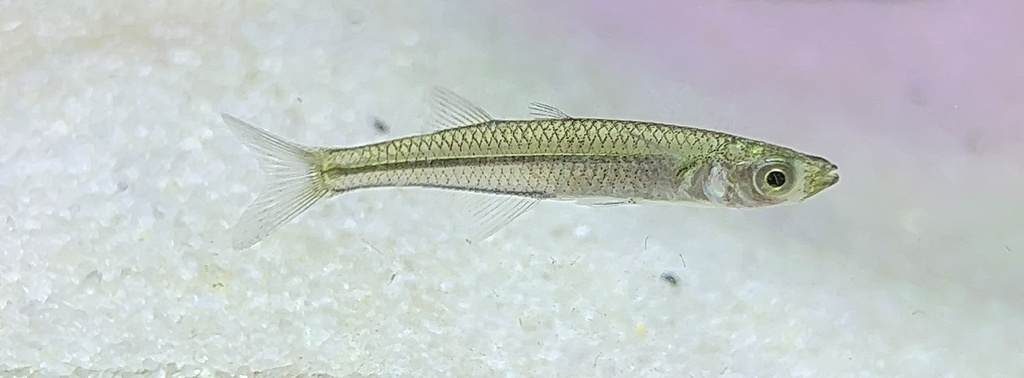
(c) James-LaFontaine, some rights reserved (CC BY) · licence
Family: Atherinopsidae · Class: Actinopterygii · Order: Atheriniformes
Menidia beryllina (Inland silverside) is a California animal in the Atherinopsidae family.
The inland silverside is a slender, elongated fish native to the Atlantic and Gulf coasts of North America that has been introduced to various freshwater systems in California. Adults typically measure 75 to 100 mm (3.0 to 3.9 inches) in total length, with a maximum recorded length of approximately 127 mm (5.0 inches). The body is laterally compressed with a translucent appearance and features a distinctive bright silver lateral stripe extending from the head to the caudal fin. The dorsal surface is pale olive to greenish, while the ventral surface is white to silver. Two separate dorsal fins are present, with the first being small and spiny, and the second larger with soft rays. Inland silversides have been introduced to several locations in California, including reservoirs and irrigation systems in the Central Valley and Southern California. The species is not native to the Pacific Coast but has established populations in various freshwater habitats following introductions, likely for bait fish purposes or as forage fish to support sport fisheries. Their current distribution in California includes artificial lakes, reservoirs, canals, and slow-moving river sections. The species inhabits shallow, vegetated areas of lakes, ponds, reservoirs, and slow-moving streams. Inland silversides prefer areas with sandy or muddy substrates and abundant aquatic vegetation. They are euryhaline, capable of tolerating a wide range of salinity levels from freshwater to moderately brackish conditions. Water temperatures between 15 and 30 degrees Celsius (59 to 86 degrees Fahrenheit) are optimal for the species. They typically remain in surface waters and rarely venture below depths of 3 meters (10 feet). Inland silversides are schooling fish that form large aggregations, particularly during feeding and spawning activities. They are opportunistic feeders, consuming zooplankton, small crustaceans, insect larvae, and occasionally small fish. Their diet varies seasonally, with zooplankton forming the primary food source during spring and summer months. Spawning occurs from April through September in California, with peak activity during warmer months. Females deposit adhesive eggs on submerged vegetation or hard substrates. A single female may produce 300 to 1,500 eggs per season through multiple spawning events. Eggs hatch in 7 to 14 days depending on water temperature. The species exhibits rapid growth, reaching sexual maturity within one year, and most individuals live for two to three years. Inland silversides are not protected under federal or California state endangered species legislation. As an introduced species, they are not considered a conservation priority and may compete with native fish species for resources. In some systems, they serve as important forage fish for predatory species including bass, pike, and waterfowl. Population monitoring is limited, but established populations appear stable in suitable habitat. Management focuses primarily on preventing further introductions to protect native fish communities rather than conservation of the species itself.
Classification
Class: Actinopterygii · Order: Atheriniformes · Family: Atherinopsidae
Frequently asked questions
How is Menidia beryllina classified?
Menidia beryllina belongs to class Actinopterygii, order Atheriniformes, family Atherinopsidae.
What family does Menidia beryllina belong to?
Menidia beryllina is in the Atherinopsidae family.
What is Menidia beryllina?
The inland silverside is a slender, elongated fish native to the Atlantic and Gulf coasts of North America that has been introduced to various freshwater systems in California.
Is Menidia beryllina found in California?
Yes. Menidia beryllina is recorded in California in The California Species Project's catalogue.
Related species
Other California species in the same genus, family, or bioregion.
Data from The California Species Project — 14,000+ California species with verified data from CNPS, CDFW, USFWS, and more.