Mergus merganser
Common Merganser
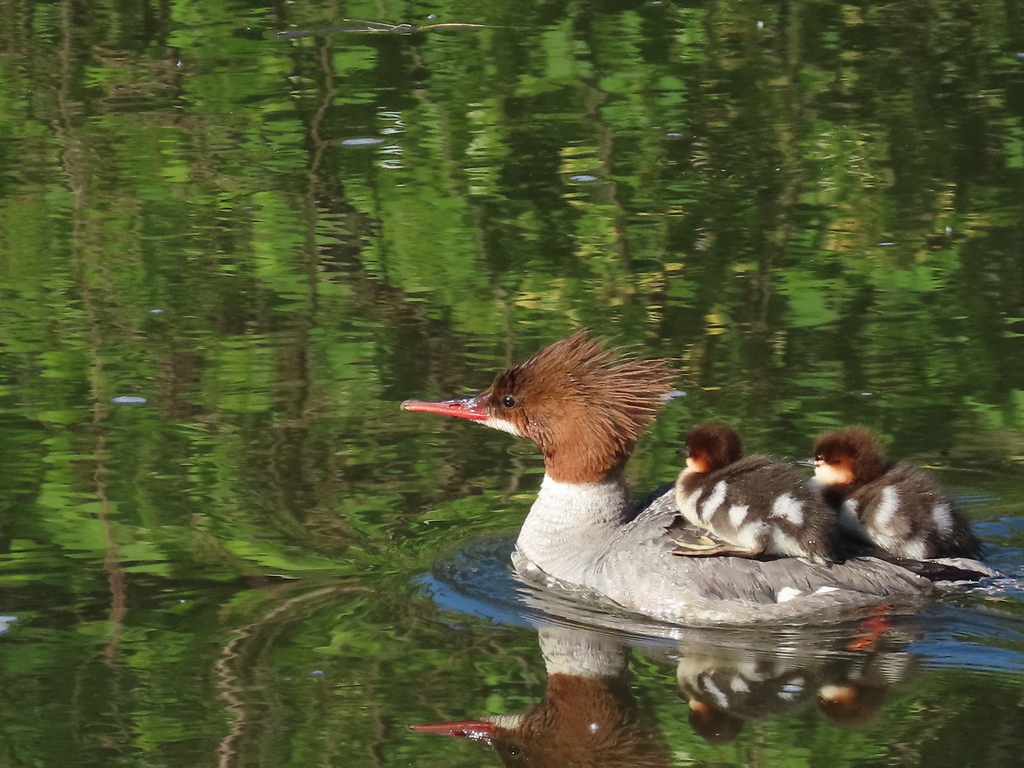
(c) Dick Mansfield, some rights reserved (CC BY) · licence
Family: Anatidae · Class: Aves · Order: Anseriformes
Mergus merganser (Common Merganser) is a California animal in the Anatidae family.
The Common Merganser is a large diving duck and the largest member of the merganser family in North America. Adult males measure 58-72 cm (23-28 inches) in length with a wingspan of 86-94 cm (34-37 inches), while females are slightly smaller at 54-64 cm (21-25 inches). Males in breeding plumage display a distinctive dark green head with a slight crest, a bright white body with salmon-pink wash on the breast, and black back markings. The bill is long, narrow, and bright red-orange with serrated edges adapted for grasping fish. Females and juveniles have rusty-brown heads with prominent crests, gray bodies, and white chins and throats. Both sexes exhibit white wing patches visible in flight. Common Mergansers breed across northern California, including the Sierra Nevada, Cascade Range, and northeastern counties. They nest along forested rivers and lakes from elevations near sea level to approximately 2,400 meters (7,900 feet). During winter months, populations expand to include much of northern and central California, with birds concentrating on large rivers, reservoirs, and coastal estuaries. The species is less common in southern California, occurring primarily as a winter visitor. Breeding habitat consists of clear, fish-bearing waters adjacent to mature forests with suitable nesting cavities. Common Mergansers nest in tree holes, typically in large conifers or deciduous trees within 100 meters of water. Nest cavities are usually 4.5-18 meters (15-60 feet) above ground. During winter, the species utilizes a broader range of aquatic habitats including large rivers, deep lakes, reservoirs, and occasionally marine environments in bays and estuaries. Common Mergansers are primarily piscivorous, feeding almost exclusively on fish ranging from 10-17 cm (4-7 inches) in length. They dive underwater to pursue prey, using their serrated bills to grasp slippery fish. Primary prey species include trout, salmon, pike, and various minnows. Breeding occurs from April through July, with females laying 6-12 cream-colored eggs. Incubation lasts 28-35 days, performed entirely by the female. Ducklings are precocial and capable of diving within hours of hatching. Broods may combine under the care of multiple females in communal crèches. The Common Merganser is not federally or state listed and maintains stable populations across most of its range. According to the North American Breeding Bird Survey, populations have shown slight increases over the past several decades. However, local populations may be affected by habitat alteration, water diversions, and human disturbance at nesting sites. The species benefits from forest management practices that retain large cavity trees near water bodies and from maintaining adequate fish populations in breeding and wintering areas.
Classification
Class: Aves · Order: Anseriformes · Family: Anatidae
Frequently asked questions
How is Mergus merganser classified?
Mergus merganser belongs to class Aves, order Anseriformes, family Anatidae.
What family does Mergus merganser belong to?
Mergus merganser is in the Anatidae family.
What is Mergus merganser?
The Common Merganser is a large diving duck and the largest member of the merganser family in North America.
Is Mergus merganser found in California?
Yes. Mergus merganser is recorded in California in The California Species Project's catalogue.
Related species
Other California species in the same genus, family, or bioregion.
Data from The California Species Project — 14,000+ California species with verified data from CNPS, CDFW, USFWS, and more.