Mergus serrator
Red-breasted Merganser
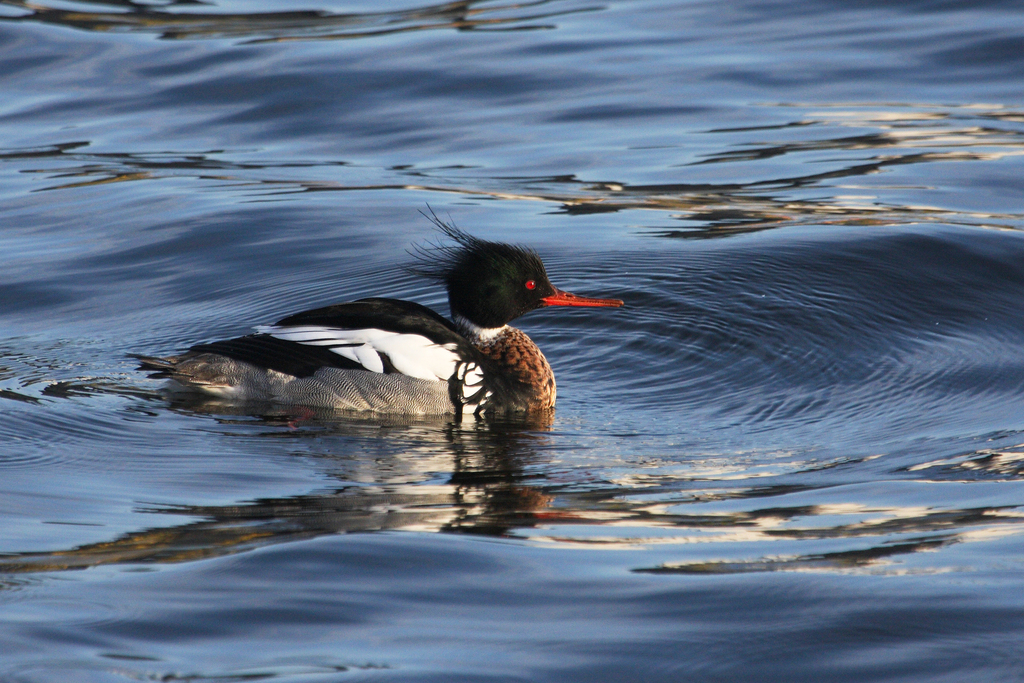
(c) Thomas Galewski, some rights reserved (CC BY) · licence
Family: Anatidae · Class: Aves · Order: Anseriformes
Mergus serrator (Red-breasted Merganser) is a California animal in the Anatidae family.
The Red-breasted Merganser is a medium-sized diving duck with distinctive features that distinguish it from other waterfowl. Males in breeding plumage display a dark green head with a prominent, shaggy double crest, a white collar separating the head from the reddish-brown breast, and bold black and white striped flanks. The bill is long, thin, and serrated, adapted for catching fish. Females and non-breeding males are gray-brown with a rust-colored head and smaller crest. Adults measure 51-64 cm (20-25 inches) in length with a wingspan of 86-94 cm (34-37 inches), weighing 850-1,350 grams (1.9-3.0 pounds). Red-breasted Mergansers breed across northern North America, from Alaska through Canada to the northern United States. In California, they are primarily winter visitors and migrants, occurring along the entire Pacific coast from October through April. The species is most abundant in San Francisco Bay, Monterey Bay, and other protected coastal waters. Small numbers may be found on large inland lakes and reservoirs during migration, particularly in the Central Valley and northeastern California. This species inhabits marine and estuarine environments during winter, preferring shallow coastal waters, bays, and harbors with depths typically less than 10 meters (33 feet). During breeding season in northern regions, they occupy freshwater lakes, ponds, and slow-moving rivers with clear water and abundant fish populations. They require areas with minimal human disturbance for roosting and feeding. Red-breasted Mergansers are piscivorous, feeding almost exclusively on small fish measuring 5-15 cm (2-6 inches) in length. Primary prey species include anchovies, sardines, herring, and sculpins in marine environments. They hunt by diving underwater and pursuing fish with rapid swimming motions, using their serrated bills to grasp slippery prey. The species often forages cooperatively in flocks of 10-50 individuals. Breeding occurs from May through August in northern habitats, with females laying 8-10 olive-buff eggs in ground nests near water, typically concealed under vegetation or in rock crevices. Incubation lasts 29-35 days, and ducklings fledge after 59-65 days. The Red-breasted Merganser is not federally listed and maintains stable populations across most of its range. According to the North American Breeding Bird Survey, continental populations have shown slight increases since 1966, with an estimated 270,000 breeding pairs. In California, the species is considered a common winter resident with no significant conservation concerns. Primary threats include habitat loss from coastal development, oil spills, and disturbance at roosting sites. Climate change may affect prey availability and alter winter distribution patterns. The species benefits from marine protected areas and waterfowl hunting regulations that provide refugia during winter months.
Classification
Class: Aves · Order: Anseriformes · Family: Anatidae
Frequently asked questions
How is Mergus serrator classified?
Mergus serrator belongs to class Aves, order Anseriformes, family Anatidae.
What family does Mergus serrator belong to?
Mergus serrator is in the Anatidae family.
What is Mergus serrator?
The Red-breasted Merganser is a medium-sized diving duck with distinctive features that distinguish it from other waterfowl.
Is Mergus serrator found in California?
Yes. Mergus serrator is recorded in California in The California Species Project's catalogue.
Related species
Other California species in the same genus, family, or bioregion.
Data from The California Species Project — 14,000+ California species with verified data from CNPS, CDFW, USFWS, and more.