Mesogona olivata
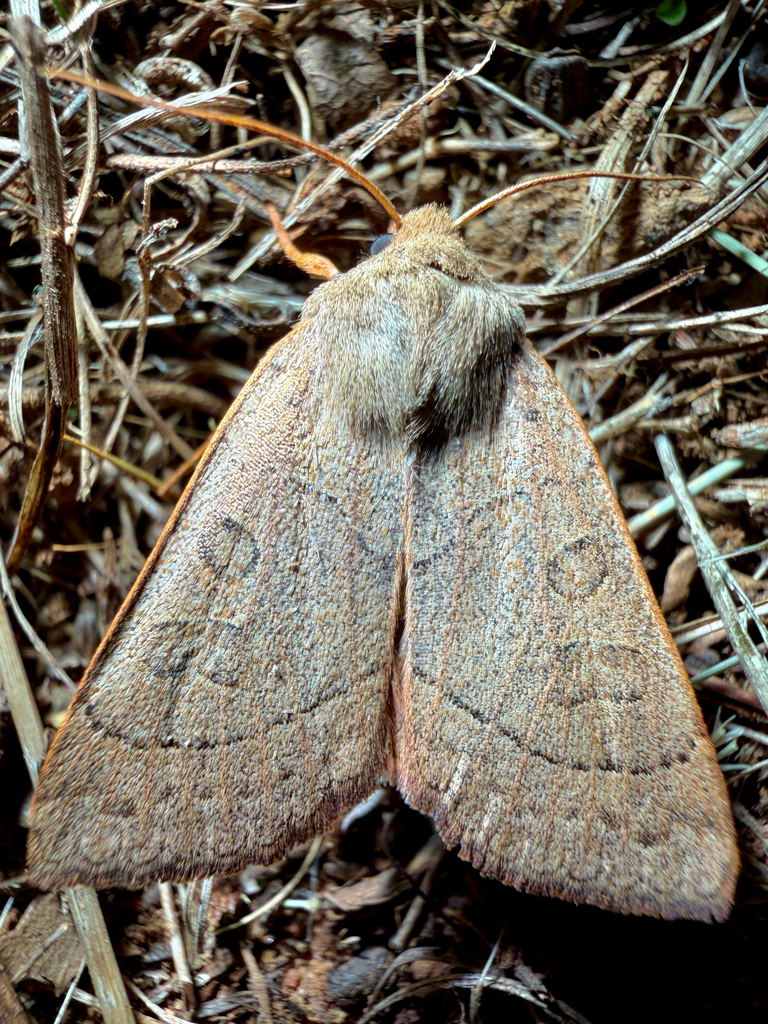
(c) Joshua, some rights reserved (CC BY) · licence
Family: Noctuidae · Class: Insecta · Order: Lepidoptera
Mesogona olivata is a California animal in the Noctuidae family.
Mesogona olivata is a moth in the family Noctuidae, subfamily Noctuinae. This species exhibits the typical noctuid body plan with a robust thorax and relatively broad forewings. The forewings display muted earth tones with olive-brown coloration, consistent with the species epithet 'olivata.' Like other members of the genus Mesogona, adults have well-developed compound eyes and feathery or thread-like antennae, with males typically showing more elaborate antennal structures than females. Mesogona olivata has a broad distribution across western North America, ranging from southern coastal and interior British Columbia south through California, Colorado, and Texas (iNaturalist). The species most likely extends into northern Mexico, though this requires confirmation. In the Pacific Northwest, M. olivata is described as common and widespread, with particular abundance in foothill areas along the eastern slopes of mountain ranges (PNW Moths). Within California, the species likely occurs across multiple bioregions given its broad habitat tolerance and extensive North American range. This moth inhabits a variety of habitat types throughout its range. In the Pacific Northwest, M. olivata is especially common in foothill environments, suggesting an affinity for transitional zones between lowland and montane ecosystems (PNW Moths). The species' broad distribution indicates considerable habitat flexibility, likely occupying mixed coniferous-deciduous forests, oak woodlands, chaparral, and grassland edge habitats. Elevational preferences appear to favor lower to middle elevations based on its foothill associations, though specific elevation ranges have not been documented. As a member of the Noctuidae, M. olivata adults are nocturnal and likely attracted to artificial lights during their active periods. Flight timing and seasonal activity patterns have not been well documented for this species, though most temperate Noctuidae have distinct flight seasons often coinciding with host plant phenology. Larval host plants and feeding ecology remain undocumented in available sources. Like other noctuids, larvae likely feed on herbaceous plants or low shrubs, pupating in soil or leaf litter. Adult moths probably nectar on available flowers during their active period. Mesogona olivata appears to have no formal conservation status at federal, state, or international levels. The species' broad distribution and apparent abundance in suitable habitats, particularly its description as 'common and widespread' in the Pacific Northwest, suggest stable populations (PNW Moths). However, like many moths, M. olivata may face localized threats from habitat conversion, light pollution, and pesticide use, though specific population trends have not been assessed. The lack of comprehensive surveys for most moth species means population status remains largely unknown despite apparent current stability. Scientific documentation for this species remains limited beyond basic distributional and taxonomic information. If you have additional verified information about this species' biology, host plants, or ecology, please contact us to help improve this species account.
Classification
Class: Insecta · Order: Lepidoptera · Family: Noctuidae
Frequently asked questions
How is Mesogona olivata classified?
Mesogona olivata belongs to class Insecta, order Lepidoptera, family Noctuidae.
What family does Mesogona olivata belong to?
Mesogona olivata is in the Noctuidae family.
What is Mesogona olivata?
Mesogona olivata is a moth in the family Noctuidae, subfamily Noctuinae.
Is Mesogona olivata found in California?
Yes. Mesogona olivata is recorded in California in The California Species Project's catalogue.
Related species
Other California species in the same genus, family, or bioregion.
Data from The California Species Project — 14,000+ California species with verified data from CNPS, CDFW, USFWS, and more.