Mesoplodon carlhubbsi
Moore's Beaked Whale
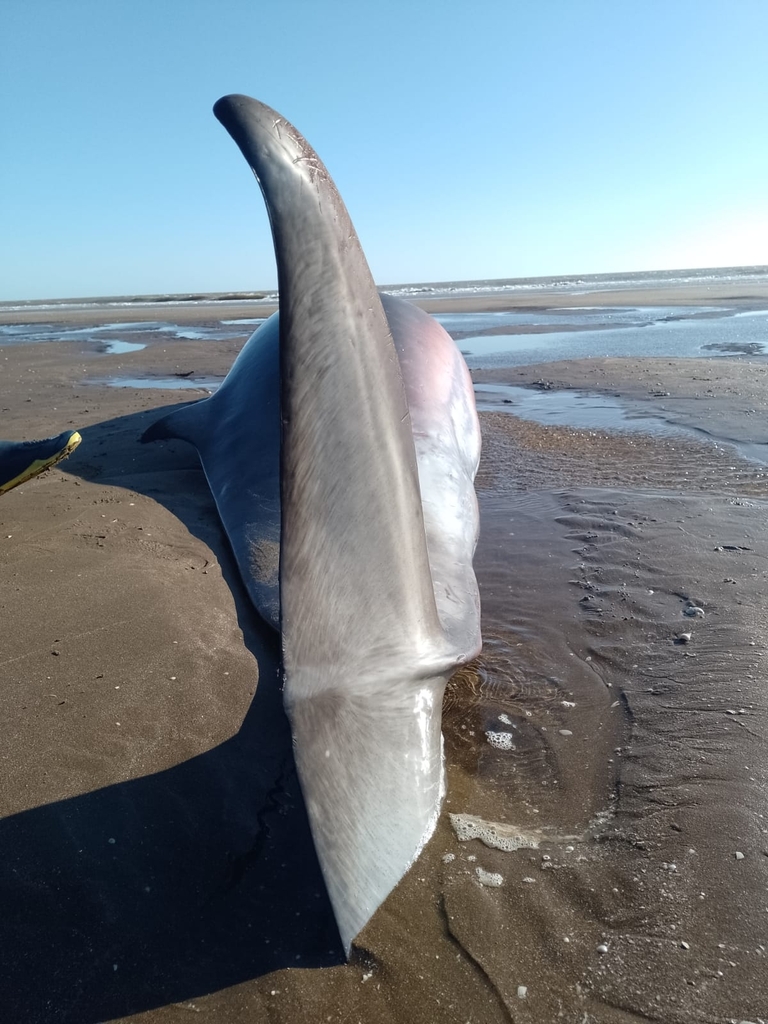
no rights reserved · CC0
Family: Hyperoodontidae · Class: Mammalia · Order: Artiodactyla
Mesoplodon carlhubbsi (Moore's Beaked Whale) is a California animal in the Hyperoodontidae family.
Moore's beaked whale (Mesoplodon carlhubbsi) is a medium-sized cetacean belonging to the family Hyperoodontidae, the beaked whales. Adult males reach lengths of 4.9 to 5.3 meters (16 to 17.4 feet), while females are slightly larger at 5.0 to 5.4 meters (16.4 to 17.7 feet). Males are distinguished by a pair of triangular teeth that erupt from the tip of the lower jaw and curve slightly backward. The body is spindle-shaped with a relatively small head and elongated beak. Coloration is typically dark gray to brownish-black dorsally, fading to lighter tones ventrally. Linear scars from tooth rakes of other males are commonly observed on adult males. Moore's beaked whale has a limited distribution in the North Pacific Ocean. The species occurs primarily in temperate and subarctic waters from Japan eastward to California and north to the Aleutian Islands. Along the California coast, sightings and strandings have been documented from Monterey Bay northward to the Oregon border. The species appears to have a preference for deep oceanic waters beyond the continental shelf. This species inhabits pelagic environments, typically in waters deeper than 1,000 meters (3,281 feet). Moore's beaked whales are associated with areas of high topographic relief, including submarine canyons, seamounts, and continental slope regions where upwelling creates productive foraging conditions. Water temperatures in their habitat range typically span 4 to 15 degrees Celsius (39 to 59 degrees Fahrenheit). Like other beaked whales, Moore's beaked whale is a deep-diving specialist that feeds primarily on squid and deep-water fish. Dive durations can exceed 60 minutes, with individuals capable of reaching depths greater than 1,400 meters (4,593 feet). The species typically occurs in small groups of 2 to 6 individuals, though larger aggregations have been observed in areas of high prey density. Breeding behavior is poorly understood, but based on related species, gestation likely lasts 12 to 13 months with calves born at approximately 2.1 to 2.3 meters (6.9 to 7.5 feet) in length. Sexual maturity is estimated to occur between 9 and 11 years of age. Moore's beaked whale is not currently listed under the U.S. Endangered Species Act or California Endangered Species Act. However, like all marine mammals, it is protected under the Marine Mammal Protection Act of 1972. The species faces threats common to deep-diving cetaceans, including entanglement in fishing gear, ship strikes, ocean noise pollution from military sonar and seismic surveys, and climate change impacts on prey distribution. Population estimates are unavailable due to the species' elusive nature and preference for deep offshore waters. The International Union for Conservation of Nature lists the species as Data Deficient, reflecting the limited scientific knowledge about population status and trends.
Classification
Class: Mammalia · Order: Artiodactyla · Family: Hyperoodontidae
Frequently asked questions
How is Mesoplodon carlhubbsi classified?
Mesoplodon carlhubbsi belongs to class Mammalia, order Artiodactyla, family Hyperoodontidae.
What family does Mesoplodon carlhubbsi belong to?
Mesoplodon carlhubbsi is in the Hyperoodontidae family.
What is Mesoplodon carlhubbsi?
Moore's beaked whale (Mesoplodon carlhubbsi) is a medium-sized cetacean belonging to the family Hyperoodontidae, the beaked whales.
Is Mesoplodon carlhubbsi found in California?
Yes. Mesoplodon carlhubbsi is recorded in California in The California Species Project's catalogue.
Related species
Other California species in the same genus, family, or bioregion.
Data from The California Species Project — 14,000+ California species with verified data from CNPS, CDFW, USFWS, and more.