Mesoplodon densirostris
Dense-beaked Whale
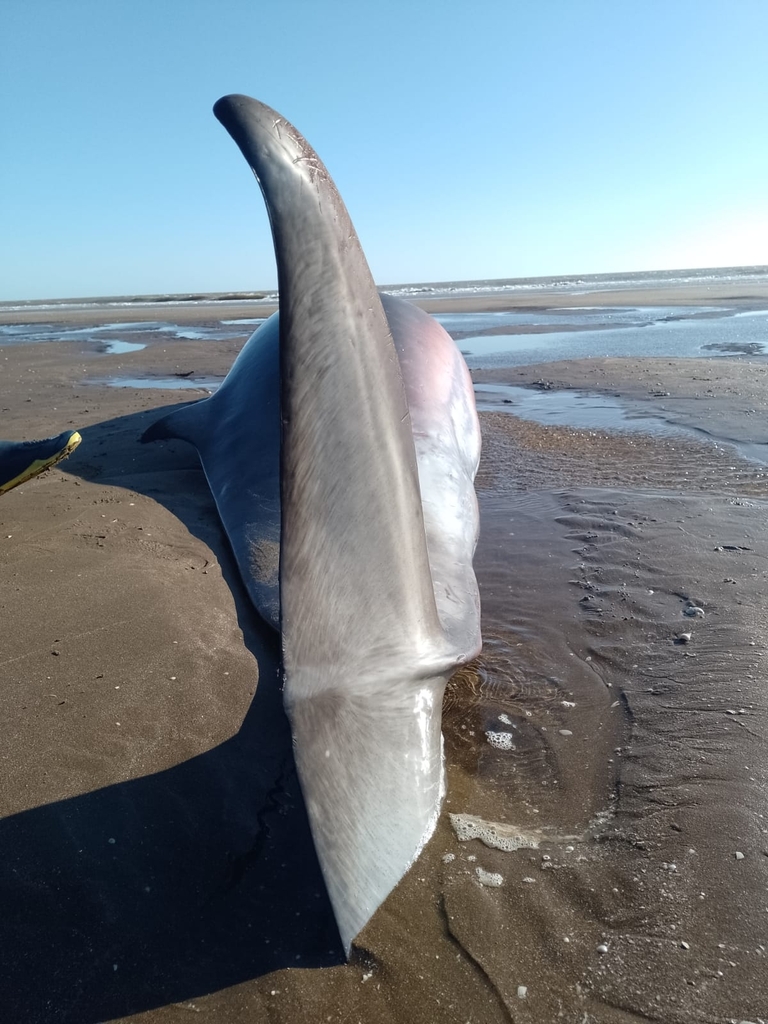
no rights reserved · CC0
Family: Hyperoodontidae · Class: Mammalia · Order: Artiodactyla
Mesoplodon densirostris (Dense-beaked Whale) is a California animal in the Hyperoodontidae family.
The Blainville's beaked whale (Mesoplodon densirostris) is a medium-sized cetacean belonging to the family Hyperoodontidae, the beaked whales. Adults typically measure 4.2 to 5.7 meters (14 to 19 feet) in length and weigh 800 to 1,200 kilograms (1,760 to 2,650 pounds). Males are distinguished by their pronounced mandibular arch, which rises above the upper jaw, giving the species its common name "dense-beaked whale." Adult males develop two prominent triangular teeth that protrude from the lower jaw at the apex of the arch. The body coloration varies from dark gray to brownish-black dorsally, with lighter coloration ventrally. Linear scars, particularly on males, result from intraspecific interactions. Blainville's beaked whales have a circumtropical distribution in warm temperate and tropical waters worldwide. In the eastern North Pacific, they occur from Southern California south to Ecuador. Off California, sightings are relatively rare and primarily documented in deep offshore waters beyond the continental shelf. The species appears to prefer waters with depths exceeding 1,000 meters (3,280 feet), typically found in areas where the continental slope meets abyssal depths. The species inhabits pelagic environments in deep oceanic waters, showing strong preference for areas near seamounts, underwater ridges, and steep continental slopes. These topographic features concentrate prey species and may serve as navigation landmarks. Water temperatures in occupied habitats typically range from 15 to 25 degrees Celsius (59 to 77 degrees Fahrenheit). Unlike some beaked whale species, Blainville's beaked whales rarely approach coastal waters. Blainville's beaked whales are deep-diving specialists, capable of reaching depths exceeding 1,400 meters (4,590 feet) during foraging dives that can last over 90 minutes. Their diet consists primarily of deep-sea cephalopods, including squid and occasionally octopus. Social structure appears fluid, with group sizes typically ranging from two to seven individuals. Breeding biology remains poorly understood, though calving is thought to occur year-round with a gestation period of approximately 12 months. Females reach sexual maturity at lengths of 4.5 to 4.7 meters. Currently, Blainville's beaked whale has no federal or state listing status in the United States, though it receives protection under the Marine Mammal Protection Act. The species is classified as "Data Deficient" by the International Union for Conservation of Nature, reflecting limited knowledge about population trends and threats. Primary conservation concerns include anthropogenic noise pollution from naval sonar and seismic surveys, which can disrupt diving behavior and potentially cause mass strandings. Ship strikes pose an additional threat in areas with heavy maritime traffic. Climate change may affect prey distribution and availability in deep-sea ecosystems. Population estimates remain uncertain due to the species' cryptic nature and preference for remote oceanic habitats.
Classification
Class: Mammalia · Order: Artiodactyla · Family: Hyperoodontidae
Frequently asked questions
How is Mesoplodon densirostris classified?
Mesoplodon densirostris belongs to class Mammalia, order Artiodactyla, family Hyperoodontidae.
What family does Mesoplodon densirostris belong to?
Mesoplodon densirostris is in the Hyperoodontidae family.
What is Mesoplodon densirostris?
The Blainville's beaked whale (Mesoplodon densirostris) is a medium-sized cetacean belonging to the family Hyperoodontidae, the beaked whales.
Is Mesoplodon densirostris found in California?
Yes. Mesoplodon densirostris is recorded in California in The California Species Project's catalogue.
Related species
Other California species in the same genus, family, or bioregion.
Data from The California Species Project — 14,000+ California species with verified data from CNPS, CDFW, USFWS, and more.