Mesoplodon ginkodens
Ginko-toothed Whale
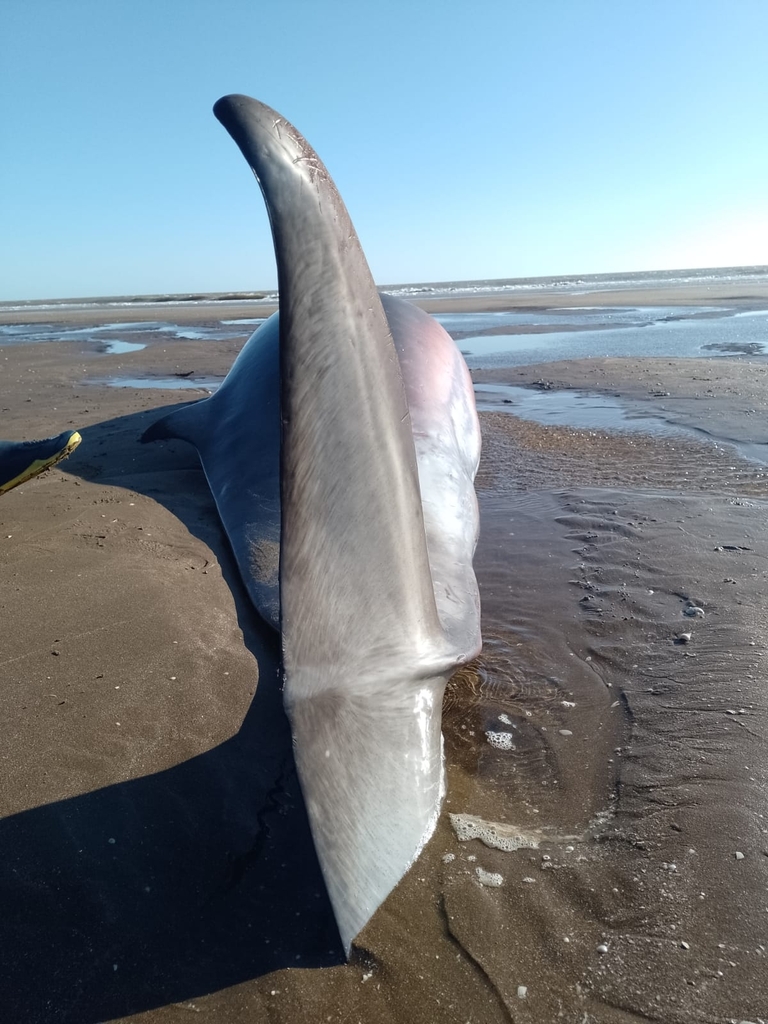
no rights reserved · CC0
Family: Hyperoodontidae · Class: Mammalia · Order: Artiodactyla
Mesoplodon ginkodens (Ginko-toothed Whale) is a California animal in the Hyperoodontidae family.
The ginkgo-toothed beaked whale (Mesoplodon ginkgodens) is a poorly known cetacean species within the family Ziphiidae (beaked whales). Adults typically measure 4.5 to 5.1 meters (14.8 to 16.7 feet) in length, with males slightly larger than females. The species is distinguished by its distinctive tooth morphology in adult males, featuring a single pair of flattened, leaf-shaped teeth that resemble ginkgo leaves, positioned at the tip of the lower jaw. The body is elongated and streamlined with a relatively small dorsal fin located in the posterior third of the back. Coloration varies from dark gray to brownish-black dorsally, with lighter gray ventral surfaces. Males often display extensive scarring from intraspecific interactions. Ginkgo-toothed beaked whales inhabit tropical and temperate waters of the Pacific and Indian Oceans (Animal Diversity Web). In the Pacific, the species ranges from Japan to California, with confirmed sightings extending from the western North Pacific to Baja California, Mexico. The species has also been documented in the Indian Ocean, though distribution patterns remain poorly understood due to limited sighting records. This deep-water species primarily inhabits pelagic environments over continental slopes and abyssal plains, typically in waters exceeding 1,000 meters depth. Like other beaked whales, ginkgo-toothed beaked whales prefer areas with steep underwater topography that support their primary prey species. They are generally found in offshore waters far from coastal areas, which contributes to their elusive nature and limited research opportunities. As deep-diving specialists, ginkgo-toothed beaked whales feed primarily on deep-water squid and fish. Their foraging behavior involves prolonged dives to depths potentially exceeding 1,500 meters, though specific dive parameters have not been well documented for this species. Recent research off Baja California, Mexico, provided the first confirmed at-sea identifications, revealing acoustic signatures and behavioral patterns previously unknown (Henderson et al.). Group sizes are typically small, usually consisting of 2-7 individuals. Reproductive biology remains largely unknown, though females likely give birth to single calves after gestation periods similar to other Mesoplodon species. The IUCN classifies the ginkgo-toothed beaked whale as Data Deficient, reflecting the significant knowledge gaps surrounding this species. Population estimates do not exist, and the species' conservation status remains uncertain due to extremely limited sighting records and research data. Primary threats likely include deep-sea fishing operations, marine noise pollution from shipping and military sonar, and potential climate change impacts on deep-water ecosystems. The species' preference for remote offshore habitats provides some natural protection from coastal human activities, but also makes population monitoring extremely challenging. Recent advances in genetic sampling and acoustic detection methods offer promising approaches for future research efforts to better understand this enigmatic whale species.
Classification
Class: Mammalia · Order: Artiodactyla · Family: Hyperoodontidae
Frequently asked questions
How is Mesoplodon ginkodens classified?
Mesoplodon ginkodens belongs to class Mammalia, order Artiodactyla, family Hyperoodontidae.
What family does Mesoplodon ginkodens belong to?
Mesoplodon ginkodens is in the Hyperoodontidae family.
What is Mesoplodon ginkodens?
The ginkgo-toothed beaked whale (Mesoplodon ginkgodens) is a poorly known cetacean species within the family Ziphiidae (beaked whales).
Is Mesoplodon ginkodens found in California?
Yes. Mesoplodon ginkodens is recorded in California in The California Species Project's catalogue.
Related species
Other California species in the same genus, family, or bioregion.
Data from The California Species Project — 14,000+ California species with verified data from CNPS, CDFW, USFWS, and more.