Mesoplodon perrini
Perrin's Beaked Whale
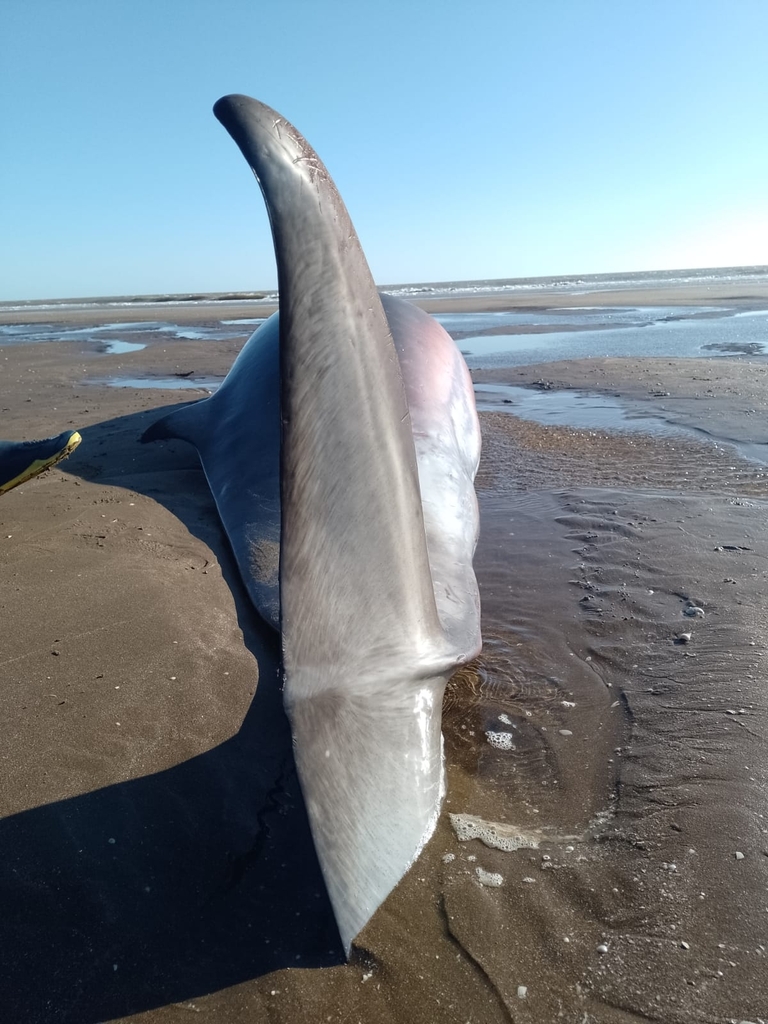
no rights reserved · CC0
Family: Hyperoodontidae · Class: Mammalia · Order: Artiodactyla
Mesoplodon perrini (Perrin's Beaked Whale) is a California animal in the Hyperoodontidae family.
Perrin's beaked whale (Mesoplodon perrini) is a medium-sized marine mammal and one of the most recently described species in the genus Mesoplodon. Adults typically measure 3.9 to 4.7 meters (12.8 to 15.4 feet) in length, with females generally larger than males. The species exhibits the characteristic elongated beak and streamlined body shape typical of beaked whales. Adult males possess two small, erupted teeth located at the tip of the lower jaw, while females and juveniles have no visible teeth. The body coloration is dark gray to brownish-black dorsally, becoming lighter on the ventral surface. Linear scars from conspecific interactions are commonly observed on adult males. Perrin's beaked whale is known only from the eastern North Pacific Ocean, with confirmed records from California waters extending from central California south to Baja California, Mexico. The species was first scientifically described in 2002 based on specimens collected from California beaches, making it one of the newest cetacean species to be formally recognized. Most documented occurrences have been from strandings along the California coast, with records from Monterey County south to San Diego County. This deep-water species inhabits pelagic waters over the continental slope and adjacent deep ocean basins. Perrin's beaked whales are typically found in waters exceeding 1,000 meters (3,280 feet) in depth, favoring areas with steep underwater topography. Like other beaked whales, they likely prefer regions with high concentrations of deep-water cephalopods, their primary prey source. Perrin's beaked whales are deep-diving marine predators that feed primarily on squid and other cephalopods found in the deep scattering layer. Diving behavior likely follows the pattern of other Mesoplodon species, with extended foraging dives lasting 20 to 60 minutes at depths exceeding 1,000 meters. The species appears to be solitary or occurs in small groups of two to three individuals. Reproductive information remains largely unknown due to the limited number of specimens studied. Like other beaked whales, they likely have a slow reproductive rate with extended gestation periods and long intervals between births. The conservation status of Perrin's beaked whale remains poorly understood due to the species' recent discovery and elusive nature. The species is not currently listed under the Endangered Species Act, and population estimates are unavailable. Primary conservation concerns include anthropogenic noise pollution from naval sonar and seismic surveys, which can cause mass strandings and behavioral disruption in beaked whale species. Ship strikes, entanglement in fishing gear, and plastic pollution represent additional threats. Climate change may affect prey distribution and availability in deep-water ecosystems. The species' apparent small population size and limited range make it potentially vulnerable to environmental changes, though comprehensive population assessments have not been conducted.
Classification
Class: Mammalia · Order: Artiodactyla · Family: Hyperoodontidae
Frequently asked questions
How is Mesoplodon perrini classified?
Mesoplodon perrini belongs to class Mammalia, order Artiodactyla, family Hyperoodontidae.
What family does Mesoplodon perrini belong to?
Mesoplodon perrini is in the Hyperoodontidae family.
What is Mesoplodon perrini?
Perrin's beaked whale (Mesoplodon perrini) is a medium-sized marine mammal and one of the most recently described species in the genus Mesoplodon.
Is Mesoplodon perrini found in California?
Yes. Mesoplodon perrini is recorded in California in The California Species Project's catalogue.
Related species
Other California species in the same genus, family, or bioregion.
Data from The California Species Project — 14,000+ California species with verified data from CNPS, CDFW, USFWS, and more.