Mesoplodon stejnegeri
North Pacific Beaked Whale
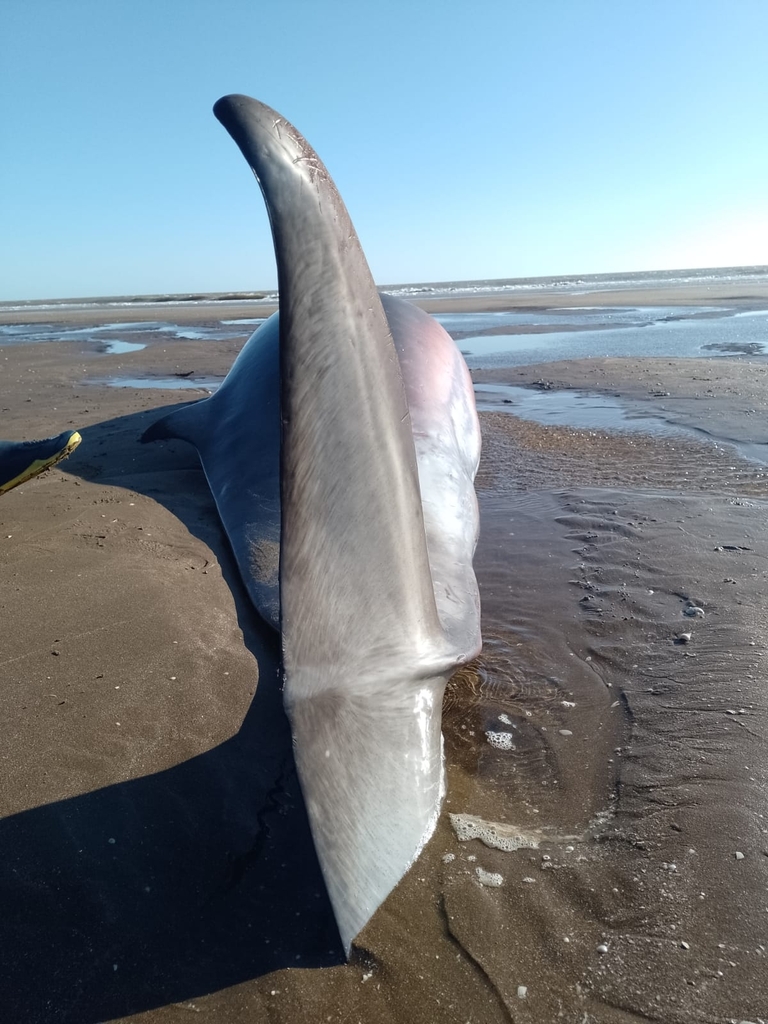
no rights reserved · CC0
Family: Hyperoodontidae · Class: Mammalia · Order: Artiodactyla
Mesoplodon stejnegeri (North Pacific Beaked Whale) is a California animal in the Hyperoodontidae family.
The North Pacific beaked whale (Mesoplodon stejnegeri), also known as Stejneger's beaked whale, is a medium-sized cetacean belonging to the family Hyperoodontidae. Adult males typically measure 5.0 to 5.5 meters (16.4 to 18.0 feet) in length, while females reach slightly larger sizes of 5.2 to 5.8 meters (17.1 to 19.0 feet). Body weight ranges from 1,400 to 1,600 kilograms (3,100 to 3,500 pounds). The species exhibits sexual dimorphism typical of beaked whales, with adult males possessing two prominent triangular teeth that erupt from the lower jaw and arch forward over the upper jaw. The body is dark gray to brownish-black dorsally, with lighter coloration on the ventral surface. Males often display extensive white scarring from intraspecific combat, creating a distinctive pale appearance on mature individuals. The North Pacific beaked whale occurs exclusively in the North Pacific Ocean, with a distribution extending from the Bering Sea south to central California. Along the California coast, the species has been documented in deep offshore waters, primarily beyond the continental shelf edge. Sightings and strandings in California waters are relatively uncommon, with most records from central and northern California counties including Monterey, San Mateo, and Humboldt. This species inhabits deep oceanic waters, typically found in areas with depths exceeding 1,000 meters (3,280 feet). North Pacific beaked whales prefer the continental slope and abyssal plain environments, where they exploit deep-water prey resources. They are rarely observed in coastal waters or over the continental shelf, maintaining a strictly pelagic lifestyle in the open ocean. North Pacific beaked whales are deep-diving specialists, capable of extended foraging dives lasting 30 to 60 minutes at depths potentially exceeding 1,500 meters (4,920 feet). Their diet consists primarily of deep-water squid and fish, including lanternfish and other mesopelagic species. Like other beaked whales, they use echolocation to locate prey in the dark deep-sea environment. The species typically occurs in small groups of 2 to 15 individuals, though larger aggregations have been observed. Breeding occurs year-round with a gestation period of approximately 12 months. Females give birth to a single calf measuring about 2.3 meters (7.5 feet) at birth. The North Pacific beaked whale is not federally listed under the Endangered Species Act, nor does it hold special status in California. However, like many deep-water cetaceans, the species faces threats from anthropogenic activities including commercial fishing operations, where individuals may become entangled in deep-water fishing gear. Underwater noise pollution from shipping and military sonar activities poses additional concerns, as beaked whales are particularly sensitive to acoustic disturbance. Climate change may affect prey distribution and abundance in deep-water ecosystems. The species' remote habitat and cryptic behavior make population assessment challenging, though it is generally considered to have stable populations throughout its range.
Classification
Class: Mammalia · Order: Artiodactyla · Family: Hyperoodontidae
Frequently asked questions
How is Mesoplodon stejnegeri classified?
Mesoplodon stejnegeri belongs to class Mammalia, order Artiodactyla, family Hyperoodontidae.
What family does Mesoplodon stejnegeri belong to?
Mesoplodon stejnegeri is in the Hyperoodontidae family.
What is Mesoplodon stejnegeri?
The North Pacific beaked whale (Mesoplodon stejnegeri), also known as Stejneger's beaked whale, is a medium-sized cetacean belonging to the family Hyperoodontidae.
Is Mesoplodon stejnegeri found in California?
Yes. Mesoplodon stejnegeri is recorded in California in The California Species Project's catalogue.
Related species
Other California species in the same genus, family, or bioregion.
Data from The California Species Project — 14,000+ California species with verified data from CNPS, CDFW, USFWS, and more.