Meta dolloff
Dolloff Cave Spider
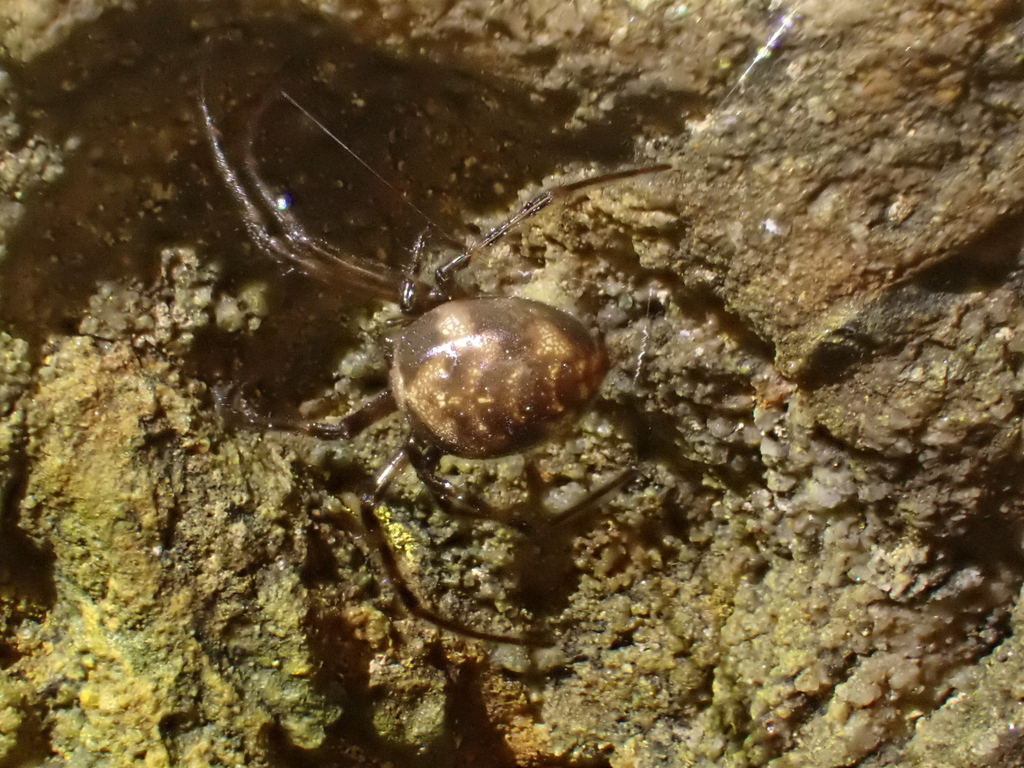
(c) reagan peschke, some rights reserved (CC BY) · licence
Family: Tetragnathidae · Class: Arachnida · Order: Araneae
Conservation status: G3 S3
Meta dolloff (Dolloff Cave Spider) is a California animal in the Tetragnathidae family.
The Dolloff cave spider (Meta dolloff) is a rare arachnid species native to California and among the rarest spiders in North America. This species belongs to the family Tetragnathidae, commonly known as long-jawed orb weavers, though cave-dwelling Meta species have adapted away from typical orb web construction. Physical characteristics of Meta dolloff are not well documented in the scientific literature, reflecting the species' rarity and specialized habitat requirements. Like other members of the genus Meta, this species likely exhibits the elongated body form typical of tetragnathids, with relatively long legs adapted for navigating cave environments. Cave-dwelling Meta species generally show reduced pigmentation and eye development compared to their surface-dwelling relatives. The species' distribution is extremely limited within California, contributing to its rarity status. Historical records indicate the species was known from cave systems, though specific locality data remains limited in published sources. The restricted range has made comprehensive population assessments challenging for researchers and conservation biologists. Dolloff cave spider inhabits cave environments and underground spaces, representing a specialized ecological niche. According to NatureServe, this species has been found in a variety of microhabitat settings including areas under human-made structures, beneath debris piles, and in wood accumulations, suggesting some adaptability to modified environments near cave systems. This habitat flexibility may be crucial for the species' persistence given its limited distribution. Like other cave-adapted spiders, Meta dolloff likely exhibits behavioral modifications suited to low-light environments. The species probably constructs irregular webs rather than the geometric orb webs typical of surface tetragnathids. Prey capture likely focuses on small arthropods that enter cave systems or inhabit the transition zones between surface and underground environments. Reproductive behavior and life cycle details remain poorly documented, though cave-dwelling Meta species typically show extended developmental periods and reduced reproductive rates compared to surface relatives. The conservation status of Meta dolloff reflects significant concern for the species' long-term viability. The species holds a Global/State Rank of G3 S3, indicating it is vulnerable to extinction with 21-100 occurrences or between 1,000-10,000 individuals remaining. A petition regarding the Dolloff cave spider and two other cave arachnids was submitted to the U.S. Fish and Wildlife Service on October 25, 1983, though no federal listing status has been established. The species' cave-dependent ecology makes it particularly vulnerable to habitat disturbance, groundwater contamination, and human activities that alter cave environments. Threat factors likely include habitat modification, recreational cave use, and potential impacts from surface development that could affect groundwater systems supporting cave ecosystems. Climate change may pose additional risks through altered precipitation patterns affecting cave humidity and temperature regimes. The species' extremely limited distribution and specialized habitat requirements make population recovery particularly challenging if local extinctions occur. Scientific documentation for this species remains limited. The information presented here is based on available sources including NatureServe Explorer and federal species databases. If you have additional verified information about this species' biology, distribution, or ecology, please contact us to help improve this species account.
Classification
Class: Arachnida · Order: Araneae · Family: Tetragnathidae
Conservation status
G3 S3
Frequently asked questions
How is Meta dolloff classified?
Meta dolloff belongs to class Arachnida, order Araneae, family Tetragnathidae.
What family does Meta dolloff belong to?
Meta dolloff is in the Tetragnathidae family.
Is Meta dolloff protected or of conservation concern?
Meta dolloff carries the following status: G3 S3.
What is Meta dolloff?
The Dolloff cave spider (Meta dolloff) is a rare arachnid species native to California and among the rarest spiders in North America.
Is Meta dolloff found in California?
Yes. Meta dolloff is recorded in California in The California Species Project's catalogue.
Related species
Other California species in the same genus, family, or bioregion.
Data from The California Species Project — 14,000+ California species with verified data from CNPS, CDFW, USFWS, and more.