Metacarcinus magister
Dungeness Crab
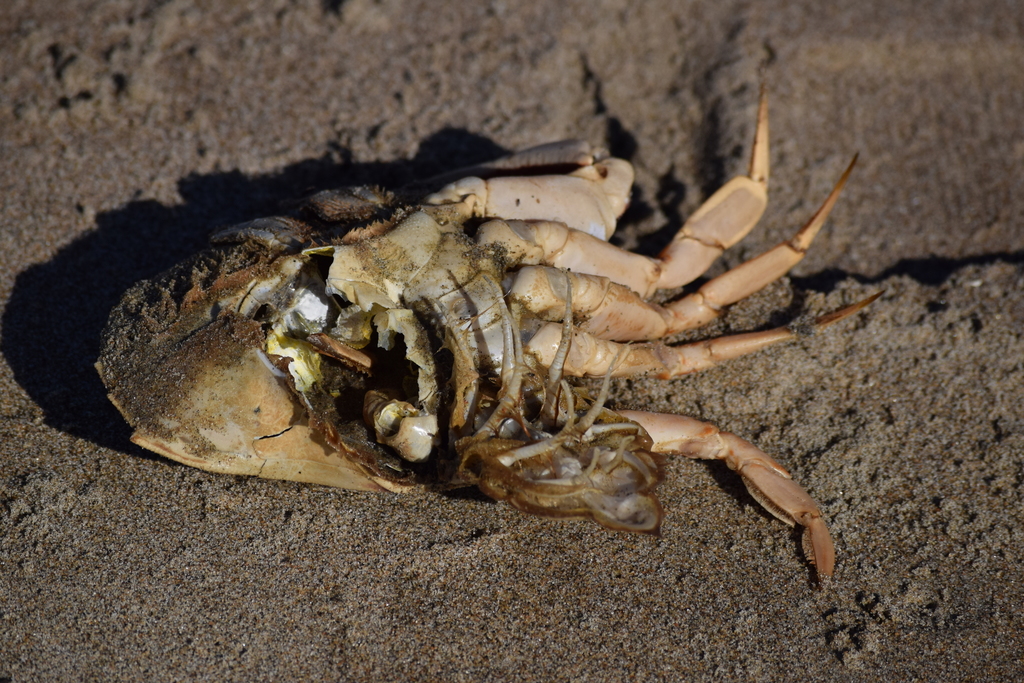
(c) velodrome, some rights reserved (CC BY) · licence
Family: Cancridae · Class: Malacostraca · Order: Decapoda
Metacarcinus magister (Dungeness Crab) is a California animal in the Cancridae family.
The Dungeness crab is a large marine decapod crustacean with a distinctive fan-shaped carapace that reaches up to 25 cm (10 inches) in width. The carapace displays a mottled purplish-brown to reddish-brown coloration dorsally, with lighter yellow-brown tones and a characteristic purple wash on the anterior portions and legs. The underside is typically white to yellowish-white. Males are distinguished by their broader abdomen and larger chelae (claws), while females possess a wider, more rounded abdominal flap. The species exhibits sexual dimorphism, with males growing considerably larger than females and reaching market size of 15.9 cm (6.25 inches) carapace width. Metacarcinus magister ranges from the eastern Aleutian Islands, Alaska, southward to Santa Barbara, California, inhabiting nearshore and estuarine waters along the Pacific coast. In California waters, the species is most abundant north of Monterey Bay, with populations decreasing rapidly south of this point. The species occupies approximately 3,873.5 square miles of suitable soft bottom habitat between 0 and 200 meters depth along the California mainland and island coasts (CDFW 2025). Dungeness crab inhabit sandy and muddy benthic substrates, with adult crabs typically found in waters 30 to 200 meters (98 to 656 feet) deep for commercial populations, while recreational fisheries target similar habitats in shallower waters of 10 to 30 meters (33 to 98 feet) depth. Juveniles and sub-adults often utilize shallower estuarine environments and eelgrass beds as nursery habitat before migrating to deeper offshore waters as they mature. The species exhibits a complex life cycle involving planktonic larval stages followed by benthic juvenile and adult phases. Mating occurs when females molt, typically in spring and early summer. Females carry fertilized eggs externally for several months before releasing planktonic larvae. The larval stage lasts approximately 3-5 months in the plankton before settling to the benthos. Dungeness crab are opportunistic predators and scavengers, feeding on bivalves, polychaete worms, small crustaceans, fish, and organic detritus. They play important ecological roles both as predators and prey species in Pacific coast marine ecosystems. Dungeness crab support one of California's most valuable commercial fisheries and a popular recreational fishery. The species is not federally or state listed, but fisheries are subject to seasonal management including seasonal closures and gear restrictions. Recent management challenges include periodic closures due to domoic acid contamination from harmful algal blooms and whale entanglement mitigation measures. As of December 2025, fishing regulations include trap restrictions in northern California counties and health advisories in certain areas. The California Marine Protected Area network prohibits Dungeness crab harvest from 287.34 square miles of soft bottom habitat, providing refugia for reproductive populations. Climate change and ocean acidification pose emerging long-term threats to the species and its prey base.
Classification
Class: Malacostraca · Order: Decapoda · Family: Cancridae
Frequently asked questions
How is Metacarcinus magister classified?
Metacarcinus magister belongs to class Malacostraca, order Decapoda, family Cancridae.
What family does Metacarcinus magister belong to?
Metacarcinus magister is in the Cancridae family.
What is Metacarcinus magister?
The Dungeness crab is a large marine decapod crustacean with a distinctive fan-shaped carapace that reaches up to 25 cm (10 inches) in width.
Is Metacarcinus magister found in California?
Yes. Metacarcinus magister is recorded in California in The California Species Project's catalogue.
Related species
Other California species in the same genus, family, or bioregion.
Data from The California Species Project — 14,000+ California species with verified data from CNPS, CDFW, USFWS, and more.