Metaltella simoni
South American Toothed Hacklemesh Weaver
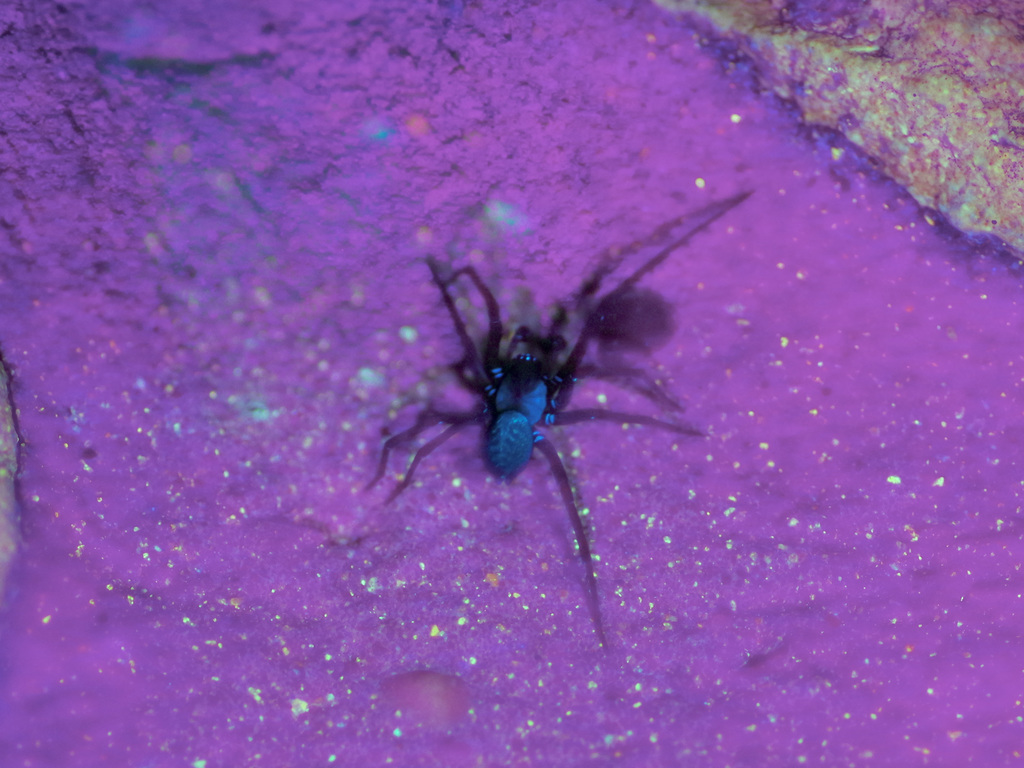
(c) Michelle W. (鍾偉瑋), some rights reserved (CC BY) · licence
Family: Amphinectidae · Class: Arachnida · Order: Araneae
Metaltella simoni (South American Toothed Hacklemesh Weaver) is a California animal in the Amphinectidae family.
Metaltella simoni, the South American Toothed Hacklemesh Weaver, is an introduced spider species belonging to the family Amphinectidae. This medium-sized spider constructs irregular webs with distinctive hackled bands of silk, giving the family its common name. Adults typically measure 6-12 mm in body length, with females generally larger than males. The cephalothorax is brownish-yellow to reddish-brown, while the abdomen displays variable patterns of darker markings on a lighter background. The species possesses the characteristic toothed chelicerae that distinguish hacklemesh weavers from other web-building spiders. Native to South America, M. simoni has established populations in various regions worldwide through human-mediated dispersal. In North America, the species occurs along the Pacific Coast, with documented populations in California. According to NatureServe, the species has a global conservation status of G4 (Apparently Secure), reflecting its widespread distribution and stable populations across its introduced range. The spider's synanthropic nature has facilitated its spread to urban and suburban environments far from its native habitat. This species demonstrates significant habitat flexibility, occurring in both natural and human-modified environments. In California, M. simoni inhabits gardens, parks, residential areas, and agricultural landscapes (iNaturalist 2025). The spiders construct their webs in shrubs, trees, fences, and building structures, particularly in areas that provide shelter and adequate prey availability. They show preference for locations with moderate moisture levels and protection from extreme weather conditions. The species tolerates a wide range of elevations and climatic conditions, contributing to its successful establishment in introduced regions. M. simoni exhibits typical desid spider behavior, constructing semi-permanent webs that combine irregular mesh patterns with distinctive hackled bands that help entangle prey insects (BugGuide 2025). Unlike true orb weavers, hacklemesh weavers do not build circular webs with radial threads and spiral capture silk. Instead, their webs feature irregular sticky capture areas and the characteristic hackled silk bands. Females remain near their webs throughout their adult lives, while males are more mobile during mating season. Reproduction occurs seasonally, with females producing egg sacs, though specific clutch sizes for this species have not been well documented in the scientific literature. The species feeds primarily on flying insects, including flies, mosquitoes, moths, and small beetles captured in their webs (BugGuide 2025). As a non-native species, M. simoni currently lacks specific conservation designation in California. The species appears to be expanding its range within suitable habitat, particularly in urban and suburban environments. While not considered invasive, its establishment represents ongoing changes in California's arachnid fauna due to global species introductions. Research on potential ecological impacts on native spider communities remains limited. The species' synanthropic habits and tolerance for human-modified environments suggest it will likely persist and potentially expand its California distribution in coming decades.
Classification
Class: Arachnida · Order: Araneae · Family: Amphinectidae
Frequently asked questions
How is Metaltella simoni classified?
Metaltella simoni belongs to class Arachnida, order Araneae, family Amphinectidae.
What family does Metaltella simoni belong to?
Metaltella simoni is in the Amphinectidae family.
What is Metaltella simoni?
Metaltella simoni, the South American Toothed Hacklemesh Weaver, is an introduced spider species belonging to the family Amphinectidae.
Is Metaltella simoni found in California?
Yes. Metaltella simoni is recorded in California in The California Species Project's catalogue.
More California species
This species has no close relatives in our California data — here are other species to explore.
Data from The California Species Project — 14,000+ California species with verified data from CNPS, CDFW, USFWS, and more.