Metridium senile
Plumose Anemone
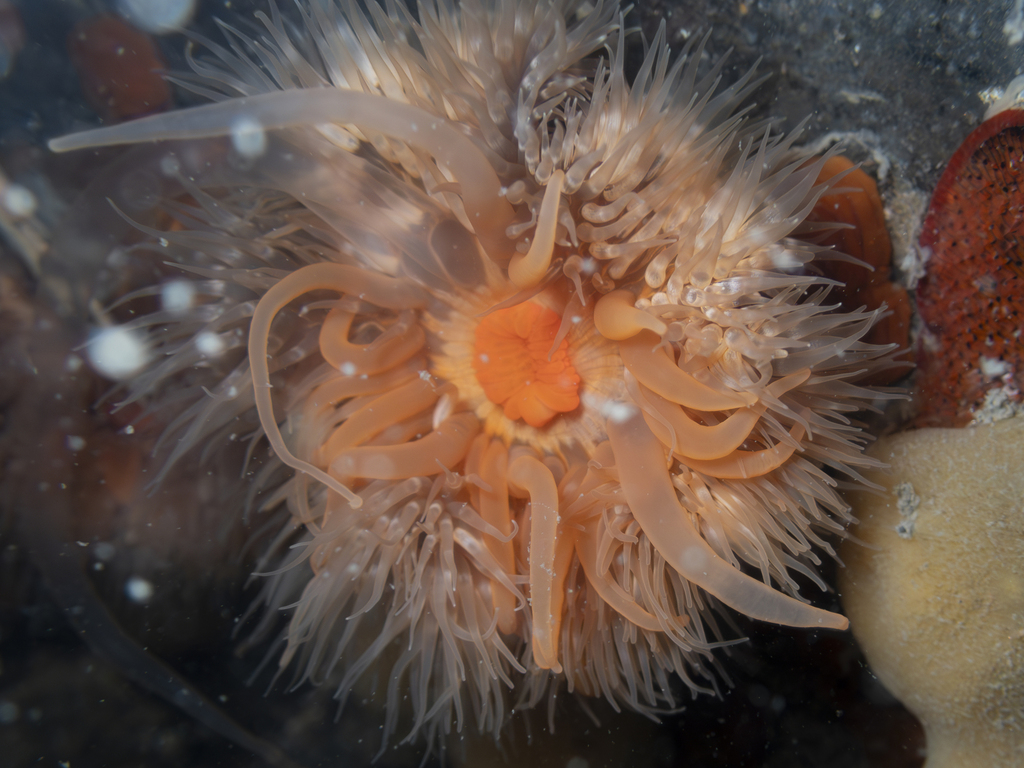
(c) Nathan, some rights reserved (CC BY) · licence
Family: Metridiidae · Class: Anthozoa · Order: Actiniaria
Metridium senile (Plumose Anemone) is a California animal in the Metridiidae family.
The plumose anemone (Metridium senile) is a large, colonial sea anemone belonging to the family Metridiidae within the order Actiniaria. This cnidarian species exhibits a distinctive plumose or feather-like appearance due to its numerous, densely packed tentacles that create a soft, flowing crown atop a cylindrical column. The column can reach heights of 25-50 cm (10-20 inches) in mature specimens, with colors ranging from white and cream to orange, brown, or greenish hues. The tentacles are typically translucent to opaque white, giving the species its common name. Metridium senile occurs along the Pacific coast of North America from Alaska to California, with significant populations documented in California waters. The species inhabits rocky substrates in subtidal zones, commonly found attached to pilings, rocky walls, and artificial structures such as piers and breakwaters. In California, plumose anemones are particularly abundant in protected marine areas including Point Conception State Marine Reserve and South Cape Mendocino State Marine Reserve, where they form part of diverse benthic communities alongside sponges, brittle stars, and rockfish species. This species thrives in cold to temperate waters with strong currents that facilitate feeding and waste removal. Plumose anemones prefer depths ranging from the low intertidal zone to approximately 150 meters (490 feet), though they are most commonly observed in depths of 5-30 meters (16-98 feet). They require hard substrates for attachment and are often found in areas with moderate to strong water movement that delivers planktonic prey. Metridium senile exhibits both sexual and asexual reproduction, with the latter being particularly significant for colony expansion. Individual polyps can reproduce asexually through longitudinal fission, where the animal splits into two genetically identical individuals. This clonal reproduction allows single colonies to spread across large areas of suitable substrate. The species is a suspension feeder, capturing zooplankton, small fish, and organic particles using its numerous tentacles equipped with specialized stinging cells called nematocysts. Feeding occurs primarily during periods of strong water flow when prey density is highest. The species plays an important ecological role as both predator and habitat provider, with its dense tentacle masses offering shelter for small invertebrates and juvenile fish. In California waters, plumose anemones contribute to the structural complexity of subtidal rocky reef ecosystems. Plumose anemones currently face no specific federal or state conservation listing status in California. However, they are protected within California's network of Marine Protected Areas, where regulations prohibit the taking or disturbance of any marine life. The species may be vulnerable to climate change impacts including ocean acidification and warming temperatures, which could affect their calcium carbonate-dependent prey species and alter local current patterns that are essential for their feeding ecology. Coastal development and water quality degradation represent potential threats to nearshore populations, particularly those inhabiting harbor and pier environments.
Classification
Class: Anthozoa · Order: Actiniaria · Family: Metridiidae
Frequently asked questions
How is Metridium senile classified?
Metridium senile belongs to class Anthozoa, order Actiniaria, family Metridiidae.
What family does Metridium senile belong to?
Metridium senile is in the Metridiidae family.
What is Metridium senile?
The plumose anemone (Metridium senile) is a large, colonial sea anemone belonging to the family Metridiidae within the order Actiniaria.
Is Metridium senile found in California?
Yes. Metridium senile is recorded in California in The California Species Project's catalogue.
Related species
Other California species in the same genus, family, or bioregion.
Data from The California Species Project — 14,000+ California species with verified data from CNPS, CDFW, USFWS, and more.