Mexoleon papago
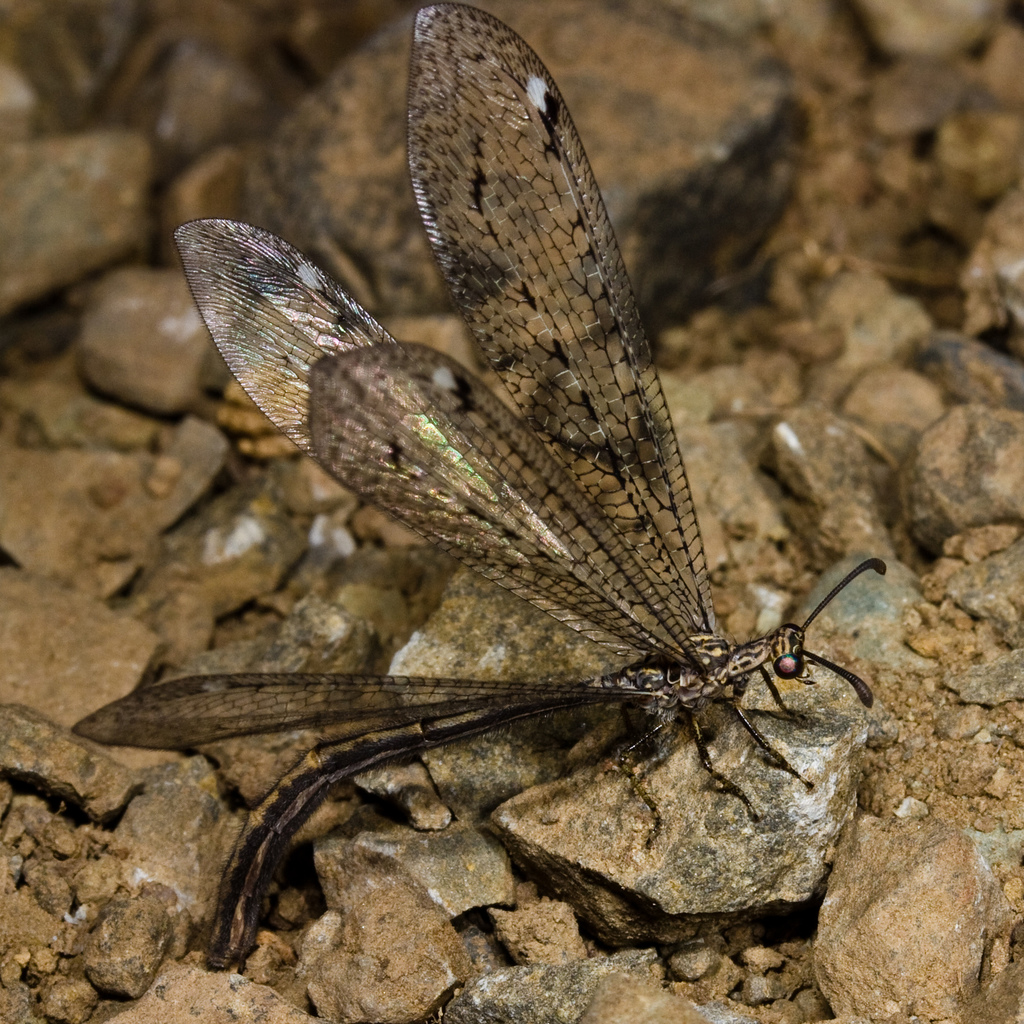
(c) Ken-ichi Ueda, some rights reserved (CC BY) · licence
Family: Myrmeleontidae · Class: Insecta · Order: Neuroptera
Mexoleon papago is a California animal in the Myrmeleontidae family.
Mexoleon papago is an antlion species belonging to the family Myrmeleontidae within the order Neuroptera. As a member of the genus Mexoleon, this species represents one of several antlion taxa documented from southwestern North America. Adult antlions in this genus typically possess elongated bodies with four membranous wings held roof-like over the abdomen when at rest, though specific morphological details for M. papago have not been well documented in the scientific literature. The range and distribution of Mexoleon papago remain poorly understood. The species name 'papago' suggests an association with the Papago (now Tohono O'odham) cultural region of the Sonoran Desert, which spans portions of southern Arizona and northwestern Mexico. However, confirmed occurrence records and the precise geographic boundaries of this species' distribution have not been thoroughly documented in accessible scientific publications. Habitat preferences for Mexoleon papago have not been specifically characterized in the literature. Other Mexoleon species typically inhabit arid and semi-arid environments characteristic of southwestern deserts. Adult antlions generally prefer areas with sandy or loose soil substrates where larvae can construct their characteristic funnel-shaped pit traps. The Sonoran Desert region associated with the species name includes diverse microhabitats ranging from desert flats to rocky slopes and arroyos. Like other myrmeleontids, Mexoleon papago likely exhibits a complex life cycle with distinct larval and adult stages. Antlion larvae, commonly called doodlebugs, are predatory insects that construct conical pit traps in sandy soil to capture small arthropods, particularly ants. The larval stage can persist for one to three years depending on environmental conditions and prey availability. Adult antlions are typically short-lived, emerging to mate and reproduce during favorable periods. Adults may be attracted to artificial lights and are generally weak fliers compared to other neuropterans. No specific conservation status has been established for Mexoleon papago. The species is not currently listed under state or federal endangered species legislation. Limited scientific documentation makes it difficult to assess population trends or identify specific conservation concerns. Desert ecosystems throughout the southwestern United States face various anthropogenic pressures including urban development, recreational activities, and climate change impacts that could potentially affect antlion populations. The taxonomic status and biological characteristics of Mexoleon papago require further scientific investigation. Current knowledge gaps include detailed morphological descriptions, verified distribution records, habitat requirements, and life history information. The species appears in the U.S. Fish and Wildlife Service Taxonomic Serial Number database (TSN: 666499), confirming its recognition as a valid taxon within the genus Mexoleon. Scientific documentation for this species remains extremely limited despite searches of entomological databases and literature. The information presented here synthesizes available taxonomic references and general knowledge of antlion biology. We welcome contributions of verified scientific data, photographs, or field observations to enhance this species account.
Classification
Class: Insecta · Order: Neuroptera · Family: Myrmeleontidae
Frequently asked questions
How is Mexoleon papago classified?
Mexoleon papago belongs to class Insecta, order Neuroptera, family Myrmeleontidae.
What family does Mexoleon papago belong to?
Mexoleon papago is in the Myrmeleontidae family.
What is Mexoleon papago?
Mexoleon papago is an antlion species belonging to the family Myrmeleontidae within the order Neuroptera.
Is Mexoleon papago found in California?
Yes. Mexoleon papago is recorded in California in The California Species Project's catalogue.
Related species
Other California species in the same genus, family, or bioregion.
Data from The California Species Project — 14,000+ California species with verified data from CNPS, CDFW, USFWS, and more.