Microlarinus lareynii
Puncture vine seed weevil
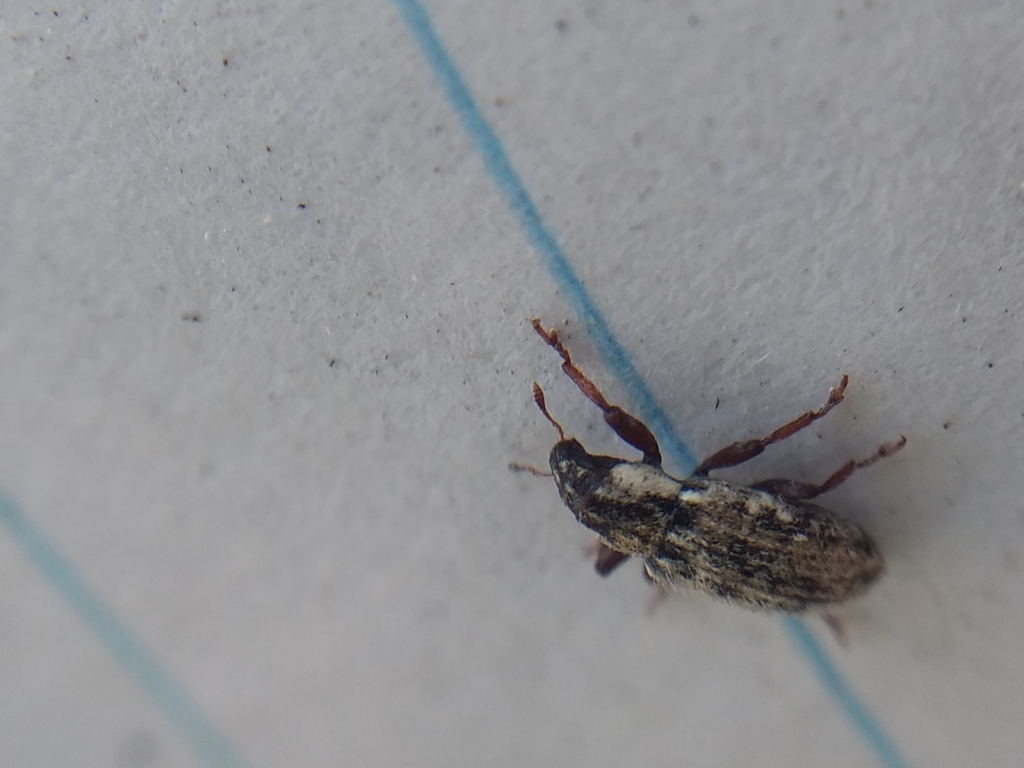
(c) Michele Jones, some rights reserved (CC BY) · licence
Family: Curculionidae · Class: Insecta · Order: Coleoptera
Microlarinus lareynii (Puncture vine seed weevil) is a California animal in the Curculionidae family.
The puncture vine seed weevil is a small beetle measuring 2.0 to 4.5 millimeters (0.08 to 0.18 inches) in length (BugGuide 2022). This weevil belongs to the family Curculionidae, subfamily Lixinae and displays the characteristic elongated snout typical of curculionid beetles. Adults are brown to grayish-brown with a mottled appearance that provides camouflage among plant debris. Native to the Mediterranean region, Microlarinus lareynii was deliberately introduced to North America in the 1960s as a biological control agent for puncture vine (Tribulus terrestris) (BugGuide 2022). The species is now widely established across the southwestern United States, with populations extending from California eastward to northeastern Texas and northward through Florida. The weevil's distribution closely follows that of its host plant, which thrives in arid and semi-arid regions. This species primarily inhabits disturbed areas where puncture vine grows, including roadsides, vacant lots, agricultural margins, and overgrazed rangeland. The weevil tolerates the same harsh, dry conditions as its host plant, typically occurring in areas with sandy or gravelly soils and full sun exposure. Elevational range extends from sea level to moderate elevations in desert and semi-desert environments. The puncture vine seed weevil exhibits host-specific behavior, feeding and reproducing exclusively on Tribulus terrestris. Adult females deposit eggs directly into developing puncture vine seeds during summer months. Larvae develop entirely within the seeds, consuming the seed contents and preventing germination. This feeding behavior effectively reduces the reproductive potential of puncture vine populations. Adults emerge from infested seeds and may feed on puncture vine foliage, though seed consumption represents the primary ecological impact. The species typically produces one generation per year, synchronized with the host plant's seed production cycle. Development from egg to adult occurs within 30 to 45 days under optimal conditions. Adults overwinter in plant debris and become active in spring as temperatures rise. Peak activity coincides with puncture vine flowering and seed development, typically from late spring through early fall in most regions. As an introduced biological control agent, Microlarinus lareynii requires no conservation measures. The species serves an ecological function in managing puncture vine, an invasive weed that poses significant agricultural and environmental problems across the western United States. Puncture vine produces sharp spines that injure livestock and humans while competing with native vegetation for resources. The weevil's establishment represents a successful biological control program, though complete eradication of puncture vine populations is neither expected nor achieved. Monitoring of biological control effectiveness continues through various agricultural extension programs, though the weevil is generally considered well-established throughout its introduced range. Climate change may affect the species' distribution as temperature and precipitation patterns shift, potentially altering the geographic overlap between the weevil and its host plant. The success of this biological control program demonstrates the potential benefits of carefully screened introductions for managing invasive plant species.
Classification
Class: Insecta · Order: Coleoptera · Family: Curculionidae
Frequently asked questions
How is Microlarinus lareynii classified?
Microlarinus lareynii belongs to class Insecta, order Coleoptera, family Curculionidae.
What family does Microlarinus lareynii belong to?
Microlarinus lareynii is in the Curculionidae family.
What is Microlarinus lareynii?
The puncture vine seed weevil is a small beetle measuring 2.0 to 4.5 millimeters (0.08 to 0.18 inches) in length (BugGuide 2022).
Is Microlarinus lareynii found in California?
Yes. Microlarinus lareynii is recorded in California in The California Species Project's catalogue.
Related species
Other California species in the same genus, family, or bioregion.
Data from The California Species Project — 14,000+ California species with verified data from CNPS, CDFW, USFWS, and more.