Micropterus dolomieu
Smallmouth bass
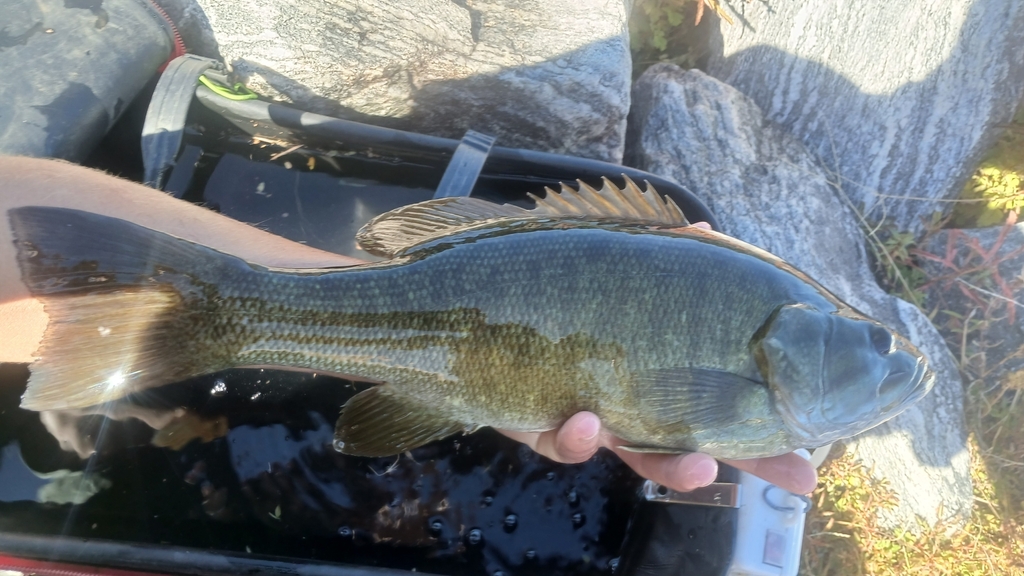
(c) Joshua Johnson, some rights reserved (CC BY) · licence
Family: Centrarchidae · Class: Actinopterygii · Order: Perciformes
Micropterus dolomieu (Smallmouth bass) is a California animal in the Centrarchidae family.
The smallmouth bass is a freshwater game fish native to eastern North America but widely introduced throughout California and other western states. Adults typically measure 305 to 406 mm (12 to 16 inches) in length and weigh 0.9 to 1.8 kg (2 to 4 pounds), though specimens can reach 610 mm (24 inches) and exceed 3.2 kg (7 pounds). The species exhibits a robust, laterally compressed body with a bronze to olive-green coloration on the dorsal surface, fading to yellowish-white on the belly. Dark vertical bars or blotches mark the sides, becoming more pronounced during spawning. The mouth extends to approximately the middle of the eye, distinguishing it from the largemouth bass where the mouth extends beyond the eye. Originally distributed from southern Canada through the Great Lakes region and Mississippi River basin to northern Alabama and eastern Oklahoma, smallmouth bass were first introduced to California waters in the 1870s. The species now occurs in numerous California reservoirs, rivers, and streams, including Lake Almanor, Lake Oroville, the American River system, and many Sierra Nevada foothill waters. Populations are established in both northern and central California watersheds, with scattered introductions in southern regions. Smallmouth bass inhabit clear, cool waters with rocky or gravel substrates and prefer temperatures between 15.6 and 26.7°C (60 to 80°F). The species thrives in lakes, reservoirs, and moderate to fast-flowing rivers and streams with depths ranging from 1.5 to 12 meters (5 to 40 feet). Rocky points, submerged boulders, fallen timber, and aquatic vegetation provide essential cover and foraging areas. Optimal habitat includes dissolved oxygen levels above 5 mg/L and minimal siltation. Smallmouth bass are opportunistic predators feeding primarily on crayfish, aquatic insects, small fish, and occasionally frogs and salamanders. Adults become increasingly piscivorous, consuming juvenile trout, minnows, and other bass species. Spawning occurs from April through June when water temperatures reach 13.9 to 18.3°C (57 to 65°F). Males construct circular nests 0.6 to 1.8 meters (2 to 6 feet) in diameter in shallow water over gravel or rocky substrates. Females deposit 2,000 to 14,000 eggs, which males guard for 3 to 5 weeks until fry disperse. Sexual maturity occurs at 3 to 4 years of age. As a non-native species in California, smallmouth bass lack formal conservation protection and are managed as a sport fish by the California Department of Fish and Wildlife. However, their presence raises ecological concerns due to potential impacts on native fish populations, particularly salmon and steelhead juveniles. Studies indicate smallmouth bass can compete with and prey upon native species in certain systems. Management strategies focus on preventing further spread to sensitive watersheds while maintaining recreational fishing opportunities in established populations. The species' adaptability and reproductive success have resulted in self-sustaining populations throughout much of their introduced range in California.
Classification
Class: Actinopterygii · Order: Perciformes · Family: Centrarchidae
Frequently asked questions
How is Micropterus dolomieu classified?
Micropterus dolomieu belongs to class Actinopterygii, order Perciformes, family Centrarchidae.
What family does Micropterus dolomieu belong to?
Micropterus dolomieu is in the Centrarchidae family.
What is Micropterus dolomieu?
The smallmouth bass is a freshwater game fish native to eastern North America but widely introduced throughout California and other western states.
Is Micropterus dolomieu found in California?
Yes. Micropterus dolomieu is recorded in California in The California Species Project's catalogue.
Related species
Other California species in the same genus, family, or bioregion.
Data from The California Species Project — 14,000+ California species with verified data from CNPS, CDFW, USFWS, and more.