Microtus longicaudus
Long-tailed Vole
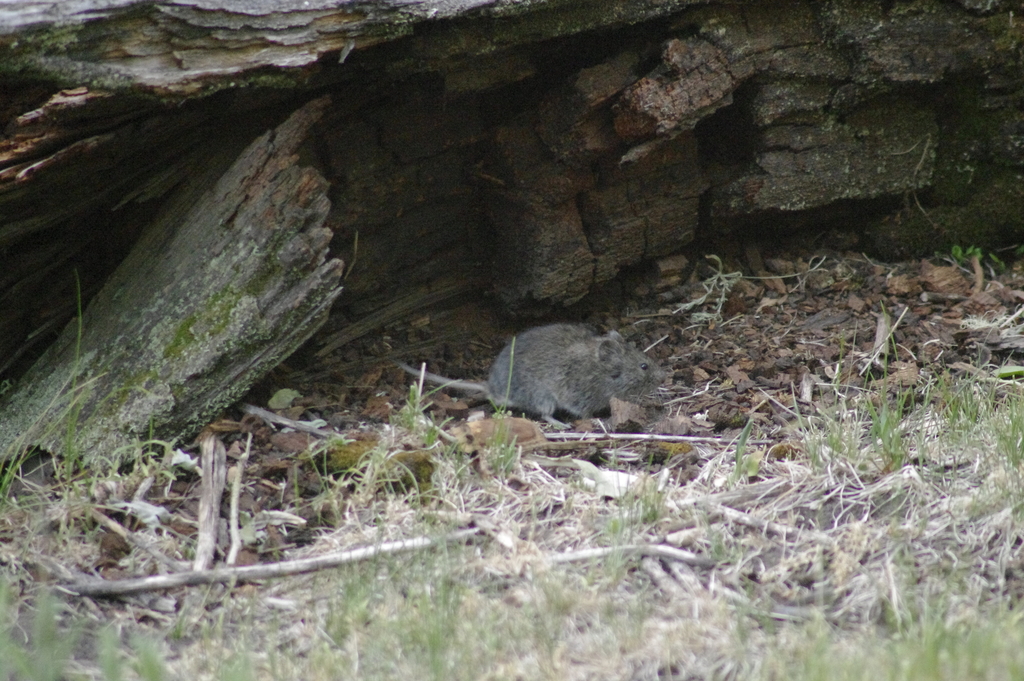
(c) Eric Knight, some rights reserved (CC BY) · licence
Family: Cricetidae · Class: Mammalia · Order: Rodentia
Microtus longicaudus (Long-tailed Vole) is a California animal in the Cricetidae family.
The long-tailed vole is a small rodent measuring 140 to 190 mm (5.5 to 7.5 inches) in total length, with the tail comprising approximately 40 to 50 percent of this measurement. Adults typically weigh 30 to 50 grams (1.1 to 1.8 ounces). The species displays grizzled brown to grayish-brown dorsal coloration with darker guard hairs, while the ventral surface is pale gray to white. The tail is distinctly bicolored, dark above and light below, and is notably longer relative to body size compared to other Microtus species. The ears are small and partially concealed by fur, and the eyes are relatively small and dark. The hind feet measure 17 to 21 mm in length. Long-tailed voles occur across western North America from Alaska south to New Mexico, with populations distributed throughout much of California. In California, the species is found in the Sierra Nevada, Cascade Range, northern Coast Ranges, and scattered locations in the southern mountains including the San Bernardino and San Jacinto ranges. The distribution extends from sea level to elevations exceeding 3,400 meters (11,150 feet), though populations are most common at higher elevations. The species inhabits a diverse range of mesic habitats including montane meadows, riparian zones, forest clearings, and areas with dense herbaceous ground cover. Preferred microhabitats feature thick grass or sedge cover near water sources, including streams, springs, and wet meadows. Long-tailed voles construct extensive runway systems through vegetation and excavate shallow burrow networks with multiple entrances. They show strong association with areas containing sufficient cover to protect against aerial predators. Long-tailed voles are primarily herbivorous, feeding on grasses, sedges, forbs, and occasionally consuming bark, seeds, and fungi during winter months. The species is active year-round and exhibits both diurnal and nocturnal activity patterns. Breeding occurs from April through September at higher elevations, with females producing two to four litters annually. Gestation lasts 19 to 21 days, and litter sizes range from three to eight young. Sexual maturity is reached at approximately six to eight weeks of age. Population densities fluctuate cyclically, typically peaking every three to four years. Long-tailed voles are not federally or state listed and are considered stable across most of their range as of December 2025. The species benefits from its broad habitat tolerance and wide distribution. However, localized populations may face pressure from habitat modification, particularly in riparian areas affected by water diversions, livestock grazing, and development. Climate change poses potential long-term threats through shifts in precipitation patterns and temperature regimes that could alter suitable habitat at higher elevations. The species serves as important prey for numerous predators including owls, hawks, weasels, and snakes, making it a significant component of montane food webs.
Classification
Class: Mammalia · Order: Rodentia · Family: Cricetidae
Frequently asked questions
How is Microtus longicaudus classified?
Microtus longicaudus belongs to class Mammalia, order Rodentia, family Cricetidae.
What family does Microtus longicaudus belong to?
Microtus longicaudus is in the Cricetidae family.
What is Microtus longicaudus?
The long-tailed vole is a small rodent measuring 140 to 190 mm (5.5 to 7.5 inches) in total length, with the tail comprising approximately 40 to 50 percent of this measurement.
Is Microtus longicaudus found in California?
Yes. Microtus longicaudus is recorded in California in The California Species Project's catalogue.
Related species
Other California species in the same genus, family, or bioregion.
Data from The California Species Project — 14,000+ California species with verified data from CNPS, CDFW, USFWS, and more.