Microtus montanus
Montane Vole
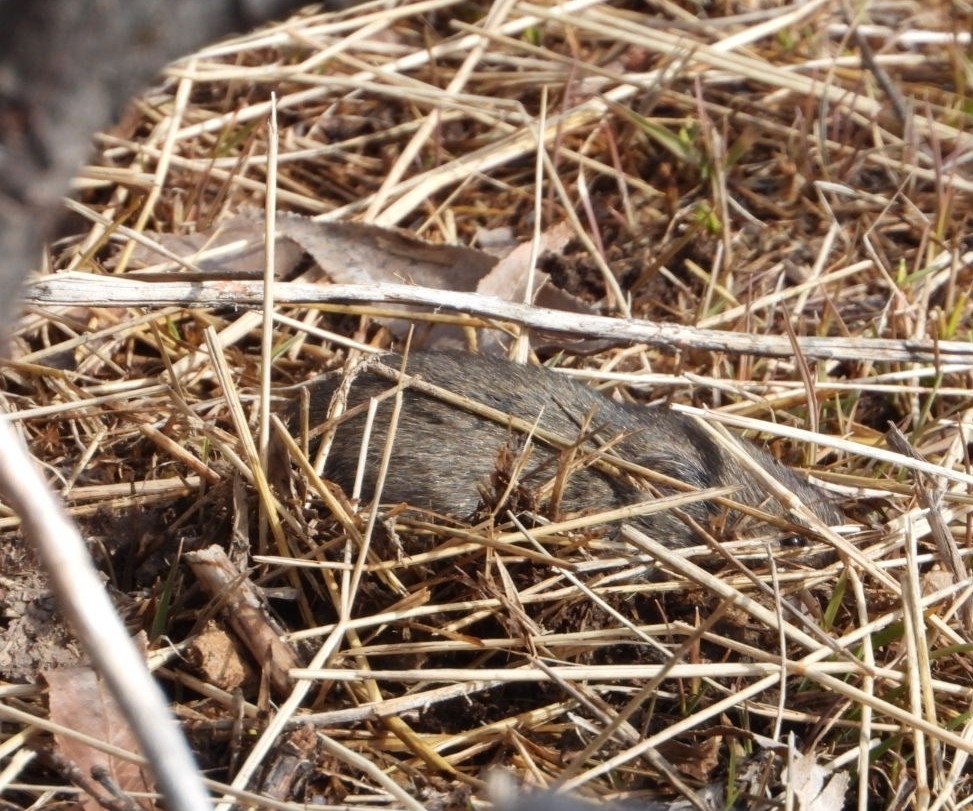
(c) Brodie Cass Talbott, some rights reserved (CC BY) · licence
Family: Cricetidae · Class: Mammalia · Order: Rodentia
Microtus montanus (Montane Vole) is a California animal in the Cricetidae family.
The montane vole is a small, compact rodent measuring 140 to 170 mm (5.5 to 6.7 inches) in total length, with a tail length of 35 to 55 mm (1.4 to 2.2 inches). Adults typically weigh 28 to 48 grams (1.0 to 1.7 ounces). The dorsal pelage ranges from grayish-brown to dark brown, while the ventral surface is lighter gray to whitish. The ears are small and partially concealed by fur, and the eyes are relatively small. The tail is bicolored, darker above and lighter below, and densely furred. Distinguished from other Microtus species by its relatively short tail and grizzled appearance. The montane vole occurs throughout much of western North America, from southern British Columbia and Alberta south to New Mexico and California. In California, the species is found primarily in the Sierra Nevada, Cascade Range, and northeastern mountains including the Modoc Plateau. Populations occur at elevations ranging from approximately 1,200 to 3,400 meters (3,900 to 11,200 feet), with highest densities typically found between 1,800 and 2,700 meters (5,900 to 8,900 feet). California populations are distributed across counties including Alpine, El Dorado, Fresno, Inyo, Lassen, Madera, Modoc, Mono, Nevada, Placer, Plumas, Shasta, Sierra, Siskiyou, Tuolumne, and Tulare. Montane voles inhabit montane and subalpine meadows, grasslands, and forest openings. The species shows strong preference for areas with dense herbaceous ground cover, particularly sedge meadows, wet montane grasslands, and riparian zones. They construct extensive runway systems through vegetation and create burrow networks in soft, moist soils. Optimal habitat includes areas with high plant productivity and adequate moisture throughout the growing season. The species is primarily herbivorous, feeding on grasses, sedges, forbs, and occasionally bark and twigs during winter months. Montane voles are active year-round and do not hibernate, remaining active beneath snow cover during winter. Breeding occurs from late spring through early fall, with females producing 2 to 4 litters annually. Gestation lasts approximately 21 days, and litter sizes range from 2 to 8 young, with an average of 4 to 5. Young reach sexual maturity at 4 to 6 weeks of age. Population densities can fluctuate dramatically, following typical microtine cycles with peaks occurring every 3 to 4 years. The montane vole is not federally or state-listed as threatened or endangered. However, localized populations may face pressure from habitat modification, livestock grazing, and climate change effects on high-elevation meadow systems. Prolonged drought conditions can significantly impact population numbers by reducing food availability and suitable habitat. The species serves as an important prey base for various predators including weasels, hawks, owls, and snakes in montane ecosystems.
Classification
Class: Mammalia · Order: Rodentia · Family: Cricetidae
Frequently asked questions
How is Microtus montanus classified?
Microtus montanus belongs to class Mammalia, order Rodentia, family Cricetidae.
What family does Microtus montanus belong to?
Microtus montanus is in the Cricetidae family.
What is Microtus montanus?
The montane vole is a small, compact rodent measuring 140 to 170 mm (5.5 to 6.7 inches) in total length, with a tail length of 35 to 55 mm (1.4 to 2.2 inches).
Is Microtus montanus found in California?
Yes. Microtus montanus is recorded in California in The California Species Project's catalogue.
Related species
Other California species in the same genus, family, or bioregion.
Data from The California Species Project — 14,000+ California species with verified data from CNPS, CDFW, USFWS, and more.