Ministrymon leda
Leda Ministreak
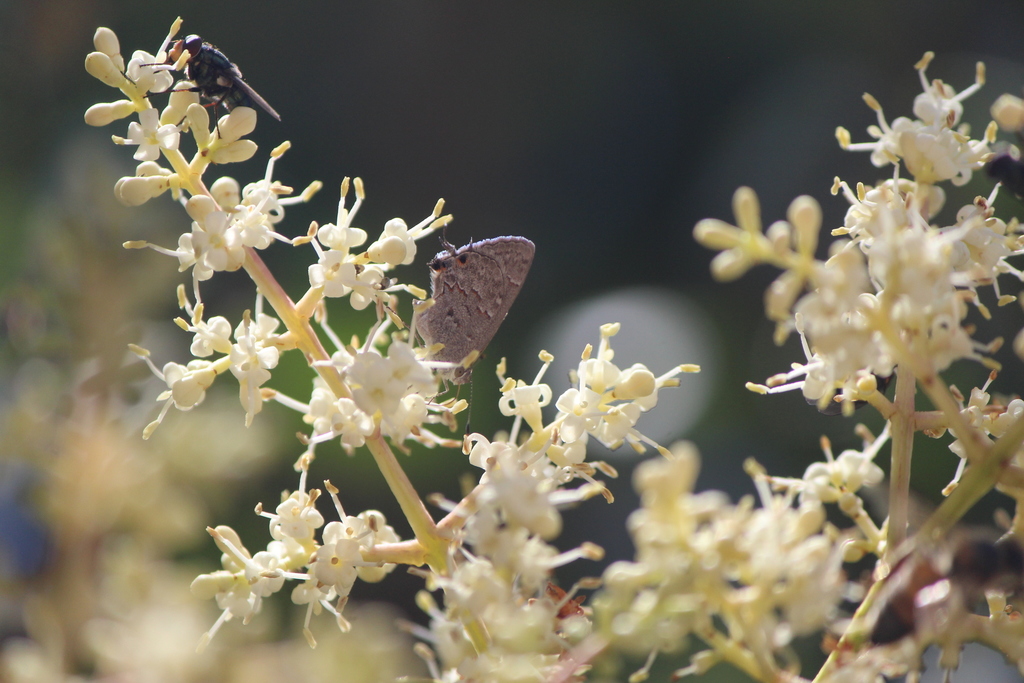
(c) José Belem Hernández Díaz, some rights reserved (CC BY) · licence
Family: Lycaenidae · Class: Insecta · Order: Lepidoptera
Ministrymon leda (Leda Ministreak) is a California animal in the Lycaenidae family.
The Leda Ministreak is a small butterfly in the hairstreak family Lycaenidae. Adults have a wingspan of approximately 20-25 mm (0.8-1.0 inches). The dorsal wing surfaces are typically dark brown to grayish-brown, while the ventral surfaces display a more complex pattern with pale gray to whitish ground color marked by thin, dark postmedial lines. Like other ministreaks, this species lacks the prominent tail-like extensions found on many hairstreak butterflies, giving the hindwings a more rounded appearance. Males and females are similar in size and coloration, though females may be slightly larger. The Leda Ministreak ranges from Mexico and Baja California north into southern Arizona and southern California. Within California, the species occurs primarily in the southeastern desert regions, including portions of Imperial, Riverside, and San Bernardino counties. The northernmost populations extend into the Coachella Valley and adjacent desert areas. This distribution represents the northern limit of the species' range, which continues southward through the Sonoran Desert region of Mexico. This species inhabits arid desert environments where its host plants occur, typically below 1,500 feet (457 meters) elevation. The butterfly is closely associated with mesquite woodland and desert wash habitats where mesquite trees (Prosopis species) in the pea family (Fabaceae) are established. These areas often occur along ephemeral streams, desert washes, and in low-lying areas where underground water supports mesquite growth. The habitat is characterized by sparse vegetation, sandy or gravelly soils, and extreme temperature variations. Leda Ministreak larvae are specialized feeders on mesquite trees, with documented use of honey mesquite (Prosopis glandulosa) and screwbean mesquite (Prosopis pubescens). Caterpillars feed on flowers, developing seed pods, and young leaves of their host plants. The species likely produces multiple broods per year in suitable habitat, with adult flight periods coinciding with mesquite flowering and fruiting cycles, typically from spring through fall when temperatures and host plant phenology are favorable. Adults are relatively small and quick-flying, often observed near their host plants during feeding and oviposition activities. The Leda Ministreak does not currently hold federal or state listing status in California or elsewhere in its range. However, like many desert-adapted species with specialized habitat requirements, populations may be vulnerable to habitat modification and loss. Primary potential threats include urban development in desert areas, water diversions that affect mesquite woodland health, invasive plant species that alter desert ecosystems, and climate change impacts on precipitation patterns in arid regions. The species' dependence on mesquite trees makes it particularly sensitive to changes in groundwater availability and desert wash habitat integrity. Limited survey data exists for this species in California, making population trend assessment difficult.
Classification
Class: Insecta · Order: Lepidoptera · Family: Lycaenidae
Frequently asked questions
How is Ministrymon leda classified?
Ministrymon leda belongs to class Insecta, order Lepidoptera, family Lycaenidae.
What family does Ministrymon leda belong to?
Ministrymon leda is in the Lycaenidae family.
What is Ministrymon leda?
The Leda Ministreak is a small butterfly in the hairstreak family Lycaenidae.
Is Ministrymon leda found in California?
Yes. Ministrymon leda is recorded in California in The California Species Project's catalogue.
Related species
Other California species in the same genus, family, or bioregion.
Data from The California Species Project — 14,000+ California species with verified data from CNPS, CDFW, USFWS, and more.