Mirounga angustirostris
Northern Elephant Sea
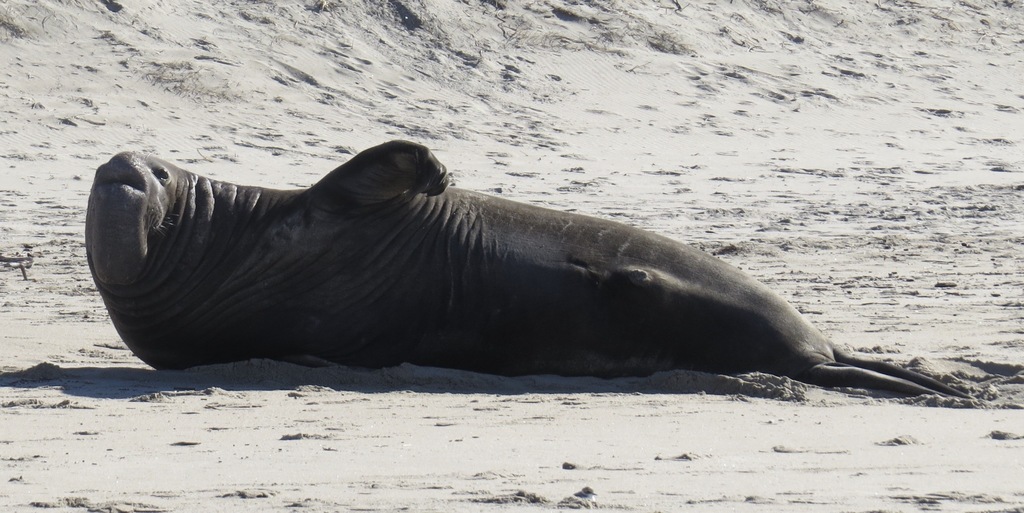
(c) Garth Harwood, some rights reserved (CC BY) · licence
Family: Phocidae · Class: Mammalia · Order: Carnivora
Conservation status: FP
Mirounga angustirostris (Northern Elephant Sea) is a California animal in the Phocidae family.
The northern elephant seal is the largest pinniped species in the Northern Hemisphere and exhibits extreme sexual dimorphism. Adult males can reach 4.5 to 5 meters (14.8 to 16.4 feet) in length and weigh up to 2,300 kilograms (5,070 pounds), while females are considerably smaller at 2.5 to 3 meters (8.2 to 9.8 feet) and 400 to 800 kilograms (880 to 1,760 pounds). Males develop a distinctive inflatable proboscis, or trunk, used for vocalizations during breeding season. Both sexes have a dark gray to brown pelage that molts annually. Northern elephant seals are found in the coastal waters of the Pacific Ocean from the Gulf of Alaska to Baja California, Mexico (Animal Diversity Web). The species breeds and gives birth primarily on offshore islands in California and Baja California (NOAA Fisheries 2021). Major breeding colonies in California occur on the Channel Islands, Año Nuevo Island, and the Farallon Islands. The population has expanded northward since recovery, with animals now regularly observed along the Oregon and Washington coasts. Breeding occurs on sandy beaches and rocky shores of offshore islands and some mainland locations. During non-breeding periods, northern elephant seals are pelagic, spending months at sea in deep oceanic waters. They prefer areas with continental shelf and slope waters where they can access their primary prey. The species undertakes extensive migrations, with some individuals traveling over 20,000 kilometers annually between feeding and breeding areas. Northern elephant seals are deep-diving predators that feed primarily on squid, fish, and occasionally crustaceans in the mesopelagic zone. They are capable of diving to depths exceeding 1,500 meters and remaining submerged for over two hours. Males and females have different foraging strategies and areas, with males typically foraging along the continental margin while females travel to more pelagic waters. Breeding occurs during winter months, with a single pup born between late December and February, primarily in February (NatureServe). Pups are weaned after approximately four weeks, and mating occurs shortly before weaning. The species exhibits a polygynous mating system with dominant males controlling access to females. Once near extinction due to hunting pressure in the 19th century, with populations reduced to fewer than 100 individuals, northern elephant seals have made a significant recovery. The species is protected under the Marine Mammal Protection Act and is currently listed as Fully Protected under California state law. According to NOAA stock assessments, the California breeding population was estimated at approximately 187,386 individuals in 2021 (NOAA Fisheries 2021). The population is considered stable and is not currently tracked by the California Natural Diversity Database. Primary current threats include entanglement in fishing gear, ship strikes, pollution, and potential impacts from climate change affecting prey availability and breeding habitat.
Classification
Class: Mammalia · Order: Carnivora · Family: Phocidae
Conservation status
FP
Frequently asked questions
How is Mirounga angustirostris classified?
Mirounga angustirostris belongs to class Mammalia, order Carnivora, family Phocidae.
What family does Mirounga angustirostris belong to?
Mirounga angustirostris is in the Phocidae family.
Is Mirounga angustirostris protected or of conservation concern?
Mirounga angustirostris carries the following status: FP.
What is Mirounga angustirostris?
The northern elephant seal is the largest pinniped species in the Northern Hemisphere and exhibits extreme sexual dimorphism.
Is Mirounga angustirostris found in California?
Yes. Mirounga angustirostris is recorded in California in The California Species Project's catalogue.
Related species
Other California species in the same genus, family, or bioregion.
Data from The California Species Project — 14,000+ California species with verified data from CNPS, CDFW, USFWS, and more.