Mirounga anustirostris
Northern Elephant Seal
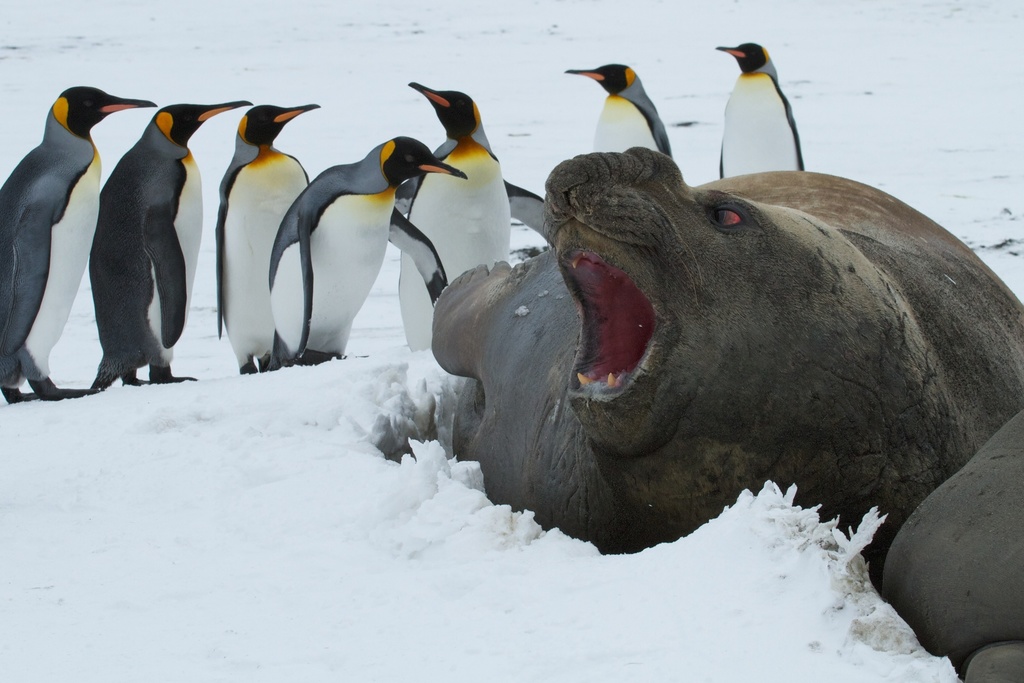
(c) Brian Gratwicke, some rights reserved (CC BY) · licence
Family: Phocidae · Class: Mammalia · Order: Carnivora
Mirounga anustirostris (Northern Elephant Seal) is a California animal in the Phocidae family.
The northern elephant seal is the largest pinniped in North America and the second-largest seal species globally. Adult males can reach lengths of 4 to 5 meters (13 to 16 feet) and weigh 1,500 to 2,300 kilograms (3,300 to 5,100 pounds), while females are considerably smaller at 2.5 to 3 meters (8 to 10 feet) long and 400 to 800 kilograms (880 to 1,760 pounds). Males develop a distinctive inflatable proboscis or trunk-like nose that gives the species its name, which becomes prominent during the breeding season. Both sexes have a brownish-gray coloration that darkens when wet, with males typically darker than females. Pups are born with black fur that molts to a light silver color when weaned at approximately 6 weeks of age. Northern elephant seals range along the Pacific coast from Baja California, Mexico, to the Gulf of Alaska. The species breeds primarily on islands and remote beaches from central Baja California to Point Reyes, California. Major breeding colonies in California include Año Nuevo State Marine Reserve, where thousands come ashore annually, and Piedras Blancas State Marine Reserve, which hosts the largest concentration of elephant seals south of Año Nuevo. Additional significant populations occur at the Farallon Islands, Point Reyes, and various Channel Islands. Outside the breeding season, these seals disperse widely across the North Pacific Ocean for foraging. Breeding habitat consists of sandy beaches, rocky shores, and offshore islands that provide protection from terrestrial predators and human disturbance. Northern elephant seals prefer areas with minimal wave action during pupping season. At sea, they inhabit pelagic waters and are among the deepest diving marine mammals, regularly reaching depths exceeding 1,000 meters (3,280 feet) while foraging. Northern elephant seals exhibit a highly seasonal breeding cycle. Females arrive at rookeries from December through February to give birth to a single pup, typically in February. Pups nurse for approximately 4 weeks on extremely rich milk containing up to 55% fat content, gaining weight rapidly while mothers fast and lose substantial body mass. Mating occurs shortly before weaning, with dominant bulls maintaining harems of 30 to 100 females. During breeding and molting periods on land, elephant seals fast completely, relying on stored blubber for energy. Adults undergo an annual molt from April through August, spending several weeks on shore while shedding their hair and outer skin layer. The species feeds primarily on deep-water squid, fish, and occasionally crustaceans during extended foraging trips that can last 2 to 8 months. Females typically forage in more northern waters, while males often travel to areas near the Aleutian Islands. Northern elephant seals are protected throughout their range under the Marine Mammal Protection Act. The species represents one of conservation's notable success stories, having recovered from near extinction in the 1890s when fewer than 100 individuals remained. Current population estimates indicate approximately 200,000 to 250,000 individuals. Primary threats include entanglement in fishing gear, ship strikes, pollution, and climate change impacts on prey distribution. NOAA Fisheries conducts ongoing research on the species' biology, behavior, and ecology to support conservation efforts.
Classification
Class: Mammalia · Order: Carnivora · Family: Phocidae
Frequently asked questions
How is Mirounga anustirostris classified?
Mirounga anustirostris belongs to class Mammalia, order Carnivora, family Phocidae.
What family does Mirounga anustirostris belong to?
Mirounga anustirostris is in the Phocidae family.
What is Mirounga anustirostris?
The northern elephant seal is the largest pinniped in North America and the second-largest seal species globally.
Is Mirounga anustirostris found in California?
Yes. Mirounga anustirostris is recorded in California in The California Species Project's catalogue.
Related species
Other California species in the same genus, family, or bioregion.
Data from The California Species Project — 14,000+ California species with verified data from CNPS, CDFW, USFWS, and more.