Mischocyttarus flavitarsis
Western Paper Wasp
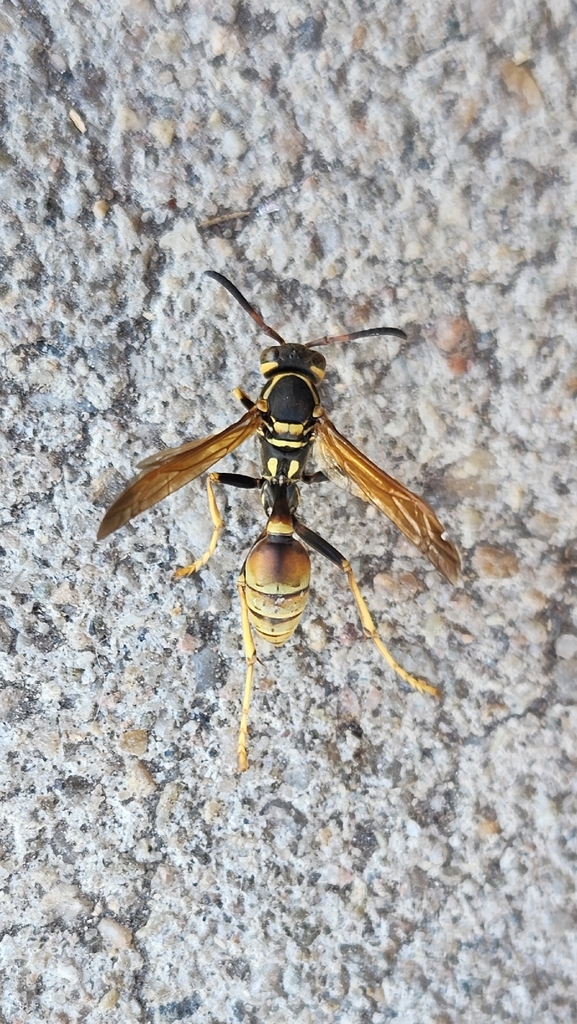
(c) ayden, some rights reserved (CC BY) · licence
Family: Vespidae · Class: Insecta · Order: Hymenoptera
Mischocyttarus flavitarsis (Western Paper Wasp) is a California animal in the Vespidae family.
The Western Paper Wasp is a moderately sized social wasp measuring 25 to 30 mm in length. This species exhibits the characteristic elongated waist typical of the genus Mischocyttarus, distinguishing it from other paper wasps in the family Vespidae. The body is predominantly brown to reddish-brown with yellow markings, and the legs display the yellowish coloration that gives the species its Latin name flavitarsis, meaning "yellow-footed." Mischocyttarus flavitarsis occurs across the western United States, with documented populations extending from California through Arizona and into New Mexico. In California, the species has been recorded in mixed oak and chaparral habitats, typically at moderate elevations. The distribution appears to be associated with warmer, drier regions of the American Southwest, where suitable nesting sites and prey resources are available. This species inhabits diverse vegetation communities including oak woodland, chaparral, and pine-oak-juniper forests. Observations indicate a preference for areas with mixed vegetation that provides both nesting materials and hunting grounds. The wasps utilize protected locations for colony establishment, often selecting sites sheltered from direct precipitation while maintaining accessibility to foraging areas. Western Paper Wasps are social insects that construct small paper nests from chewed plant fibers mixed with saliva. Colonies are typically smaller than those of many Polistes species, with founding queens establishing nests in spring and workers emerging to assist with brood care and foraging activities (Little 1979). The species exhibits semi-social behavior, with colonies persisting through the warmer months before declining in late fall. Adults are predators that hunt caterpillars and other soft-bodied arthropods to provision their larvae, making them beneficial for natural pest control. Reproductive biology follows typical polistine patterns, with mated queens overwintering in protected locations and emerging in spring to establish new colonies. Egg-laying and larval development occur throughout the active season, with multiple generations possible in favorable climates. The species faces parasitism pressure from pyralid moths, particularly Chalcoela iphitalis, whose larvae attack wasp broods within the nest (Little 1979). Mischocyttarus flavitarsis does not appear on federal or state conservation lists and is not considered threatened. Population trends are not well documented, though the species appears to maintain stable populations throughout its range. As a beneficial predator, the Western Paper Wasp contributes to ecosystem balance by controlling herbivorous insect populations. Climate change and habitat modification represent potential long-term concerns, particularly in areas experiencing increased urbanization or altered precipitation patterns that could affect nesting site availability and prey abundance.
Classification
Class: Insecta · Order: Hymenoptera · Family: Vespidae
Frequently asked questions
How is Mischocyttarus flavitarsis classified?
Mischocyttarus flavitarsis belongs to class Insecta, order Hymenoptera, family Vespidae.
What family does Mischocyttarus flavitarsis belong to?
Mischocyttarus flavitarsis is in the Vespidae family.
What is Mischocyttarus flavitarsis?
The Western Paper Wasp is a moderately sized social wasp measuring 25 to 30 mm in length.
Is Mischocyttarus flavitarsis found in California?
Yes. Mischocyttarus flavitarsis is recorded in California in The California Species Project's catalogue.
Related species
Other California species in the same genus, family, or bioregion.
Data from The California Species Project — 14,000+ California species with verified data from CNPS, CDFW, USFWS, and more.