Misumena vatia
Goldenrod Crab Spider
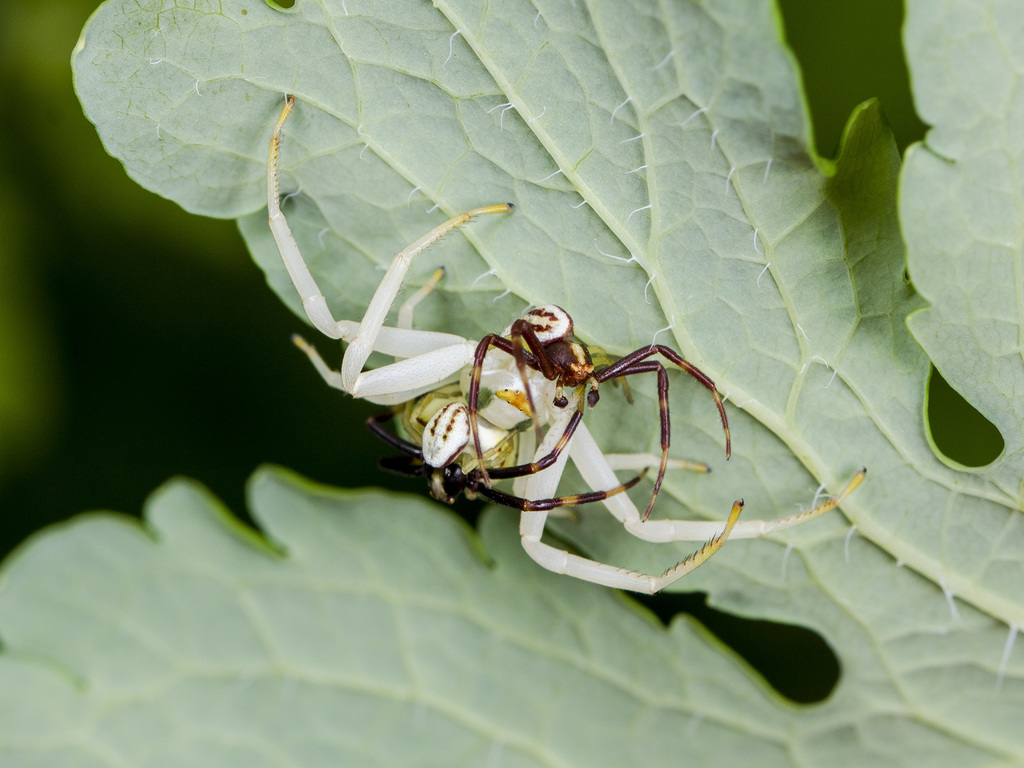
(c) Анатолий Озерной /Anatoly Ozernoy, some rights reserved (CC BY-SA) · licence
Family: Thomisidae · Class: Arachnida · Order: Araneae
Misumena vatia (Goldenrod Crab Spider) is a California animal in the Thomisidae family.
The goldenrod crab spider is a small thomisid spider exhibiting pronounced sexual dimorphism in size and coloration. Females measure 6 to 9 mm in body length, while males are considerably smaller at 2.9 to 4 mm (BugGuide). Females display variable coloration with a white to yellow carapace featuring darker sides and an eye region often tinged with red. The abdomen matches the carapace color, sometimes unmarked but frequently bearing red bands on both sides. Legs are typically light-colored. Males present distinctly different coloration with a red to reddish-brown carapace marked by a central white spot extending to the eyes and clypeus. The first two pairs of legs are reddish-brown while the posterior legs are yellow. Male abdomens feature paired dorsal and lateral red bands on a white background (BugGuide). Misumena vatia occurs throughout much of North America, with documented populations across the continental United States and southern Canada. In California, the species has been recorded from various locations including San Benito County, where specimens have been observed in live oak and chaparral habitats (BugGuide). The species demonstrates a broad distribution pattern consistent with its adaptability to diverse environmental conditions. This crab spider inhabits a wide range of vegetation types, showing particular association with flowering plants. The common name reflects its frequent occurrence on goldenrod (Solidago species), though the species utilizes numerous other flowering hosts. California observations include specimens on cultivated plants such as Argyranthemum frutescens in garden settings within oak woodland and chaparral communities (BugGuide). The species adapts to both natural and anthropogenic environments, utilizing ornamental plantings in addition to native vegetation. Goldenrod crab spiders are ambush predators that position themselves on flowers to capture visiting prey. Females possess the ability to change coloration between white and yellow over several days to match their floral substrate, enhancing their camouflage while hunting. This color-changing capability involves the movement of pigment within specialized cells. The species employs a sit-and-wait strategy, remaining motionless on flowers until prey approaches within striking distance. Reproduction involves the construction of silk egg sacs, typically placed in protected locations within the vegetation. Males are considerably more active than females, often moving between plants in search of mates. Misumena vatia holds a NatureServe global conservation status of G5, indicating the species is secure globally with no significant conservation concerns (NatureServe). The species' wide distribution, habitat flexibility, and apparent stable populations across its range support this assessment. No federal or state listing status applies to this species, and it faces no immediate conservation threats. The spider's adaptability to both natural and modified habitats, including urban gardens and agricultural areas, contributes to its conservation security. Climate change and habitat modification represent potential long-term considerations, though current evidence suggests the species maintains stable populations throughout its range.
Classification
Class: Arachnida · Order: Araneae · Family: Thomisidae
Frequently asked questions
How is Misumena vatia classified?
Misumena vatia belongs to class Arachnida, order Araneae, family Thomisidae.
What family does Misumena vatia belong to?
Misumena vatia is in the Thomisidae family.
What is Misumena vatia?
The goldenrod crab spider is a small thomisid spider exhibiting pronounced sexual dimorphism in size and coloration.
Is Misumena vatia found in California?
Yes. Misumena vatia is recorded in California in The California Species Project's catalogue.
Related species
Other California species in the same genus, family, or bioregion.
Data from The California Species Project — 14,000+ California species with verified data from CNPS, CDFW, USFWS, and more.