Moapa coriacea
Moapa dace
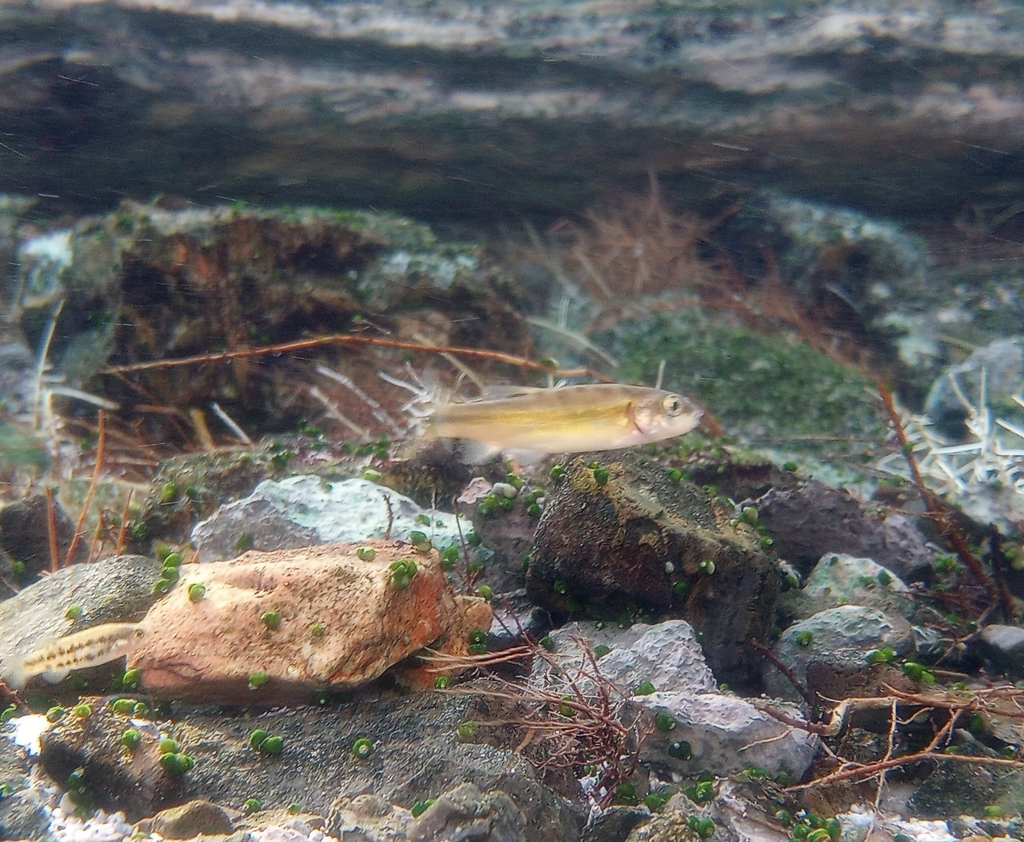
(c) Mike Ostrowski, some rights reserved (CC BY-SA) · licence
Family: Unknown · Class: Actinopterygii · Order: Unknown
Conservation status: Endangered
Moapa coriacea (Moapa dace) is a California animal in the Unknown family.
The Moapa dace is a small freshwater fish endemic to the thermal spring systems of the Muddy River in Clark County, Nevada. Adults measure approximately 7.6 cm (3 inches) in length, with an iridescent gold or bronze coloration on the back and sides marked by a distinctive dark middorsal stripe. A prominent black spot occurs at the base of the caudal fin, providing a key identifying characteristic (USFWS Moapa Valley NWR). The species is restricted to the Warm Springs area of Clark County, Nevada, where it inhabits the headwaters of the Muddy River system. Historically, Moapa dace occurred in approximately 25 springs and 16 km of the upper Muddy River (USFWS 1996). The species' range has been significantly reduced from its historical distribution, with current populations confined to three springs and less than 3.2 km of tributary and main stem habitat within the thermal spring provinces that form the Muddy River headwaters. Moapa dace occupy a highly specialized thermal habitat with water temperatures ranging from 19.4 to 30.5°C (67 to 86.9°F), generally decreasing with distance from spring sources. At Pedersen Spring, monthly temperature averages range from 30.1 to 32.7°C (86.2 to 90.8°F) (USFWS 2024). The species requires warm spring outflows and their associated stream systems, with habitat restricted to areas where water temperatures remain within this narrow thermal range. Downstream areas of the Muddy River have become unsuitable due to habitat modifications and the presence of introduced fish species. As the sole member of the genus Moapa, this species represents a unique evolutionary lineage. Moapa dace feed opportunistically on aquatic invertebrates and small organisms found in their spring-fed habitat. The species' reproductive biology and specific dietary preferences remain incompletely documented, though spawning likely occurs in the warmer months when spring flows provide optimal conditions. The U.S. Fish and Wildlife Service listed Moapa dace as endangered on March 11, 1967, under the Endangered Species Preservation Act, making it one of the first fish species to receive federal protection. The species maintains a recovery priority ranking of 1, the highest designation due to its taxonomic uniqueness and severe population decline (USFWS 1996). When the original recovery plan was developed in 1983, the population was estimated at fewer than 1,000 individuals. Primary threats include habitat loss from water diversions, introduced species such as blue tilapia that compete for resources and degrade habitat, and the species' extremely limited range making it vulnerable to localized disturbances. The Moapa Valley National Wildlife Refuge was established specifically to protect this species and its thermal spring ecosystem. Recent surveys have documented severe population crashes in some spring systems, with the Apcar Spring population declining from over 500 individuals to fewer than 70 between 1997 and 1998 following blue tilapia invasion (Scoppettone et al. 1998).
Classification
Class: Actinopterygii · Order: Unknown · Family: Unknown
Conservation status
Endangered
Frequently asked questions
How is Moapa coriacea classified?
Moapa coriacea belongs to class Actinopterygii, order Unknown, family Unknown.
What family does Moapa coriacea belong to?
Moapa coriacea is in the Unknown family.
Is Moapa coriacea protected or of conservation concern?
Moapa coriacea carries the following status: Endangered.
What is Moapa coriacea?
The Moapa dace is a small freshwater fish endemic to the thermal spring systems of the Muddy River in Clark County, Nevada.
Is Moapa coriacea found in California?
Yes. Moapa coriacea is recorded in California in The California Species Project's catalogue.
Related species
Other California species in the same genus, family, or bioregion.
Data from The California Species Project — 14,000+ California species with verified data from CNPS, CDFW, USFWS, and more.