Molothrus ater
Brown-headed Cowbird
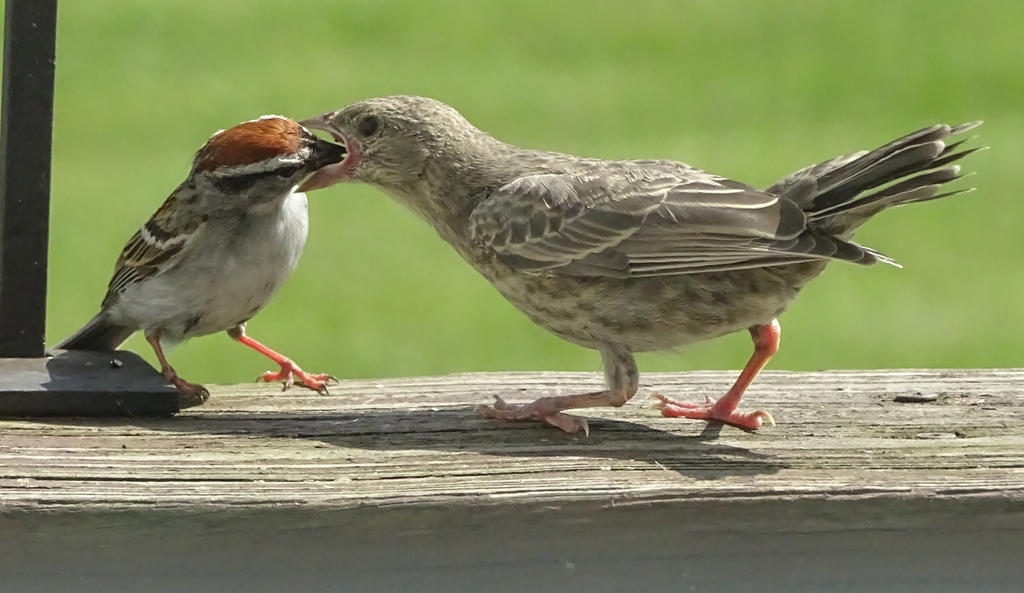
(c) Shirley Zundell, some rights reserved (CC BY) · licence
Family: Icteridae · Class: Aves · Order: Passeriformes
Molothrus ater (Brown-headed Cowbird) is a California animal in the Icteridae family.
The Brown-headed Cowbird is a medium-sized blackbird measuring 16 to 22 cm (6.3 to 8.7 inches) in length with a wingspan of 30 to 38 cm (12 to 15 inches). Males are glossy black with a distinctive brown head that appears chocolate-colored in good lighting. Females are smaller and uniformly grayish-brown with a lighter throat and subtle streaking on the underparts. Both sexes have dark eyes, a short, thick, conical bill adapted for seed-eating, and relatively short tails. Juveniles resemble females but show more prominent streaking and may have yellowish gapes. Brown-headed Cowbirds have one of the most extensive ranges of any North American bird. The species occurs throughout most of the United States and southern Canada, extending south into Mexico. In California, cowbirds are year-round residents and abundant throughout the state, from sea level to elevations exceeding 3,000 meters (9,800 feet). They inhabit all California counties and are present in virtually every habitat type except dense, unbroken forest. The species occupies diverse habitats including grasslands, agricultural areas, suburban landscapes, woodland edges, riparian corridors, and open forests. Brown-headed Cowbirds show strong association with areas where livestock graze, as they feed on insects stirred up by cattle and horses. They avoid dense forest interiors but readily use forest clearings and edges. Urban and suburban environments with scattered trees and open lawns provide suitable habitat. Brown-headed Cowbirds are obligate brood parasites, laying their eggs exclusively in the nests of other bird species. Females locate host nests during early morning hours, remove one host egg, and deposit a single cowbird egg. A single female may parasitize up to 40 nests per breeding season, laying 70 to 80 eggs annually. The species parasitizes over 220 documented host species, though smaller songbirds such as vireos, warblers, and sparrows are primary targets. Cowbird eggs typically hatch earlier than host eggs, and the larger cowbird nestling often outcompetes host young for food. The diet consists primarily of seeds from grasses and forbs, supplemented with insects, especially during the breeding season. Cowbirds forage on the ground in flocks, often following grazing animals to capture disturbed arthropods. The species forms large communal roosts outside the breeding season, sometimes numbering in the thousands. Brown-headed Cowbirds are not federally or state listed and maintain stable, widespread populations. However, their brood parasitism significantly impacts many host species, particularly those with small population sizes or limited ranges. The cowbird's expansion into new habitats, facilitated by forest fragmentation and agricultural development, has increased parasitism pressure on numerous songbird species. Some endangered species, including the Black-capped Vireo and Kirtland's Warbler, have required cowbird control programs as part of recovery efforts. In California, cowbird management is sometimes implemented to protect sensitive species such as the Least Bell's Vireo and Southwestern Willow Flycatcher in riparian restoration areas.
Classification
Class: Aves · Order: Passeriformes · Family: Icteridae
Frequently asked questions
How is Molothrus ater classified?
Molothrus ater belongs to class Aves, order Passeriformes, family Icteridae.
What family does Molothrus ater belong to?
Molothrus ater is in the Icteridae family.
What is Molothrus ater?
The Brown-headed Cowbird is a medium-sized blackbird measuring 16 to 22 cm (6.3 to 8.7 inches) in length with a wingspan of 30 to 38 cm (12 to 15 inches).
Is Molothrus ater found in California?
Yes. Molothrus ater is recorded in California in The California Species Project's catalogue.
Related species
Other California species in the same genus, family, or bioregion.
Data from The California Species Project — 14,000+ California species with verified data from CNPS, CDFW, USFWS, and more.