Monadenia churchi
Klamath Sideband
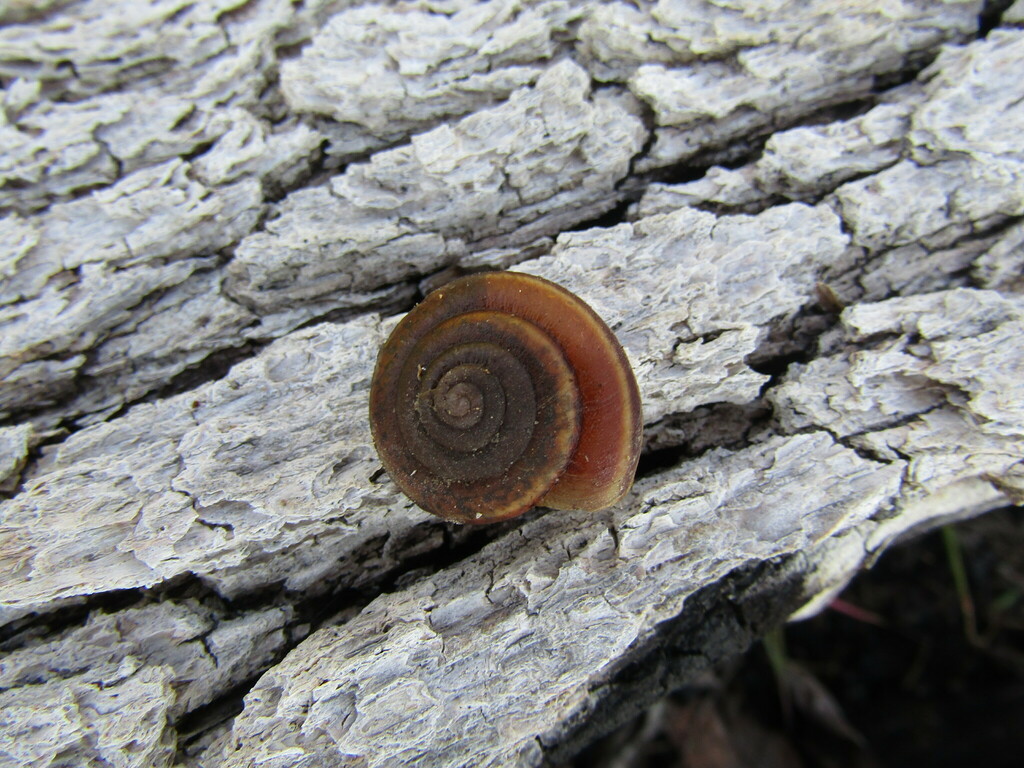
(c) Matt D'Agrosa, some rights reserved (CC BY) · licence
Family: Xanthonychidae · Class: Gastropoda · Order: Stylommatophora
Conservation status: G3 S3
Monadenia churchi (Klamath Sideband) is a California animal in the Xanthonychidae family.
The Klamath sideband is a terrestrial gastropod mollusc in the family Xanthonychidae, endemic to northern California. This snail species belongs to the genus Monadenia, which comprises several sideband snails found throughout the western United States. The species was named after its discoverer and represents one of several closely related sideband species in the region. Monadenia churchi is distributed within the Greater Trinity Basin watershed in northern California, with populations documented in Humboldt, Mendocino, Shasta, Siskiyou, Tehama, and Trinity counties (Sullivan 2021). The species occurs within the Klamath Bioregion, an area that encompasses much of the Shasta-Trinity and Six Rivers National Forests. This distribution overlaps spatially with the Trinity bristle snail (M. setosa) in the south-central portion of the Greater Trinity Basin, where both species maintain coincident populations. The Klamath sideband inhabits diverse habitat types within forested ecosystems. According to NatureServe, this species is found mostly in limestone outcrops, caves, talus slides, and lava rockslides, but also occurs under forest debris in heavy cover. The species occupies areas within Klamath montane and Douglas fir forests, white fir associations, and mixed conifer habitats. Vegetation communities in its range include tanoak and canyon live oak cover types, extending through montane hardwoods and chaparral assemblages at lower elevations. The snail's preference for limestone formations and rocky substrates suggests specific microhabitat requirements related to calcium availability and moisture retention. Limited ecological information is available for M. churchi, though studies indicate it coexists with other terrestrial gastropods in forest ecosystems. Research has documented spatial relationships between Church's sideband and Trinity bristle snail populations, suggesting similar ecological niches within their shared range. Like other Monadenia species, this snail likely feeds on decomposing organic matter, fungi, and microorganisms found in leaf litter and soil. Reproductive biology and seasonal activity patterns have not been thoroughly documented for this species. The Klamath sideband carries a global conservation rank of G3 and state rank of S3, indicating it is vulnerable to extirpation. These rankings suggest the species faces moderate risk due to restricted range, habitat specificity, and potential threats. The snail's dependence on limestone formations and forest habitats makes it susceptible to habitat alteration from logging, mining, and land development activities. Climate change may also impact this species through altered precipitation patterns and temperature regimes that affect soil moisture levels critical for terrestrial gastropod survival. The species' narrow distribution within the Greater Trinity Basin further increases its vulnerability to local environmental changes. Scientific documentation for this species remains limited compared to more widely studied gastropods. Continued research is needed to better understand population dynamics, habitat requirements, and conservation needs. The co-occurrence with other sensitive snail species in the region highlights the importance of maintaining intact forest ecosystems and limestone habitat features for terrestrial gastropod conservation in northern California.
Classification
Class: Gastropoda · Order: Stylommatophora · Family: Xanthonychidae
Conservation status
G3 S3
Frequently asked questions
How is Monadenia churchi classified?
Monadenia churchi belongs to class Gastropoda, order Stylommatophora, family Xanthonychidae.
What family does Monadenia churchi belong to?
Monadenia churchi is in the Xanthonychidae family.
Is Monadenia churchi protected or of conservation concern?
Monadenia churchi carries the following status: G3 S3.
What is Monadenia churchi?
The Klamath sideband is a terrestrial gastropod mollusc in the family Xanthonychidae, endemic to northern California.
Is Monadenia churchi found in California?
Yes. Monadenia churchi is recorded in California in The California Species Project's catalogue.
Related species
Other California species in the same genus, family, or bioregion.
Data from The California Species Project — 14,000+ California species with verified data from CNPS, CDFW, USFWS, and more.