Monadenia circumcarinata
Keeled Sideband Snail
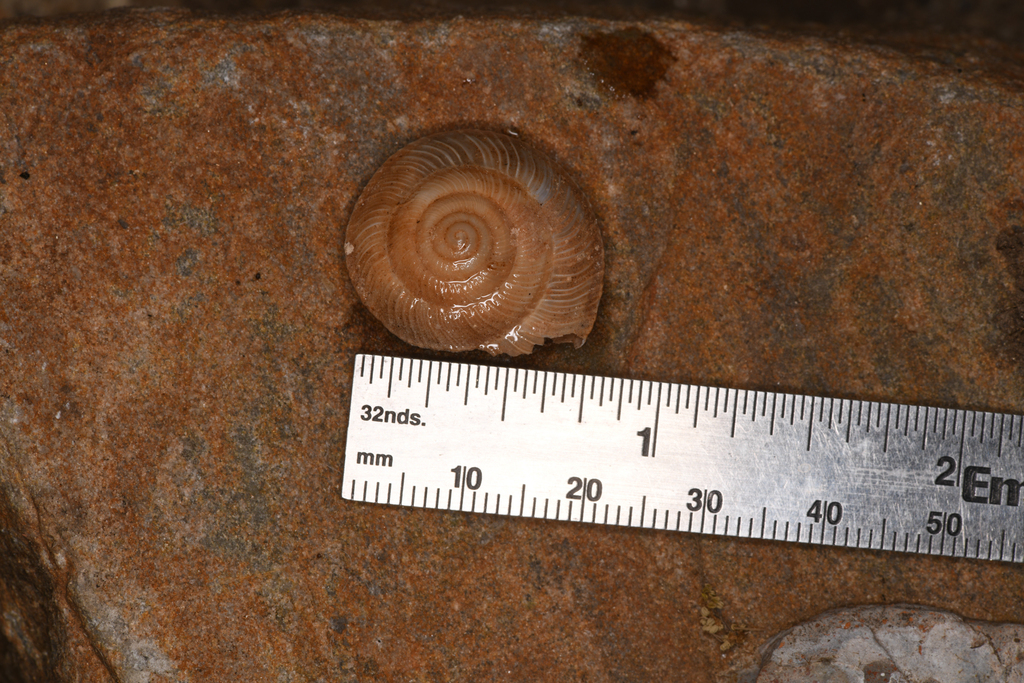
(c) Trevor Van Loon, some rights reserved (CC BY) · licence
Family: Xanthonychidae · Class: Gastropoda · Order: Stylommatophora
Conservation status: G3 S3
Monadenia circumcarinata (Keeled Sideband Snail) is a California animal in the Xanthonychidae family.
The keeled sideband snail is a terrestrial gastropod mollusk belonging to the family Xanthonychidae. This species is characterized by its distinctive shell morphology, which features a prominent keel or ridge around the periphery of the whorl, giving the species its common name. The shell is typically medium-sized for terrestrial snails in the genus Monadenia, with a flattened spire and relatively wide aperture. Monadenia circumcarinata is endemic to California, where it occurs in a highly restricted geographic range. The species' distribution is considerably narrower than related taxa such as Monadenia fidelis, which occurs along the Pacific coast from southeastern Alaska to northern California. The specific counties and elevational range where this species occurs have not been well documented in the scientific literature. Habitat requirements for this species remain poorly documented. Like other members of the genus Monadenia, it presumably occurs in forested or woodland environments where adequate moisture and shelter are available. Many terrestrial gastropods require calcium-rich substrates for shell development, though specific substrate preferences for M. circumcarinata have not been scientifically established. As a terrestrial gastropod, the keeled sideband snail is presumed to be herbivorous, feeding on decaying plant matter, fungi, and microorganisms typical of forest floor ecosystems. Like other Monadenia species, this snail likely exhibits seasonal activity patterns influenced by moisture availability, being most active during periods of adequate humidity. Reproduction in terrestrial snails typically involves the deposition of eggs in moist soil or under protective cover such as logs or rock crevices, though specific reproductive ecology for this species has not been documented. The conservation status of Monadenia circumcarinata is not well established. The species does not currently appear on federal threatened or endangered species lists, nor does it have a formal conservation status designation from California Department of Fish and Wildlife. Its presumably restricted range and the general vulnerability of terrestrial gastropods to habitat modification suggest it may warrant conservation attention, but population data and trend information are not available. Scientific documentation for this species remains extremely limited. Detailed ecological studies, population assessments, and habitat characterization are lacking. Much of its specific biology, including population size, reproductive ecology, precise habitat requirements, and current distribution, requires further research. The species exemplifies the knowledge gaps that exist for many of California's terrestrial gastropod fauna, particularly those with restricted ranges. We welcome contributions of verified scientific data, field observations, or photographs to help improve this species account.
Classification
Class: Gastropoda · Order: Stylommatophora · Family: Xanthonychidae
Conservation status
G3 S3
Frequently asked questions
How is Monadenia circumcarinata classified?
Monadenia circumcarinata belongs to class Gastropoda, order Stylommatophora, family Xanthonychidae.
What family does Monadenia circumcarinata belong to?
Monadenia circumcarinata is in the Xanthonychidae family.
Is Monadenia circumcarinata protected or of conservation concern?
Monadenia circumcarinata carries the following status: G3 S3.
What is Monadenia circumcarinata?
The keeled sideband snail is a terrestrial gastropod mollusk belonging to the family Xanthonychidae.
Is Monadenia circumcarinata found in California?
Yes. Monadenia circumcarinata is recorded in California in The California Species Project's catalogue.
Related species
Other California species in the same genus, family, or bioregion.
Data from The California Species Project — 14,000+ California species with verified data from CNPS, CDFW, USFWS, and more.