Monadenia infumata setosa
Trinity bristle snail
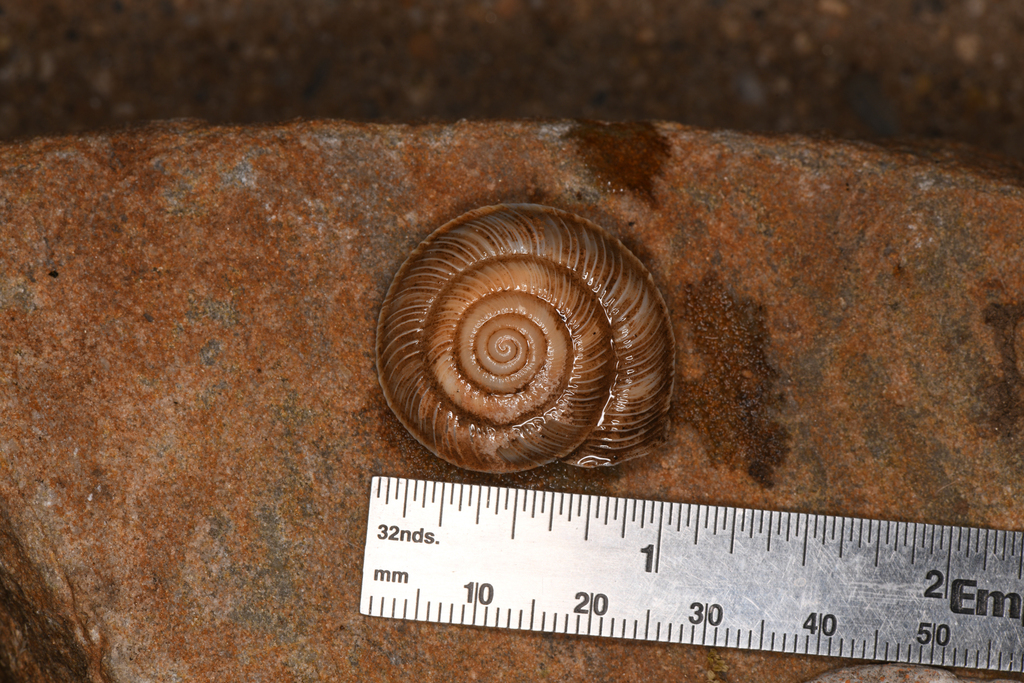
(c) Trevor Van Loon, some rights reserved (CC BY) · licence
Family: Xanthonychidae · Class: Gastropoda · Order: Stylommatophora
Conservation status: ST · G2T2 S2
Monadenia infumata setosa (Trinity bristle snail) is a California animal in the Xanthonychidae family.
The Trinity bristle snail is a large terrestrial gastropod endemic to northern California's Trinity County region. This forest-dwelling species represents a subspecies of Monadenia infumata, distinguished by its bristle-like structures and substantial size among California's native land snails. The shell exhibits the typical characteristics of the Monadenia genus, though specific morphometric details for this subspecies remain undocumented in available literature. The species occurs exclusively within the Greater Trinity Basin of northern California, with its current range estimated at approximately 1,484 square kilometers, representing about 18% of Trinity County's total area of 8,307 square kilometers (California Fish and Wildlife Journal 2022). This distribution places the Trinity bristle snail within the Klamath Bioregion, where it occupies fragmented forest habitats across mountainous terrain. The subspecies' range appears to be naturally restricted, with no documented populations outside the Trinity Basin watershed. Trinity bristle snails inhabit mature forest ecosystems, showing strong associations with specific microhabitat conditions that support their survival and reproduction. Research indicates the species requires particular combinations of forest structure, moisture regimes, and substrate characteristics, though detailed habitat requirements have been the subject of ongoing scientific investigation (California Fish and Wildlife Journal 2022). The snails appear to be sensitive to habitat disturbance and fragmentation, which has implications for population connectivity across their limited range. Like other members of the Monadenia genus, the Trinity bristle snail consumes plants, fungi, and organic detritus (NatureServe 2025). Terrestrial gastropods typically exhibit limited mobility, moving primarily to locate food sources or reproductive partners, with olfaction serving as the primary sensory mechanism for navigation and resource detection. Specific reproductive behavior, seasonal activity patterns, and population dynamics for this subspecies have not been well documented in available scientific literature. The Trinity bristle snail is listed as threatened by the State of California, where it is officially recognized as Monadenia setosa according to California Department of Fish and Wildlife records. NatureServe assigns the subspecies a conservation rank of G2T2 S2, indicating it is imperiled both globally and within California, with fewer than 20 known occurrences or very few remaining individuals. The species faces ongoing threats from habitat loss, forest management practices, and wildfire impacts. Recent research has examined the effects of large-scale disturbances, including the Monument Fire, on suitable habitat within the Greater Trinity Basin (California Fish and Wildlife Journal 2022). Conservation efforts focus on habitat protection and developing management strategies that maintain the forest conditions necessary for the subspecies' persistence. The restricted range and specific habitat requirements make this gastropod particularly vulnerable to environmental changes and human activities that alter forest ecosystems in the Trinity Basin region.
Classification
Class: Gastropoda · Order: Stylommatophora · Family: Xanthonychidae
Conservation status
ST · G2T2 S2
Frequently asked questions
How is Monadenia infumata setosa classified?
Monadenia infumata setosa belongs to class Gastropoda, order Stylommatophora, family Xanthonychidae.
What family does Monadenia infumata setosa belong to?
Monadenia infumata setosa is in the Xanthonychidae family.
Is Monadenia infumata setosa protected or of conservation concern?
Monadenia infumata setosa carries the following status: ST · G2T2 S2.
What is Monadenia infumata setosa?
The Trinity bristle snail is a large terrestrial gastropod endemic to northern California's Trinity County region.
Is Monadenia infumata setosa found in California?
Yes. Monadenia infumata setosa is recorded in California in The California Species Project's catalogue.
Related species
Other California species in the same genus, family, or bioregion.
Data from The California Species Project — 14,000+ California species with verified data from CNPS, CDFW, USFWS, and more.