Monadenia mormonum hirsuta
Hirsute Sierra Sideband Snail
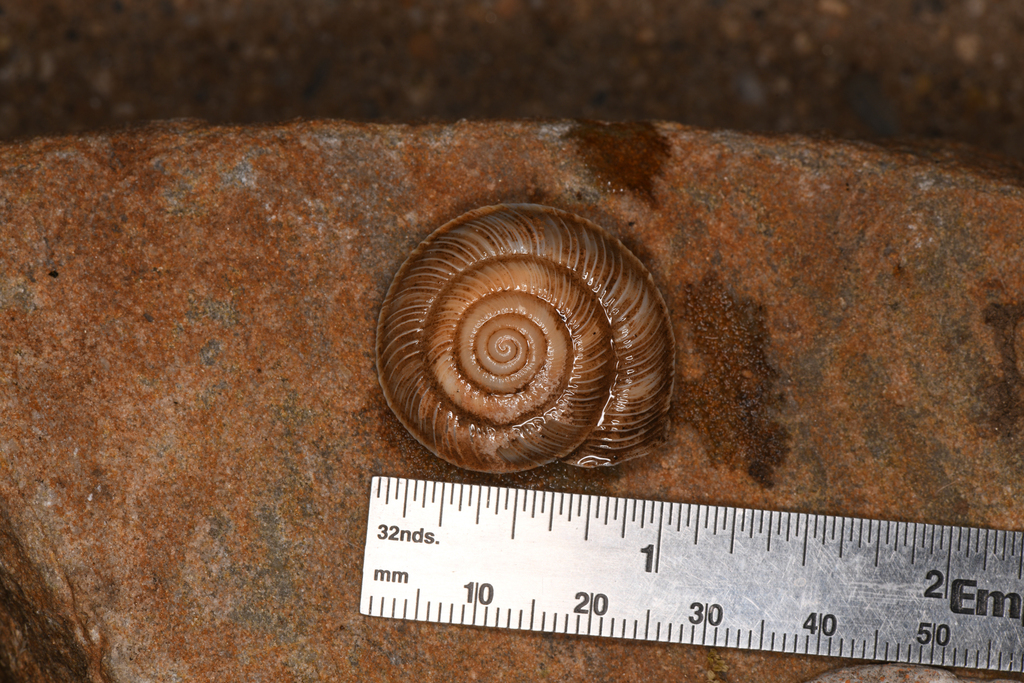
(c) Trevor Van Loon, some rights reserved (CC BY) · licence
Family: Xanthonychidae · Class: Gastropoda · Order: Stylommatophora
Conservation status: G2T1 S1
Monadenia mormonum hirsuta (Hirsute Sierra Sideband Snail) is a California animal in the Xanthonychidae family.
Monadenia mormonum hirsuta, the Hirsute Sierra Sideband Snail, is a terrestrial gastropod subspecies endemic to the Sierra Nevada mountains of California. This snail is characterized by its distinctively hairy or hirsute shell surface, from which its common name derives. The shell typically displays the characteristic sideband pattern common to the Monadenia genus, with spiral banding that distinguishes it from other related subspecies. Adult shells generally measure 15-25 millimeters in diameter, though specific morphometric data for this subspecies remains limited in the scientific literature. The Hirsute Sierra Sideband Snail is found exclusively in Tuolumne County, California, within the central Sierra Nevada range (NatureServe 2023). This restricted distribution makes it one of the more geographically limited subspecies within the Monadenia mormonum complex. The subspecies appears to occupy a narrow elevational band within the montane zone, though precise elevation ranges have not been comprehensively documented. Habitat requirements for this subspecies include mixed coniferous forests typical of the Sierra Nevada, particularly areas with adequate moisture retention and organic debris accumulation. Like other Monadenia species, it likely requires microhabitats with sufficient humidity, such as areas under logs, rocks, or dense leaf litter. The species probably favors north-facing slopes and riparian zones where moisture levels remain more consistent throughout the dry California summer months. Specific substrate preferences and vegetation associations remain poorly documented in the scientific literature. Behavioral and ecological information for Monadenia mormonum hirsuta is limited, but the subspecies likely follows patterns typical of Sierra Nevada terrestrial gastropods. Activity is presumably highest during spring and early summer when moisture conditions are optimal, with individuals becoming less active during the hot, dry summer and fall months. Reproduction likely occurs in late spring, with individuals depositing small clutches of eggs in moist soil or organic matter. The species is presumed to be herbivorous, feeding on decaying plant material, fungi, and possibly algae growing on bark and rock surfaces. The conservation status of the Hirsute Sierra Sideband Snail has not been formally assessed at federal or state levels, and it does not appear on current endangered species lists. However, the subspecies' extremely limited range within a single county makes it potentially vulnerable to habitat disturbance, climate change, and other environmental pressures. The Sierra Nevada region faces increasing threats from wildfire, drought, and development pressure, all of which could impact the moist microhabitats essential for terrestrial snail survival. Climate change poses particular concerns, as warming temperatures and altered precipitation patterns may reduce the availability of suitable humid microhabitats. Current population status and trends for this subspecies remain unknown due to limited survey effort and taxonomic uncertainty within the Monadenia mormonum complex. Additional research is needed to clarify the subspecies' distribution, habitat requirements, and conservation needs. The lack of comprehensive biological data highlights the need for systematic surveys and ecological studies of Sierra Nevada endemic gastropods.
Classification
Class: Gastropoda · Order: Stylommatophora · Family: Xanthonychidae
Conservation status
G2T1 S1
Frequently asked questions
How is Monadenia mormonum hirsuta classified?
Monadenia mormonum hirsuta belongs to class Gastropoda, order Stylommatophora, family Xanthonychidae.
What family does Monadenia mormonum hirsuta belong to?
Monadenia mormonum hirsuta is in the Xanthonychidae family.
Is Monadenia mormonum hirsuta protected or of conservation concern?
Monadenia mormonum hirsuta carries the following status: G2T1 S1.
What is Monadenia mormonum hirsuta?
Monadenia mormonum hirsuta, the Hirsute Sierra Sideband Snail, is a terrestrial gastropod subspecies endemic to the Sierra Nevada mountains of California.
Is Monadenia mormonum hirsuta found in California?
Yes. Monadenia mormonum hirsuta is recorded in California in The California Species Project's catalogue.
Related species
Other California species in the same genus, family, or bioregion.
Data from The California Species Project — 14,000+ California species with verified data from CNPS, CDFW, USFWS, and more.