Monadenia troglodytes wintu
Wintu Sideband
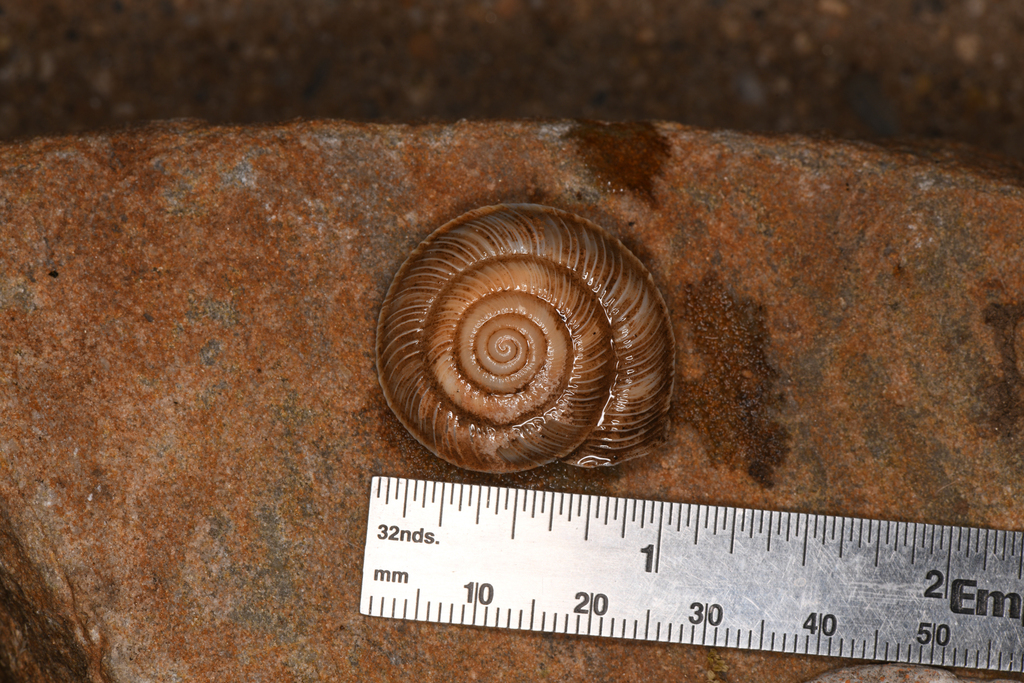
(c) Trevor Van Loon, some rights reserved (CC BY) · licence
Family: Xanthonychidae · Class: Gastropoda · Order: Stylommatophora
Conservation status: G2T2 S2
Monadenia troglodytes wintu (Wintu Sideband) is a California animal in the Xanthonychidae family.
The Wintu sideband is a terrestrial snail subspecies endemic to Shasta County, California. As a member of the family Xanthonychidae, this gastropod represents one of several rare mollusk taxa restricted to the limestone regions around Shasta Lake. The species exhibits the typical spiral shell morphology of sideband snails, though specific morphometric data for this subspecies remains limited in published literature. The Wintu sideband occurs at only eight known sites, with seven located along the Pit River arm of Shasta Lake (Burke et al. 1999; USDA and USDI 2007). Seven of these eight sites are situated on federal land managed by the U.S. Forest Service and other federal agencies. The subspecies' range is extremely restricted compared to its close relative, the Shasta sideband (Monadenia troglodytes troglodytes), which occupies adjacent areas in the same general region. This subspecies is apparently restricted to limestone outcrops and related calcareous substrates, showing strong geological specificity in its habitat requirements (FWS 2023). The snails are associated with caves, talus slopes, and rocky outcrops in open brushy areas and late-successional pine-oak woodland environments. These limestone-dependent habitats provide the calcium carbonate necessary for shell formation and likely offer the moist microclimatic conditions essential for terrestrial gastropod survival in this relatively arid region of northern California. Detailed ecological and behavioral information for the Wintu sideband remains limited in scientific literature. Like other terrestrial snails, the subspecies likely exhibits seasonal activity patterns tied to moisture availability, becoming most active during periods of adequate humidity. Reproductive biology, diet preferences, and specific microhabitat requirements have not been thoroughly documented, representing significant knowledge gaps for this rare taxon. The Wintu sideband currently holds a Global/State conservation rank of G2T2 S2, indicating it is imperiled both globally and within California. This species is included on the California Department of Fish and Wildlife's Special Animals List. The subspecies has been under review for federal listing under the Endangered Species Act since November 2022, with the U.S. Fish and Wildlife Service including it in the National Domestic Listing Workplan for fiscal year 2024 as part of the California Terrestrial Mollusks package. Primary threats include habitat loss and degradation from logging operations, road construction and maintenance activities, and recreational impacts (FWS 2023). According to NatureServe, the subspecies faces particular vulnerability from activities that alter moist microclimates, increase exposure to desiccation, and remove protective litter cover (NatureServe 2023). The potential expansion of Shasta Dam represents an additional threat that could impact remaining populations through habitat modification and hydrological changes in the Shasta Lake vicinity.
Classification
Class: Gastropoda · Order: Stylommatophora · Family: Xanthonychidae
Conservation status
G2T2 S2
Frequently asked questions
How is Monadenia troglodytes wintu classified?
Monadenia troglodytes wintu belongs to class Gastropoda, order Stylommatophora, family Xanthonychidae.
What family does Monadenia troglodytes wintu belong to?
Monadenia troglodytes wintu is in the Xanthonychidae family.
Is Monadenia troglodytes wintu protected or of conservation concern?
Monadenia troglodytes wintu carries the following status: G2T2 S2.
What is Monadenia troglodytes wintu?
The Wintu sideband is a terrestrial snail subspecies endemic to Shasta County, California.
Is Monadenia troglodytes wintu found in California?
Yes. Monadenia troglodytes wintu is recorded in California in The California Species Project's catalogue.
Related species
Other California species in the same genus, family, or bioregion.
Data from The California Species Project — 14,000+ California species with verified data from CNPS, CDFW, USFWS, and more.