Monochamus clamator
Spotted Pine Sawyer
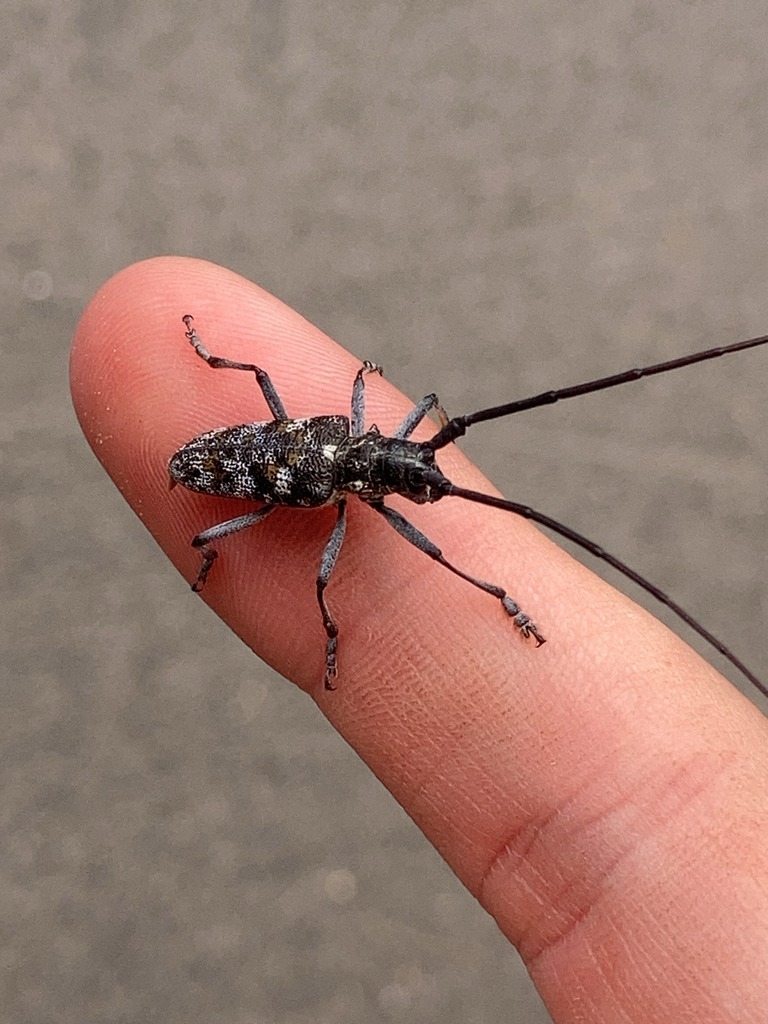
(c) Zeke Blankenship, some rights reserved (CC BY) · licence
Family: Cerambycidae · Class: Insecta · Order: Coleoptera
Monochamus clamator (Spotted Pine Sawyer) is a California animal in the Cerambycidae family.
The Spotted Pine Sawyer (Monochamus clamator) is a large longhorn beetle in the family Cerambycidae. Adults typically measure 15-28 mm (0.6-1.1 inches) in length, with females generally larger than males. The body is robust and cylindrical, with a distinctive mottled appearance created by patches of white, yellow, and brown pubescence against a dark brown to black background. Males possess characteristically long antennae that can exceed twice their body length, while female antennae are shorter, approximately equal to body length. The elytra (wing covers) display irregular white and pale yellow spots that give the species its common name. Monochamus clamator occurs across much of North America, with several recognized subspecies showing regional variation. In California, the species is represented primarily by M. c. nevadensis in the Sierra Nevada and northern regions, and M. c. rubigineus in coastal areas (BugGuide). The species ranges from sea level to montane elevations, adapting to various pine forest ecosystems throughout the state. Distribution extends from British Columbia south through California and eastward across the continent. This beetle inhabits coniferous forests, showing a strong association with pine species (Pinus spp.). Adults are commonly found on recently dead, dying, or severely stressed pine trees, where they feed on bark and cambium. The species also occurs on other conifers including fir and spruce in mixed coniferous stands. Preferred habitats include both natural forest areas and disturbed sites such as logged areas, fire-damaged forests, and areas affected by bark beetle outbreaks. Spotted Pine Sawyers are wood-boring beetles with a two-year life cycle in most climates. Adults emerge primarily from June through September, with peak activity during warm summer months. Mating occurs on host trees, where females use their strong mandibles to chew through bark before depositing eggs in the cambium layer. Larvae are large, white, legless grubs that create extensive galleries as they feed on the inner bark and outer sapwood. This feeding activity produces characteristic oval emergence holes approximately 10-15 mm in diameter. Adults are attracted to recently stressed or dead conifers, often responding to tree pheromones released during attack by bark beetles or following physical damage. The species serves as both a secondary pest and beneficial decomposer in forest ecosystems. While larvae occasionally attack living but stressed trees, they primarily colonize trees already compromised by other factors such as drought, disease, or bark beetle infestation. Natural predators include woodpeckers, which consume larvae, and various parasitoid wasps that attack the immature stages. The Spotted Pine Sawyer currently has no special conservation status and maintains stable populations throughout its range. Climate change and forest management practices may affect future distributions, particularly as they influence host tree health and forest fire patterns. The species' role in forest succession and nutrient cycling makes it an ecologically important component of western coniferous forest communities.
Classification
Class: Insecta · Order: Coleoptera · Family: Cerambycidae
Frequently asked questions
How is Monochamus clamator classified?
Monochamus clamator belongs to class Insecta, order Coleoptera, family Cerambycidae.
What family does Monochamus clamator belong to?
Monochamus clamator is in the Cerambycidae family.
What is Monochamus clamator?
The Spotted Pine Sawyer (Monochamus clamator) is a large longhorn beetle in the family Cerambycidae.
Is Monochamus clamator found in California?
Yes. Monochamus clamator is recorded in California in The California Species Project's catalogue.
Related species
Other California species in the same genus, family, or bioregion.
Data from The California Species Project — 14,000+ California species with verified data from CNPS, CDFW, USFWS, and more.