Monochamus scutellatus
White-spotted Sawyer
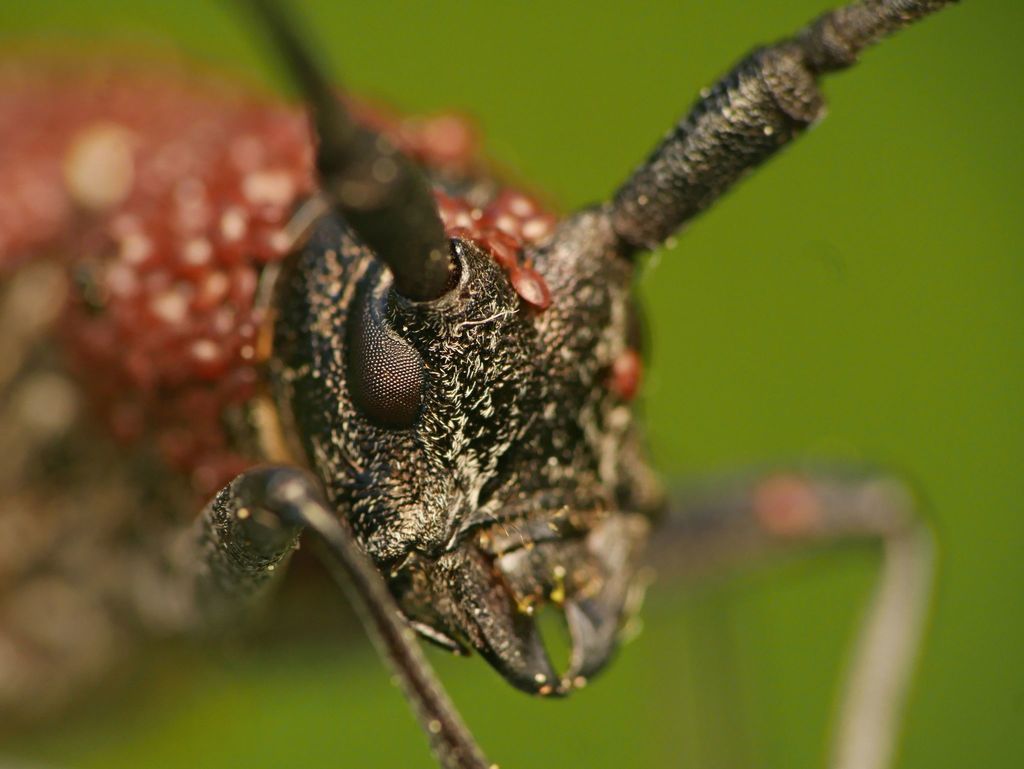
(c) Alexis Tinker-Tsavalas, some rights reserved (CC BY) · licence
Family: Cerambycidae · Class: Insecta · Order: Coleoptera
Monochamus scutellatus (White-spotted Sawyer) is a California animal in the Cerambycidae family.
The white-spotted sawyer (Monochamus scutellatus) is a large longhorn beetle belonging to the family Cerambycidae. Adults typically measure 12-25 millimeters (0.5-1.0 inches) in length, with a robust, elongated body characteristic of the sawyer beetle group. The species displays sexual dimorphism, with males possessing notably longer antennae that can exceed twice their body length. The elytra (wing covers) are dark brown to black with distinctive white or yellowish spots scattered across the surface, giving the species its common name. A prominent white patch typically appears on the scutellum, the small triangular plate between the wing covers. Monochamus scutellatus occurs across a broad range of North America, from Alaska and Canada south through the northern United States. In California, the species is found primarily in mountainous regions where suitable coniferous forest habitat exists. The beetle's distribution closely follows that of its host trees, particularly pine, fir, and spruce species. According to BugGuide, the species shows considerable geographic variation across its range, with some regional forms previously considered separate subspecies (BugGuide 2025). The white-spotted sawyer inhabits coniferous forests, preferring areas with pine (Pinus species), fir (Abies species), and spruce (Picea species) trees. Adults are most commonly found on recently dead, dying, or stressed conifers, where they seek mates and oviposition sites. The species shows a particular association with fire-damaged forests and areas affected by bark beetle outbreaks, as these provide optimal breeding conditions. Elevation preferences vary geographically but generally correspond to montane coniferous forest zones. Adults are active primarily during summer months, with peak emergence typically occurring from June through August, depending on local climate conditions. Males use their elongated antennae to detect pheromones released by females and compete for mating opportunities on host trees. Females lay eggs in bark crevices or chewed galleries on recently dead or weakened conifers (BugGuide 2025). Larvae develop as wood borers, creating extensive galleries beneath the bark and in the outer sapwood as they feed. The larval stage typically lasts one to two years, depending on temperature and host tree condition. Pupation occurs in pupal chambers carved within the wood, and newly emerged adults chew characteristic round emergence holes through the bark. As a native forest insect, Monochamus scutellatus plays an important ecological role as a decomposer of dead and dying coniferous wood. The species is not considered threatened and maintains stable populations throughout its range. However, modern forest management practices, including aggressive fire suppression and salvage logging, can reduce the availability of suitable breeding habitat. The beetle serves as prey for woodpeckers and other forest wildlife, particularly during outbreaks following forest disturbances. While not typically considered a forest pest in North America, the species has gained attention as a potential vector for pine wood nematodes in regions where these pathogens occur.
Classification
Class: Insecta · Order: Coleoptera · Family: Cerambycidae
Frequently asked questions
How is Monochamus scutellatus classified?
Monochamus scutellatus belongs to class Insecta, order Coleoptera, family Cerambycidae.
What family does Monochamus scutellatus belong to?
Monochamus scutellatus is in the Cerambycidae family.
What is Monochamus scutellatus?
The white-spotted sawyer (Monochamus scutellatus) is a large longhorn beetle belonging to the family Cerambycidae.
Is Monochamus scutellatus found in California?
Yes. Monochamus scutellatus is recorded in California in The California Species Project's catalogue.
Related species
Other California species in the same genus, family, or bioregion.
Data from The California Species Project — 14,000+ California species with verified data from CNPS, CDFW, USFWS, and more.