Monoleuca occidentalis
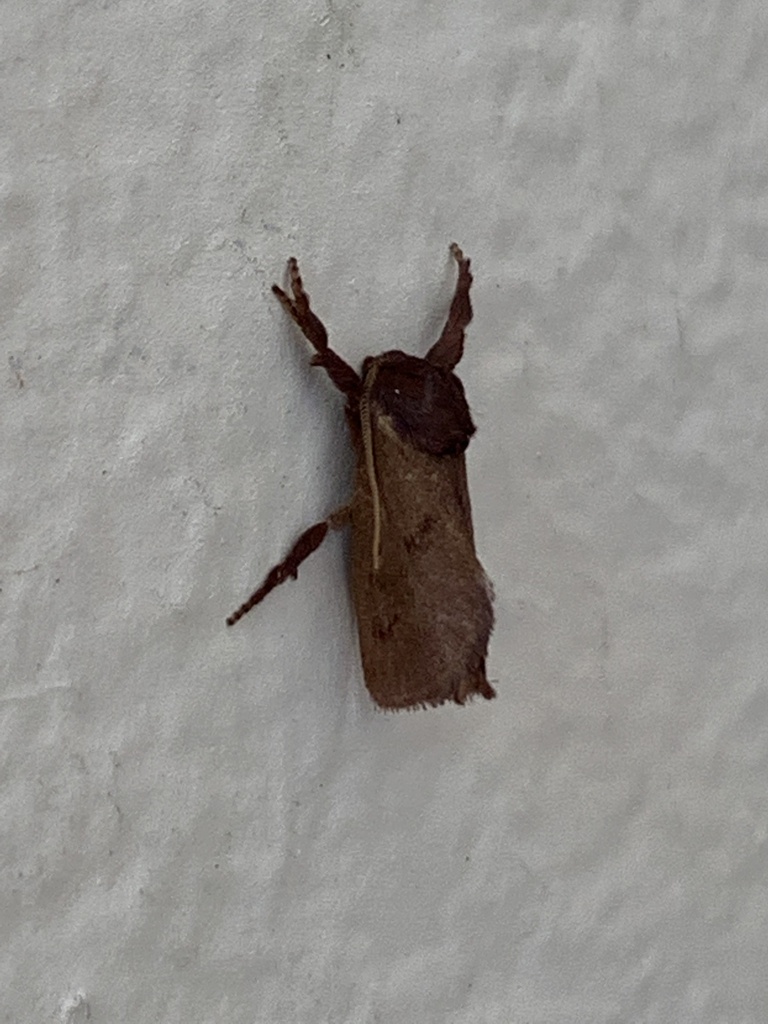
(c) Chad King, some rights reserved (CC BY) · licence
Family: Limacodidae · Class: Insecta · Order: Lepidoptera
Monoleuca occidentalis is a California animal in the Limacodidae family.
Monoleuca occidentalis is a moth species in the family Limacodidae, commonly known as slug moths or cup moths. This family is characterized by their distinctive larval stage, which resembles slugs more than typical caterpillars. Adult M. occidentalis are small moths with forewings typically measuring 10-15 mm in length. The wings display muted brown and gray coloration with subtle patterns that provide effective camouflage against tree bark and dead vegetation. The species occurs in western North America, with documented populations in California, Oregon, and Washington. In California, records exist from coastal and inland regions, though specific county-level distribution data remains limited in published literature. The species appears to have a relatively restricted range compared to other Limacodidae members found in eastern North America. Monoleuca occidentalis inhabits mixed deciduous and coniferous forests, oak woodlands, and riparian corridors. Adults are typically found at elevations ranging from near sea level to approximately 1,500 meters. The species shows preference for areas with diverse plant communities that support their larval host plants. Forest edges and clearings appear to be particularly favorable habitats for adult activity. Larvae of M. occidentalis feed on various deciduous trees and shrubs, though specific host plant relationships require further documentation. Like other slug moth caterpillars, the larvae are distinctively flattened and move in a gliding motion across leaf surfaces. They lack the typical prolegs of most lepidopteran larvae, instead using their flattened body to adhere to surfaces. The larval stage is equipped with stinging hairs or spines that can cause skin irritation in humans, a defensive adaptation common throughout the Limacodidae family. Adults are nocturnal and attracted to artificial lights during their flight period, which typically occurs from late spring through early fall depending on local climate conditions. Pupation occurs in distinctive oval cocoons that are tough and papery, often attached to bark or sturdy plant stems. The species likely produces one generation per year in most of its range, though this aspect of its biology requires additional study. The conservation status of Monoleuca occidentalis has not been formally assessed by major conservation organizations. Population trends and threats are poorly documented, reflecting the limited research attention given to many western North American Limacodidae species. Potential threats may include habitat loss from development and forest management practices, though the species' ecological requirements and sensitivity to environmental changes remain understudied. The lack of comprehensive distribution and abundance data makes it difficult to assess whether conservation concerns exist for this species.
Classification
Class: Insecta · Order: Lepidoptera · Family: Limacodidae
Frequently asked questions
How is Monoleuca occidentalis classified?
Monoleuca occidentalis belongs to class Insecta, order Lepidoptera, family Limacodidae.
What family does Monoleuca occidentalis belong to?
Monoleuca occidentalis is in the Limacodidae family.
What is Monoleuca occidentalis?
Monoleuca occidentalis is a moth species in the family Limacodidae, commonly known as slug moths or cup moths.
Is Monoleuca occidentalis found in California?
Yes. Monoleuca occidentalis is recorded in California in The California Species Project's catalogue.
More California species
This species has no close relatives in our California data — here are other species to explore.
Data from The California Species Project — 14,000+ California species with verified data from CNPS, CDFW, USFWS, and more.