Monomorium ergatogyna
Ergatogyne Trailing Ant
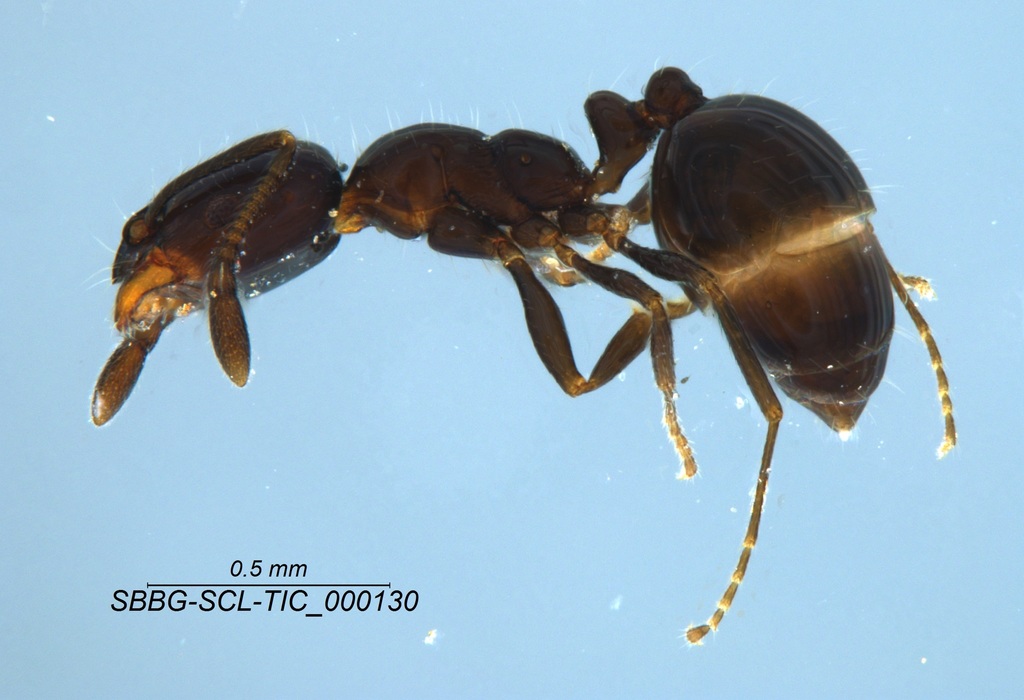
(c) Casey H. Richart, some rights reserved (CC BY) · licence
Family: Formicidae · Class: Insecta · Order: Hymenoptera
Monomorium ergatogyna (Ergatogyne Trailing Ant) is a California animal in the Formicidae family.
The Ergatogyne Trailing Ant (Monomorium ergatogyna) is a small, monomorphic ant species characterized by its shiny black coloration and distinctive reproductive biology. This species exhibits ergatoid queens, which are worker-like reproductive females that lack wings and differ from typical winged queens found in most ant species. Workers are uniformly sized within colonies, lacking the size polymorphism seen in many other ant genera. Monomorium ergatogyna is native to the western United States, with documented populations across a broad elevational and geographic range. The species occurs from arid desert zones through grasslands and sagebrush communities to pinyon-pine woodlands at mid-elevations. In the southwestern United States, Monomorium species show distinct altitudinal distribution patterns with minimal overlap between species (Cover et al. 2017). This ant demonstrates extensive habitat flexibility, occupying essentially all habitat types within its range from arid zones to wet mid-altitude environments. The species adapts to diverse vegetation communities including desert scrub, grasslands, sagebrush steppe, and pinyon-juniper woodlands. This broad habitat tolerance allows the species to maintain populations across varied elevational gradients and climatic conditions. The reproductive biology of M. ergatogyna represents a significant departure from typical ant social organization. Rather than producing large, winged queens, colonies are headed by ergatoid queens that resemble workers but retain reproductive capabilities. This reproductive strategy may be advantageous in harsh or unpredictable environments where the energetic costs of producing large, winged reproductives would be prohibitive. Colony founding likely occurs through budding or adoption of ergatoid queens rather than dispersal flights typical of winged queens. The species exhibits typical myrmicine ant behavior, with workers foraging for small arthropods, seeds, and other organic matter. Colonies construct nests in soil, often under rocks or within root systems of shrubs and trees. The monomorphic worker caste performs all colony maintenance tasks including foraging, brood care, and nest construction. Seasonal activity patterns likely vary with elevation and local climate, with reduced activity during extreme temperature periods. Monomorium ergatogyna currently has no special conservation status at federal or state levels. The species appears to maintain stable populations across its native range, likely benefiting from its broad habitat tolerance and flexible reproductive strategy. However, like many native ant species, populations may face pressure from habitat modification, invasive species, and climate change. The species' ability to occupy diverse habitats may provide some resilience against environmental changes, though specific population trends have not been systematically monitored. Research on queen phenotype evolution in Monomorium has enhanced understanding of reproductive strategies in social insects, with M. ergatogyna serving as an important study species for examining the evolution and development of alternative queen forms (Peeters et al. 2017).
Classification
Class: Insecta · Order: Hymenoptera · Family: Formicidae
Frequently asked questions
How is Monomorium ergatogyna classified?
Monomorium ergatogyna belongs to class Insecta, order Hymenoptera, family Formicidae.
What family does Monomorium ergatogyna belong to?
Monomorium ergatogyna is in the Formicidae family.
What is Monomorium ergatogyna?
The Ergatogyne Trailing Ant (Monomorium ergatogyna) is a small, monomorphic ant species characterized by its shiny black coloration and distinctive reproductive biology.
Is Monomorium ergatogyna found in California?
Yes. Monomorium ergatogyna is recorded in California in The California Species Project's catalogue.
Related species
Other California species in the same genus, family, or bioregion.
Data from The California Species Project — 14,000+ California species with verified data from CNPS, CDFW, USFWS, and more.