Morone chrysops
White bass
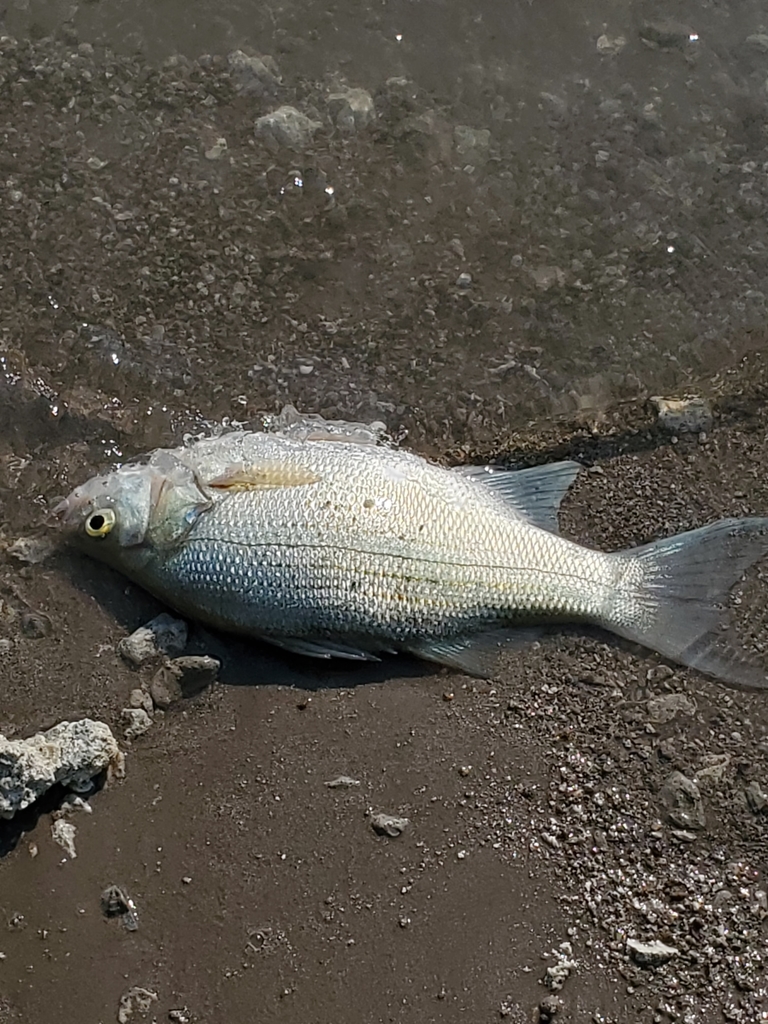
(c) Bennett Grappone, some rights reserved (CC BY) · licence
Family: Moronidae · Class: Actinopterygii · Order: Perciformes
Morone chrysops (White bass) is a California animal in the Moronidae family.
The white bass (Morone chrysops) is a freshwater fish in the temperate bass family Moronidae. Adults typically measure 250 to 380 mm (10 to 15 inches) in total length and weigh 0.5 to 1.4 kg (1 to 3 pounds), though some individuals may reach 430 mm (17 inches). The body is moderately compressed laterally with a silvery-white coloration. The species is distinguished by 6 to 7 narrow, dark horizontal stripes running along each side of the body, with the stripes below the lateral line often broken or incomplete. The dorsal profile is arched, and the species possesses two separate dorsal fins - the first with 8 to 10 sharp spines and the second with one spine and 12 to 14 soft rays. White bass are not native to California waters. The species' natural range extends throughout the central and eastern United States, from the Great Lakes south through the Mississippi River basin to the Gulf of Mexico states. In California, white bass have been introduced to several reservoirs and river systems, primarily in the Central Valley and southern California. Established populations occur in the California Aqueduct system, including San Luis Reservoir in Merced County, and in the Colorado River along California's southeastern border. The species inhabits large lakes, reservoirs, and river systems, preferring open water areas with depths ranging from 3 to 12 meters (10 to 40 feet). White bass typically occupy the middle and upper portions of the water column and are most active in areas with moderate current or wind-driven circulation. During spawning season, they move into tributary streams or shallow areas with rocky or gravel substrates. Water temperatures between 16 and 24°C (60 to 75°F) are optimal for most life activities. White bass are schooling fish that feed primarily on small fish, crustaceans, and aquatic insects. Their diet consists largely of threadfin shad, gizzard shad, and other small schooling fish species. They are opportunistic predators that hunt cooperatively in groups, often driving prey to the surface in feeding frenzies. Spawning occurs from March through May when water temperatures reach 13 to 18°C (55 to 65°F). Females broadcast 25,000 to 1 million eggs over rocky or sandy bottoms in shallow water. Eggs are semi-adhesive and hatch within 2 to 7 days depending on water temperature. White bass are not listed under state or federal conservation programs in California. As an introduced species, they are managed as a sport fish rather than a conservation concern. The species can have ecological impacts on native fish communities through predation and competition. In some California waters, white bass populations have established successfully and provide recreational fishing opportunities, while in others, populations remain limited or have failed to persist due to habitat constraints or environmental conditions.
Classification
Class: Actinopterygii · Order: Perciformes · Family: Moronidae
Frequently asked questions
How is Morone chrysops classified?
Morone chrysops belongs to class Actinopterygii, order Perciformes, family Moronidae.
What family does Morone chrysops belong to?
Morone chrysops is in the Moronidae family.
What is Morone chrysops?
The white bass (Morone chrysops) is a freshwater fish in the temperate bass family Moronidae.
Is Morone chrysops found in California?
Yes. Morone chrysops is recorded in California in The California Species Project's catalogue.
Related species
Other California species in the same genus, family, or bioregion.
Data from The California Species Project — 14,000+ California species with verified data from CNPS, CDFW, USFWS, and more.