Morsea californica
Chaparral Monkey Grasshopper
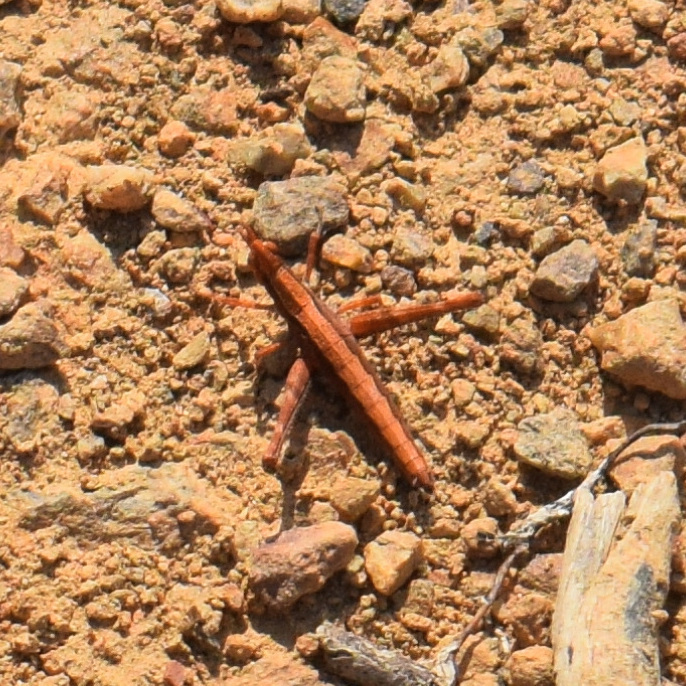
no rights reserved · CC0
Family: Eumastacidae · Class: Insecta · Order: Orthoptera
Morsea californica (Chaparral Monkey Grasshopper) is a California animal in the Eumastacidae family.
The Chaparral Monkey Grasshopper (Morsea californica) is a distinctive orthopteran species belonging to the family Eumastacidae. This grasshopper exhibits the characteristic features of monkey grasshoppers, including a robust body structure and enlarged hind legs adapted for jumping. The species displays muted coloration typical of chaparral-dwelling insects, with body colors that blend effectively with the dry, shrubland environment it inhabits. Morsea californica is endemic to California, where it occurs in chaparral and associated shrubland habitats throughout the state's Mediterranean climate regions. The species' distribution appears to be closely tied to chaparral vegetation communities, which are dominated by drought-adapted shrubs and occur primarily in coastal mountain ranges and foothills. These habitats are characterized by hot, dry summers and mild, wet winters, conditions that have shaped the evolutionary adaptations of this grasshopper. The species inhabits chaparral ecosystems, which consist of dense stands of sclerophyllous shrubs such as manzanita, ceanothus, and chamise. These plant communities typically occur on slopes and ridges at elevations ranging from near sea level to approximately 1,500 meters (4,900 feet). Chaparral habitats are adapted to periodic wildfire cycles and experience Mediterranean climate conditions with pronounced seasonal variation in precipitation. The grasshopper likely utilizes the complex three-dimensional structure of chaparral vegetation for shelter, foraging, and reproduction. As a member of the Eumastacidae family, the Chaparral Monkey Grasshopper likely exhibits herbivorous feeding behavior, consuming various parts of chaparral plants including leaves, stems, and potentially flowers. Monkey grasshoppers are known for their powerful jumping ability, which serves both as an escape mechanism from predators and as a means of moving through dense shrubland vegetation. The species' life cycle likely follows the typical orthopteran pattern of egg, multiple nymphal instars, and adult stages, with timing adapted to the seasonal patterns of California's Mediterranean climate. The conservation status of Morsea californica has not been formally assessed at federal or state levels, and the species lacks formal listing under endangered species legislation. However, chaparral habitats face ongoing pressure from urban development, fire suppression policies that alter natural fire cycles, and climate change effects that may shift the distribution of Mediterranean climate zones. The conversion of chaparral to residential and commercial development represents a primary threat to chaparral-dependent species throughout California. Additionally, altered fire regimes and invasive plant species may degrade the quality of remaining chaparral habitat. The species would benefit from comprehensive surveys to determine current population status and distribution, as detailed ecological information remains limited. Scientific documentation of this species' biology, habitat requirements, and population trends is needed to assess conservation needs and develop appropriate management strategies for chaparral ecosystems.
Classification
Class: Insecta · Order: Orthoptera · Family: Eumastacidae
Frequently asked questions
How is Morsea californica classified?
Morsea californica belongs to class Insecta, order Orthoptera, family Eumastacidae.
What family does Morsea californica belong to?
Morsea californica is in the Eumastacidae family.
What is Morsea californica?
The Chaparral Monkey Grasshopper (Morsea californica) is a distinctive orthopteran species belonging to the family Eumastacidae.
Is Morsea californica found in California?
Yes. Morsea californica is recorded in California in The California Species Project's catalogue.
Related species
Other California species in the same genus, family, or bioregion.
Data from The California Species Project — 14,000+ California species with verified data from CNPS, CDFW, USFWS, and more.