Morus bassanus
Northern Gannet
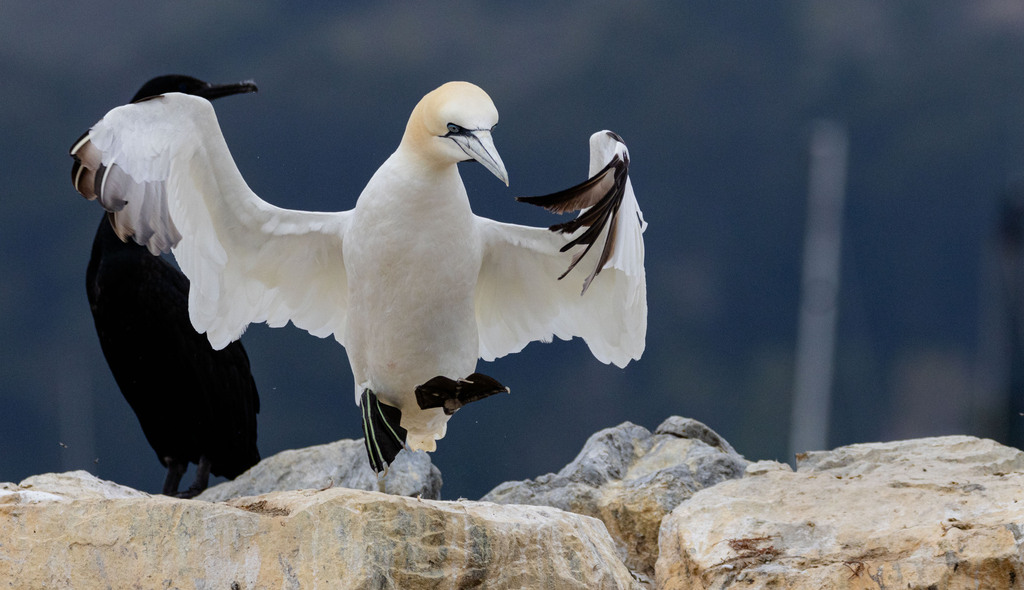
(c) Brooke J., some rights reserved (CC BY) · licence
Family: Sulidae · Class: Aves · Order: Suliformes
Morus bassanus (Northern Gannet) is a California animal in the Sulidae family.
The Northern Gannet is a large seabird with distinctive morphological adaptations for plunge diving. Adults measure 87 to 100 cm (34 to 39 inches) in length with a wingspan of 165 to 180 cm (65 to 71 inches). Body weight ranges from 2.2 to 3.6 kg (4.9 to 7.9 pounds). Adult plumage is predominantly white with a pale yellow-buff head and neck. The bill is long, straight, and blue-gray with dark cutting edges. Feet are fully webbed and dark colored. Juveniles are dark brown with white spotting, gradually acquiring adult plumage over four to five years. The species exhibits pronounced sexual dimorphism, with males averaging larger than females. Northern Gannets breed colonially on offshore islands and coastal cliffs in the North Atlantic. In North America, breeding colonies occur from Labrador south to North Carolina, with major colonies at Cape St. Mary's, Newfoundland, and Bonaventure Island, Quebec. Along the California coast, Northern Gannets are uncommon to rare visitors, typically observed during winter months from November through March. Sightings are most frequent in central and northern California waters, particularly around the Farallon Islands and Monterey Bay. This species inhabits marine and coastal environments, foraging primarily in continental shelf waters within 200 km of breeding colonies during the nesting season. Northern Gannets prefer areas with water depths of 20 to 40 meters where prey fish concentrate. During non-breeding periods, they range widely across open ocean waters, following prey movements and thermal currents. California waters represent the southern extent of their Pacific range. Northern Gannets are specialized piscivores, feeding almost exclusively on fish through plunge diving behavior from heights of 10 to 30 meters. Primary prey includes herring, sardines, anchovies, and mackerel, typically 15 to 30 cm in length. The species exhibits specialized diving adaptations, including forward-facing eyes for depth perception, reinforced skull structure, and air sacs that cushion impact. Breeding occurs in dense colonies on cliff ledges, with pairs constructing nests from seaweed, grass, and debris. Females lay a single blue-white egg, with incubation lasting 42 to 46 days. Chicks fledge after 84 to 97 days but depend on parents for several additional weeks. The Northern Gannet is not federally listed and maintains stable global populations estimated at approximately 1.2 million breeding pairs. The species has shown significant recovery from historical persecution and egg collection, with populations increasing throughout much of their range since the mid-20th century. Climate change represents an emerging concern, as warming ocean temperatures affect prey fish distribution and breeding success. In California waters, Northern Gannets face threats from gillnet entanglement, plastic pollution, and oil spills. The species' occurrence in California waters reflects natural range dynamics and seasonal movements rather than conservation concerns.
Classification
Class: Aves · Order: Suliformes · Family: Sulidae
Frequently asked questions
How is Morus bassanus classified?
Morus bassanus belongs to class Aves, order Suliformes, family Sulidae.
What family does Morus bassanus belong to?
Morus bassanus is in the Sulidae family.
What is Morus bassanus?
The Northern Gannet is a large seabird with distinctive morphological adaptations for plunge diving.
Is Morus bassanus found in California?
Yes. Morus bassanus is recorded in California in The California Species Project's catalogue.
Related species
Other California species in the same genus, family, or bioregion.
Data from The California Species Project — 14,000+ California species with verified data from CNPS, CDFW, USFWS, and more.