Motacilla tschutschensis
Eastern Yellow Wagtail
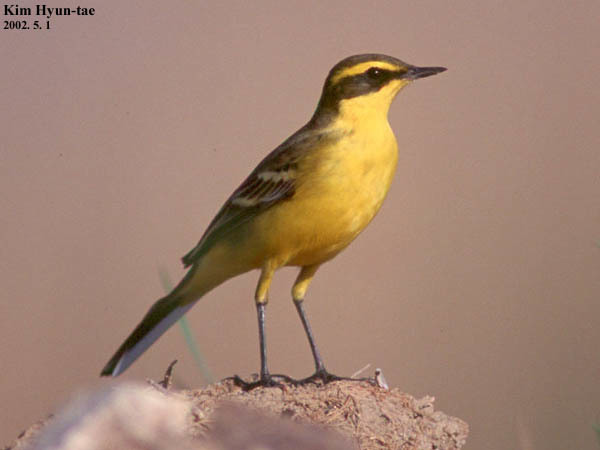
(c) Kim, Hyun-tae, some rights reserved (CC BY) · licence
Family: Motacillidae · Class: Aves · Order: Passeriformes
Motacilla tschutschensis (Eastern Yellow Wagtail) is a California animal in the Motacillidae family.
The Eastern Yellow Wagtail is a small passerine bird in the family Motacillidae, measuring approximately 15-16 cm (5.9-6.3 inches) in length with a wingspan of 23-27 cm (9.1-10.6 inches). During breeding season, males display bright yellow underparts from chin to undertail coverts, with an olive-green to brownish-green back and wings. The head shows variable coloration depending on subspecies, ranging from gray to blackish with distinctive white or yellow supercilium stripes above the eyes. Females and non-breeding males are duller, with pale yellow to whitish underparts and brownish upperparts. The species has a long, slender tail that is frequently wagged up and down, a characteristic behavior that gives wagtails their common name. The bill is thin and pointed, adapted for catching small insects, and the legs are relatively long and dark. The Eastern Yellow Wagtail breeds across northern and eastern Asia, from eastern Siberia through Mongolia, northern China, and into Alaska. In North America, breeding populations occur primarily in western and northern Alaska, particularly in the Arctic coastal plain and interior regions. During migration and winter, the species travels to Southeast Asia, the Philippines, and Indonesia. In California, the Eastern Yellow Wagtail appears as a rare vagrant, typically during fall migration from September through November. Most California records come from coastal locations, particularly along the immediate Pacific coast from San Diego County north to Humboldt County, with occasional inland sightings. During breeding season, Eastern Yellow Wagtails inhabit open tundra, wet meadows, marshy areas, and the edges of lakes and streams in Arctic and subarctic regions. They prefer areas with low vegetation, scattered shrubs, and nearby water sources. In migration and winter quarters, the species utilizes a broader range of habitats including agricultural fields, grasslands, mudflats, and shorelines. California vagrant birds are typically found in coastal habitats such as beaches, tidal flats, agricultural areas, and short-grass fields near the ocean. Eastern Yellow Wagtails are primarily insectivorous, feeding on flies, mosquitoes, midges, beetles, and other small arthropods caught by gleaning from vegetation, ground surfaces, or captured in short aerial sallies. The species walks and runs along the ground with characteristic tail-wagging motions while foraging. Breeding occurs from June through August in Arctic regions, with females constructing cup-shaped nests on the ground among vegetation or in small depressions. Clutch size typically ranges from 4-6 eggs, which are incubated for 11-13 days. Both parents feed the nestlings, which fledge after 10-13 days. The Eastern Yellow Wagtail is not federally or state listed in California, as it occurs only as a rare vagrant. The global population appears stable, though specific population estimates are not well documented. Climate change may potentially affect breeding habitat availability in Arctic regions and alter migration patterns. In California, the species remains one of the rarer vagrant wagtails, with most sightings representing single individuals during fall migration periods.
Classification
Class: Aves · Order: Passeriformes · Family: Motacillidae
Frequently asked questions
How is Motacilla tschutschensis classified?
Motacilla tschutschensis belongs to class Aves, order Passeriformes, family Motacillidae.
What family does Motacilla tschutschensis belong to?
Motacilla tschutschensis is in the Motacillidae family.
What is Motacilla tschutschensis?
The Eastern Yellow Wagtail is a small passerine bird in the family Motacillidae, measuring approximately 15-16 cm (5.9-6.3 inches) in length with a wingspan of 23-27 cm (9.1-10.6 inches).
Is Motacilla tschutschensis found in California?
Yes. Motacilla tschutschensis is recorded in California in The California Species Project's catalogue.
Related species
Other California species in the same genus, family, or bioregion.
Data from The California Species Project — 14,000+ California species with verified data from CNPS, CDFW, USFWS, and more.